Cry the beloved trees
Neglected saplings inspired a poem that inspired an environmental film, now screening at Gimli film fest

Advertisement
Read this article for free:
or
Already have an account? Log in here »
To continue reading, please subscribe:

Digital Subscription
One year of digital access for only $205*
- Enjoy unlimited reading on winnipegfreepress.com
- Read the E-Edition, our digital replica newspaper
- Access News Break, our award-winning app
- Play interactive puzzles
*First annual payment billed as $205.00 + GST for one year. This annual subscription will automatically renew at $233.00 + GST every 52 weeks (10% off the regular annual price of $259.35). Offer available to new and qualified returning subscribers only. Cancel any time.
To continue reading, please subscribe:
Add Free Press access to your Brandon Sun subscription for only an additional
$1 for the first 4 weeks*
- Enjoy unlimited reading on winnipegfreepress.com
- Read the E-Edition, our digital replica newspaper
- Access News Break, our award-winning app
- Play interactive puzzles
*Your next Brandon Sun subscription payment will increase by $1.00 and you will be charged $17.95 plus GST for four weeks. After four weeks, your payment will increase to $24.95 plus GST every four weeks.
Read unlimited articles for free today:
or
Already have an account? Log in here »
Hey there, time traveller!
This article was published 27/07/2024 (743 days ago), so information in it may no longer be current.
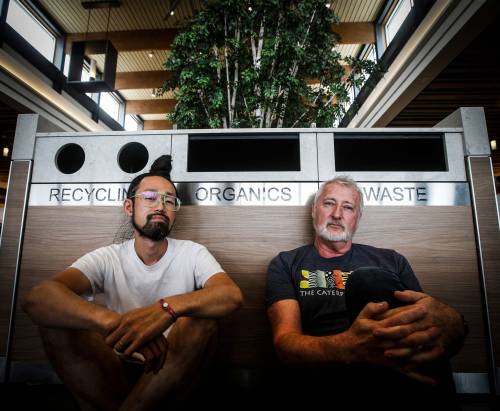
On a sweltering Monday afternoon in July, Takashi Iwasaki and Jeff McKay met in the food court of Winnipeg’s outlet mall — an air-conditioned town unto itself.
Years ago, trees stood where there is now a crepe stand and furry creatures rested where men now gloomscroll while waiting for their significant others to call it quits at Kate Spade.
“When push came to shove, people wanted an outlet,” says McKay, a wizened filmmaker with a rebellious streak who’s won a Peabody Award. “They didn’t want a forest. They didn’t want the woods. This was all forest. Nobody sees the value in the forest.”
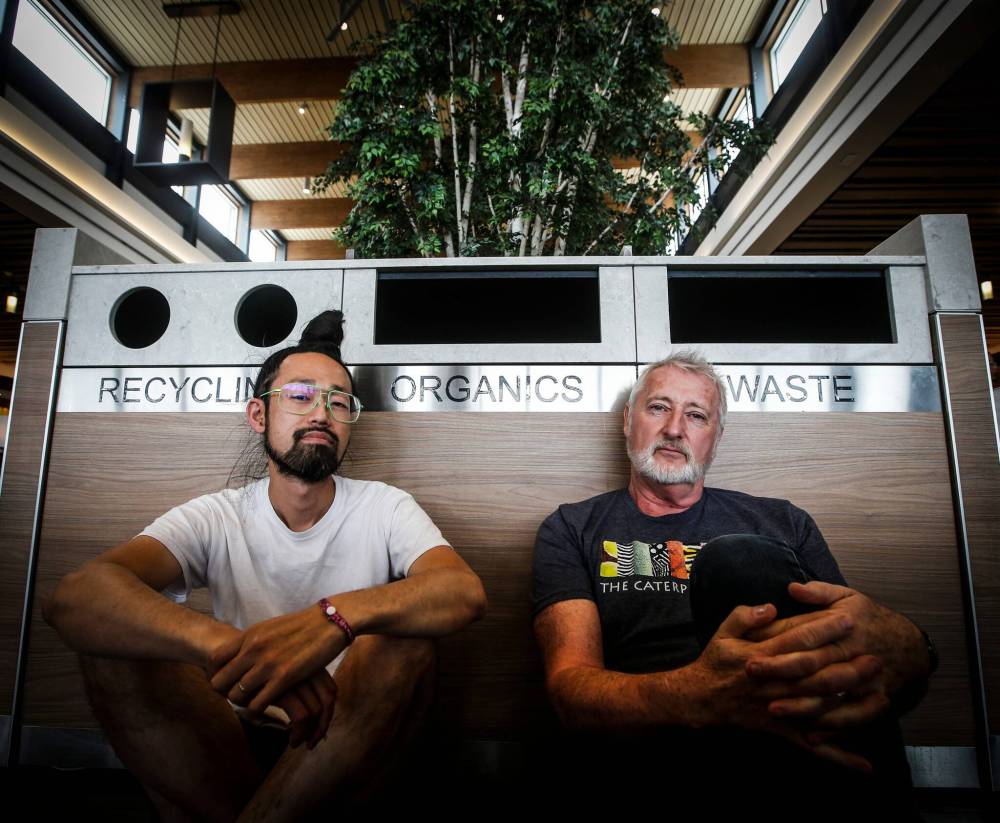
JOHN WOODS / FREE PRESS
Takashi Iwasaki and Jeff McKay’s animated short film, Shitty Little, is a crie de coeur about failing to prioritize ecology.
As McKay’s speech became more animated, Iwasaki, an artist whose sense of whimsy floats on an undercurrent of pessimism, nods along, his topknot bobbing to the beat of the mall’s sanitized pop music soundtrack.
The two friends chose this location to speak with a reporter about their short film, Shitty Little, a black-and-white cri de coeur about the sacrifices humankind has made by choosing to prioritise economy ahead of ecology.
“This is a shitty little tree,” McKay says to open his narration of the seven-minute short, sounding so disinterested in the sapling’s future that what happens next — removal, destruction and transformation into goods — is a foregone conclusion. Told through McKay’s sardonic poem and vivid craft-paper cutouts devised by Iwasaki, Shitty Little is a prairified Lorax, an environmental parable the filmmakers needed to make.
McKay, who cut his teeth from 1985 to 2003 with the National Film Board of Canada, has always explored excess and outliers in his filmmaking career. The Peabody-winning, Genie-nominated Fat Chance, released in 1994, was a heartfelt and evocative portrait of one man’s struggle with obesity. He’s made films about the Royal Winnipeg Ballet (40 Years of One Night Stands), cultural offshoots (Winnipagans) and sewage leaks (2003’s Crapshoot).
A few years ago, while presenting a film called Call of the Forest in Toronto, McKay was walking the film’s subject, botanist Diana Beresford-Kroeger, to the train station when he stopped in his tracks.
“There were these two sad-looking trees,” he recalls, with garbage encircling the base. “The city had nailed an electrical outlet to them. It was just obvious there was no respect there whatsoever.”
So McKay wrote a poem about those trees, later recognizing their potential as a central symbol for a film. But McKay knew the problem with nature documentaries: so many had been made, so many had been ignored, so many had made the exact same arguments in exactly the same ways. Then he called Iwasaki, a Hokkaido-born Winnipegger with a penchant for making anything with his hands that he can see in his head.
Last year, the two men holed up in the basement studio of St. Boniface’s Forum Art Centre to adapt McKay’s song of urban malaise into a live-animation film that reaches surprising, elegiac depths.
Iwasaki, who has known McKay since 2008, imprinted his own touch. A ceramicist, collagist, painter and a newly minted MFA recipient from the University of Manitoba, Iwasaki’s work is generally “happy looking,” he says, but he maintains that it’s always aware of the “double-sidedness of life.”
Shitty Little was no different. Using a pen knife, craft paper and his children’s art supplies, Iwasaki cut out flat, black figures — wolves, bears, snakes, greedy humans and those shitty little trees — to establish an ominous aura.
In the film, McKay mockingly refers to these creatures as shitty to remind the audience that they’re the opposite. In the food court, he stops just short of calling Iwasaki a magician.
“I call Takashi and say, I need an airplane with a banner, and by the time I finish the sentence, he’s already done,” he laughs.
The film, which screened at the Gimli International Film Festival Thursday and will run again today, has also been shown at festivals in Montreal, Montana, Glasgow and Dawson City.
At Thursday’s screening in Gimli, the audience was particularly moved by a cameo from Iwasaki’s hand, which descends from the top of the frame like a claw machine, outfitted with long, sharp fingernail extensions to enable the uprooting of a tree.
The filmmakers considered having the final removal being performed by a machine — the kind that can cut down, debark and shred a cedar in the blink of an eye — but decided a more human touch was more effective.
Iwasaki’s hand — which to McKay had the bite of Nosferatu — was the ideal choice.
“(The human hand) is the perfect death machine for trees,” he said.
ben.waldman@winnipegfreepress.com
Ben Waldman is a National Newspaper Award-nominated reporter on the Arts & Life desk at the Free Press. Born and raised in Winnipeg, Ben completed three internships with the Free Press while earning his degree at Ryerson University’s (now Toronto Metropolitan University’s) School of Journalism before joining the newsroom full-time in 2019. Read more about Ben.
Every piece of reporting Ben produces is reviewed by an editing team before it is posted online or published in print — part of the Free Press‘s tradition, since 1872, of producing reliable independent journalism. Read more about Free Press’s history and mandate, and learn how our newsroom operates.
Our newsroom depends on a growing audience of readers to power our journalism. If you are not a paid reader, please consider becoming a subscriber.
Our newsroom depends on its audience of readers to power our journalism. Thank you for your support.
Tree’s Company
Shitty Little screens today at 9 p.m. at the Lady of the Lake Theatre as part of the festival’s shorts program Class, Order, Species. The program also includes the Icelandic tragicomic short Fár; The Conquest of Space, an animals-in-rockets documentary; Winnipeg-born director Solmund MacPherson’s Lobster-esque satire Wildmen of the Greater Toronto Area; local filmmaker Rowan Gray’s muted gymnastics drama Discordia; Montreal-based Jean-Bastien Niyigaruye’s inner space drama Sirius; Starbound, Winnipeg director Madison Thomas’ film about abduction and recovery; and Winnipeg filmmaker Karsten Wall’s standout drama Modern Goose, a moving depiction of a national creature searching for oasis in an increasingly hazardous Winnipeg.
Ben Waldman is a National Newspaper Award-nominated reporter on the Arts & Life desk at the Free Press. Born and raised in Winnipeg, Ben completed three internships with the Free Press while earning his degree at Ryerson University’s (now Toronto Metropolitan University’s) School of Journalism before joining the newsroom full-time in 2019. Read more about Ben.
Every piece of reporting Ben produces is reviewed by an editing team before it is posted online or published in print — part of the Free Press‘s tradition, since 1872, of producing reliable independent journalism. Read more about Free Press’s history and mandate, and learn how our newsroom operates.
Our newsroom depends on a growing audience of readers to power our journalism. If you are not a paid reader, please consider becoming a subscriber.
Our newsroom depends on its audience of readers to power our journalism. Thank you for your support.
Advertisement Advertise With Us
Advertisement Advertise With Us