How Harris and Trump differ on artificial intelligence policy
Advertisement
Read this article for free:
or
Already have an account? Log in here »
To continue reading, please subscribe:

Digital Subscription
One year of digital access for only $205*
- Enjoy unlimited reading on winnipegfreepress.com
- Read the E-Edition, our digital replica newspaper
- Access News Break, our award-winning app
- Play interactive puzzles
*First annual payment billed as $205.00 + GST for one year. This annual subscription will automatically renew at $233.00 + GST every 52 weeks (10% off the regular annual price of $259.35). Offer available to new and qualified returning subscribers only. Cancel any time.
To continue reading, please subscribe:
Add Free Press access to your Brandon Sun subscription for only an additional
$1 for the first 4 weeks*
- Enjoy unlimited reading on winnipegfreepress.com
- Read the E-Edition, our digital replica newspaper
- Access News Break, our award-winning app
- Play interactive puzzles
*Your next Brandon Sun subscription payment will increase by $1.00 and you will be charged $17.95 plus GST for four weeks. After four weeks, your payment will increase to $24.95 plus GST every four weeks.
Read unlimited articles for free today:
or
Already have an account? Log in here »
Hey there, time traveller!
This article was published 29/07/2024 (754 days ago), so information in it may no longer be current.
Two days after President Joe Biden signed a sweeping executive order on artificial intelligence last year, Vice President Kamala Harris brought the wonky document to a global AI summit, telling an international audience what set the U.S. apart in its approach to AI safety.
In an event meant to address the potential catastrophes posed by futuristic forms of AI, Harris made waves by pivoting to present-day concerns — and the need to codify protections quickly without stifling innovation.
“When a senior is kicked off his healthcare plan because of a faulty AI algorithm, is that not existential for him?” Harris told a crowd in London last November. “When a woman is threatened by an abusive partner with explicit deepfake photographs, is that not existential for her?”
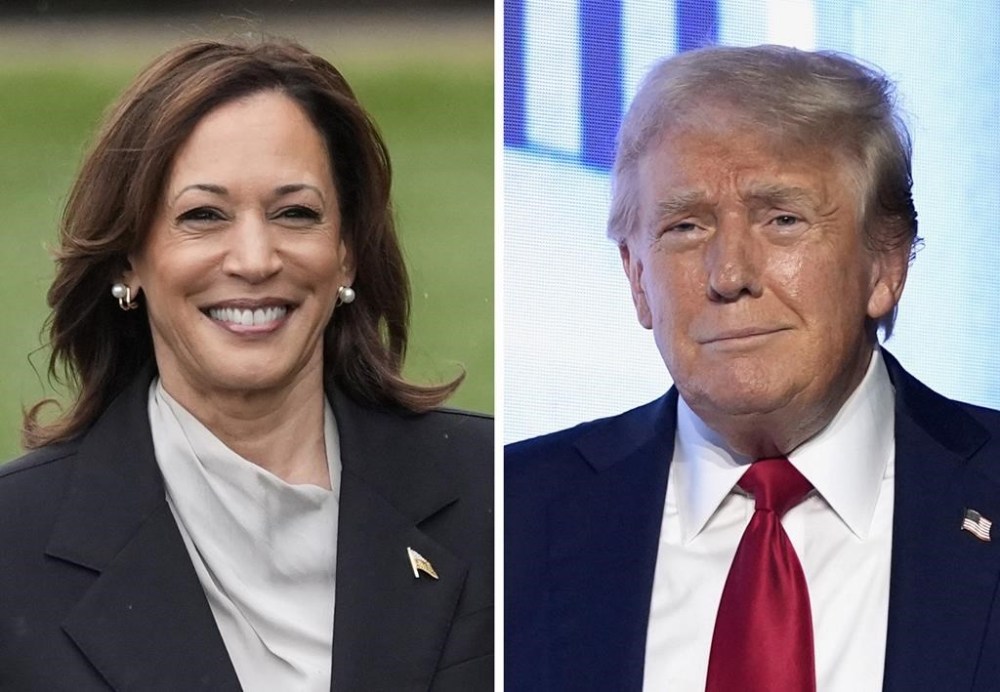
Now, she’s running for president and her chief opponent, former President Donald Trump, has said he wants to “cancel” the Biden order. Trump’s running mate, Ohio Sen. JD Vance, also brings his own views on AI, which are influenced by his ties to some Silicon Valley figures pushing to limit AI regulation.
AI’s growing visibility in everyday life has made it a popular discussion topic but hasn’t yet elevated it to a top concern for American voters. But this could be the first presidential election where the candidates are crafting competing visions on how to guide American leadership over the fast-developing technology.
Here are the candidates’ records on AI:
Trump’s approach
Biden signed his AI executive order last Oct. 30, and soon after Trump was signaling on the campaign trail that, if re-elected, he’d do away with it. His pledge was memorialized in the platform of this month’s Republican National Convention.
“We will repeal Joe Biden’s dangerous Executive Order that hinders AI Innovation, and imposes Radical Leftwing ideas on the development of this technology,” says Trump’s platform. “In its place, Republicans support AI Development rooted in Free Speech and Human Flourishing.”
The Trump campaign didn’t respond to a requests for more details.
Trump didn’t spend much time talking about AI during his four years as president, though in 2019 he became the first to sign an executive order about AI. It directed federal agencies to prioritize research and development in the field.
Before that, tech experts were pushing the Trump-era White House for a stronger AI strategy to match what other countries were pursuing. In 2017, not long before Google quietly introduced a research breakthrough helping to set the foundation of the technology now known as generative AI, then-Treasury Secretary Steven Mnuchin brushed aside concerns about AI displacing jobs, saying that prospect was so far in the future that “it’s not even on my radar screen.”
That perspective later shifted, with Trump’s top tech adviser telling corporate leaders in 2018 that AI-fueled job displacement is “inevitable” and that “we can’t sit idle, hoping eventually the market will sort it out.” The 2019 order called on federal agencies to “protect civil liberties, privacy and American values” in applying AI technologies, and to help workers gain relevant skills.
Trump also in the waning weeks of his administration signed an executive order promoting the use of “trustworthy” AI in the federal government. Those policies carried over into the Biden administration.
Harris’ approach
The debut of ChatGPT nearly halfway through Biden’s presidential term made it impossible for politicians to ignore AI. Within months, Harris was convening the heads of Google, Microsoft and other tech companies at the White House, a first step down a path that brought leading developers to agree to voluntary commitments to ensure their technology won’t put people’s rights and safety at risk.
Then came Biden’s AI order, which used Korean War-era national security powers to scrutinize high-risk commercial AI systems but was mostly directed at safeguarding the government’s use of the technology and setting standards that could foster commercial adoption. Unlike the European Union, however, the U.S. still has no broad rules on AI — something that would require Congress to pass.
Harris already brought to the White House a deep understanding of Silicon Valley, having grown up and worked in the San Francisco Bay Area and later served as California’s attorney general, where she forged relationships with some tech leaders, said Alondra Nelson, former director of the White House Office of Science and Technology Policy.
Even before ChatGPT, Nelson led the White House efforts to draft a blueprint for an AI “bill of rights” to guard against the technology’s potential harms. But it was the speech at the Global Summit on AI Safety in London where Harris brought all those threads together and “articulated to the world what American AI strategy was,” Nelson said.
Harris said she and Biden “reject the false choice that suggests we can either protect the public or advance innovation.” And while acknowledging a need to consider existential threats to humanity, Harris emphasized “the full spectrum of AI risk.”
“She kind of opened the aperture of the conversation about potential AI risks and harms,” Nelson said.
Vance and the VCs
Trump’s pick of the former venture capitalist Vance as running mate added a new element to the differences between the campaigns. So did Trump’s newfound endorsements from a group of AI-focused tech leaders including Elon Musk and the venture capitalists Marc Andreessen and Ben Horowitz.
Vance has acknowledged some harmful AI applications, but said at a July Senate hearing that he worries that concern is justifying “some preemptive overregulation attempts that would frankly entrench the tech incumbents that we already have.”
Andreessen, who sits on the board of Meta Platforms, has criticized a provision of Biden’s order that requires government scrutiny of the most powerful and ostensibly risky AI systems if they can perform a certain number of mathematical calculations per second.
On a podcast with business partner Horowitz explaining their support of Trump, Andreessen said he was concerned with “the idea that we’re going to deliberately hamstring ourselves through onerous regulations while the rest of the world lights up on this, and while China lights up on this.”
Horowitz read aloud the RNC call to repeal Biden’s order, saying “that sounds like a good plan to me” and noting that he and Andreessen had discussed the proposals with Trump at a dinner.
Trump met with another group of VCs in a video podcast in June, sharing their view that AI leadership will require huge amounts of electricity — a perspective he shared again on the RNC stage where he said it will require “twice the electricity that’s available now in our country.” It was his sole mention of AI in the 92-minute speech.
Are they that different on AI?
Much is still unknown, including to what extent either Harris or the Trump-Vance ticket will heed the opinions of their competing wings of Silicon Valley support.
While the rhetorical differences are sharpening, “there’s a lot of similarity” between how the Trump and Biden administrations approached AI policy, said Aaron Cooper, senior vice president of global policy for BSA The Software Alliance, which advocates for software companies including Microsoft.
Voters haven’t yet heard much detail about how a Harris or second Trump administration would change that.
“What we’ll continue to see as the technology develops and as new issues arise, regardless of who’s in the White House, they’ll be looking at how we can unleash the most good from AI while reducing the most harm,” Cooper said. “That sounds obvious, but it’s not an easy calculation.”