More bike lanes make for a better city
Read this article for free:
or
Already have an account? Log in here »
To continue reading, please subscribe:

Digital Subscription
One year of digital access for only $205*
- Enjoy unlimited reading on winnipegfreepress.com
- Read the E-Edition, our digital replica newspaper
- Access News Break, our award-winning app
- Play interactive puzzles
*First annual payment billed as $205.00 + GST for one year. This annual subscription will automatically renew at $233.00 + GST every 52 weeks (10% off the regular annual price of $259.35). Offer available to new and qualified returning subscribers only. Cancel any time.
To continue reading, please subscribe:
Add Free Press access to your Brandon Sun subscription for only an additional
$1 for the first 4 weeks*
- Enjoy unlimited reading on winnipegfreepress.com
- Read the E-Edition, our digital replica newspaper
- Access News Break, our award-winning app
- Play interactive puzzles
*Your next Brandon Sun subscription payment will increase by $1.00 and you will be charged $17.95 plus GST for four weeks. After four weeks, your payment will increase to $24.95 plus GST every four weeks.
Read unlimited articles for free today:
or
Already have an account? Log in here »
Hey there, time traveller!
This article was published 04/08/2024 (765 days ago), so information in it may no longer be current.
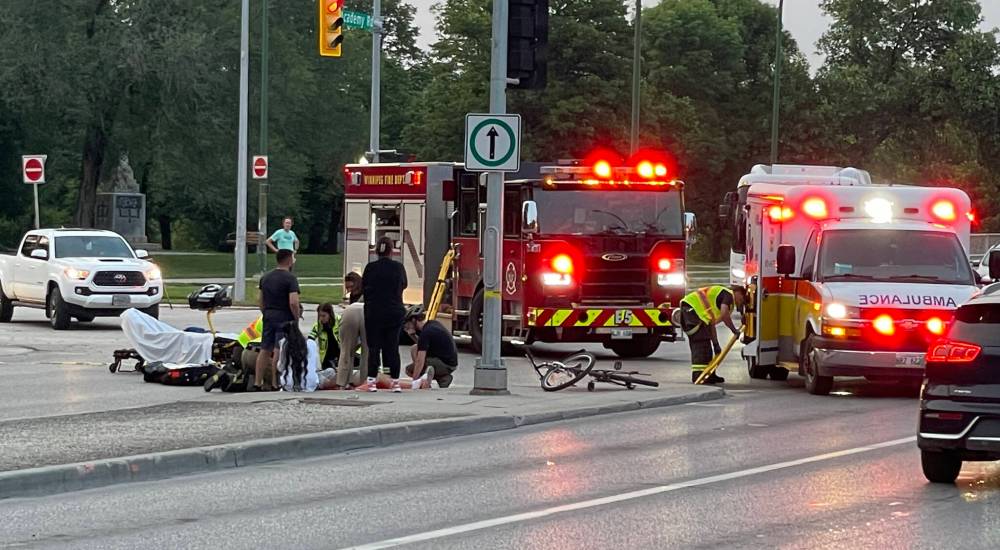
A few weeks ago in Winnipeg, Rob Jenner was killed by a driver while riding his bike to work. On July 29, a few blocks away, a young girl out for a bike ride with her dad was hospitalized after a driver crashed into her. Every year, an average of 70 people riding a bike are hit by drivers so severely that an injury report is filed with the police. In a six-month cycling season, that’s every third day.
Yet, when the city began public consultation for three new protected bike lanes, two downtown and one in the West-Alexander area, the usual public opposition was heard. The talking points are always predictable and can be addressed one-by-one.
Winnipeg is a winter city. We don’t need bike lanes for six months a year.
This is like saying, “I don’t need to wear a life jacket because I only go boating in the summertime.” Far fewer people cycle in winter, but this shouldn’t diminish the need for safe streets in the seasons when people are riding bikes and fighting for road space with thousand-kilogram machines.
We publicly invest in many things not used to their full capacity year-round. Would this same argument not apply to parks, sidewalks, arenas, pools and splash pads?
We can’t afford bike lanes.
Bike lanes are cheap. We spend $5 million per year on all active transportation projects. Most of this funding is used to build and maintain sidewalks, with a small percentage used for on-street bike lanes that are often rolled into larger road renewal projects.
Spending on dedicated cycling infrastructure is a rounding error in our overall roads budget. We spend $170 million every year fixing existing roads, and the Transportation Master Plan projects spending almost that amount building new roads.
If we can’t afford bike infrastructure, we really can’t afford car infrastructure like the Kenaston Boulevard widening, pegged to cost the equivalent of the entire active transportation budget for 150 years.
Winnipeg is a car city.
It sure is, but with 8,300 kilometers of public roads and less than 30 kilometres of on-street protected bike lanes, there’s lots of room for cars.
Related Articles
Cyclist dies after crashing into parked tractor-trailer






Nobody rides a bike in Winnipeg anyway.
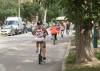
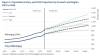
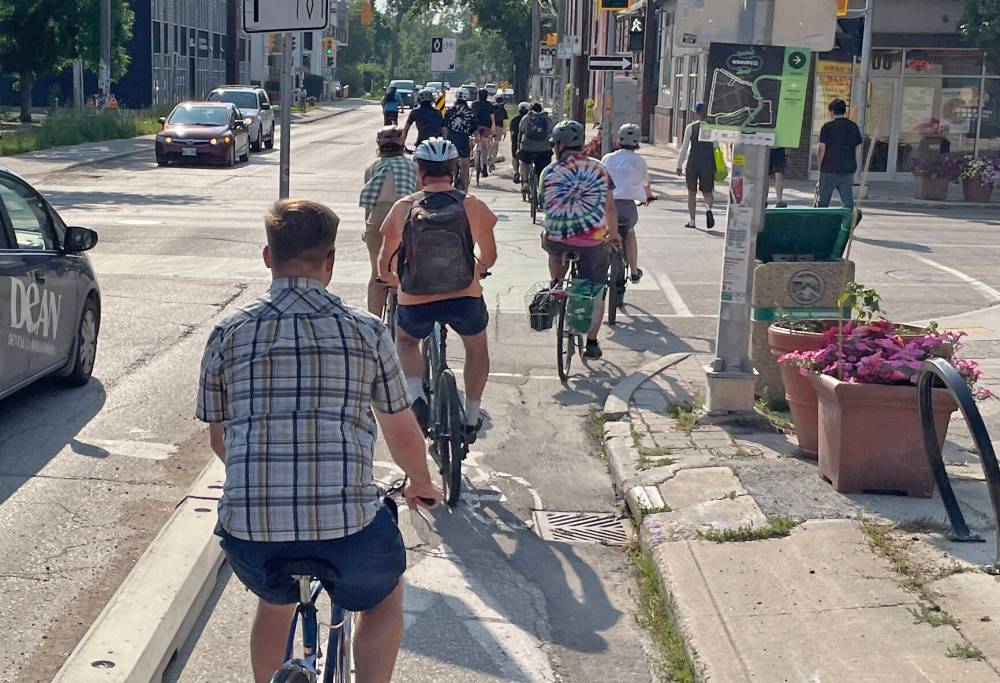
The federal census shows between 5,000 and 7,000 people ride a bike to work daily between May and October. While this represents less than two per cent of commuters citywide, it varies significantly by neighbourhood.
About two-thirds of bike commuters live less than five kilometres from Portage and Main. In suburban neighbourhoods like Bridgwater, Seven Oaks, Island Lakes, Linden Woods, Sage Creek, and North Kildonan, this percentage is close to zero. It’s understandable, if you live in this type of neighbourhood, you might believe nobody rides a bike.
In mature neighbourhoods like River Heights, West Broadway, Osborne, and Earl Grey, cycling mode share is closer to six per cent of all commuters. Wolseley is ranked as a top 10 cycling neighbourhood in Canada with 12 per cent of commuters riding a bike.
Many more people, including children, cycle for other reasons, such as recreation, exercise, or riding to school. The bike counter near The Forks regularly shows more than a thousand people biking past on a summer weekend day. A 2022 CAA survey found that 15 per cent of Winnipeggers ride a bike at least a few times per week, with a further 30 per cent riding occasionally. Forty per cent of respondents said they would bike more if they had safe, protected lanes to ride in.
If cyclists want bike lanes, they should pay for it themselves.
City streets, sidewalks, and bike lanes are paid for overwhelmingly through property taxes. Like drivers, people who ride bikes pay property taxes.
Cyclists don’t pay fuel taxes that go into the government’s general revenues, but the money they save is spent on other things that are similarly taxed.
Most cyclists also drive a car.
Bike lanes take parking away from downtown businesses.
Planners are careful to design bike lanes to be as minimally disruptive as possible. When the Exchange District bike lanes were built, diagonal parking was implemented to increase the total number of stalls in the immediate area.
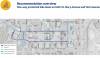
The downtown lanes currently being proposed will remove 97 on-street stalls, representing 0.3 percent of downtown’s 26,000 public parking stalls.
Diversifying mobility options is a key step in the long-term process of creating a downtown residential neighbourhood to support local shops and businesses, so they don’t have to rely on the ever-dwindling number of people driving downtown to shop.

Bike lanes make driving worse.
Separating cyclists, drivers, and pedestrians into their own lanes is better for everyone. If you get frustrated as a driver having to pass slow-moving cyclists on the street, you should support bike lanes that keep them separate from car traffic.
Bike lanes often get blamed for narrowing car lanes, but most often, as in the case of Goulet Street, this is done intentionally to slow vehicle speeds and calm traffic, having nothing to do with bike lanes.
Many people will read this angrily and think cyclists deserve their fate because they don’t follow the rules of the road.
Undoubtedly, some percentage of the population is selfish and irresponsible, but just as many of those people are drivers, or pedestrians. Cyclists aren’t protected by a thousand kilograms of steel with crumple zones, air bags and seat belts. Improving their safety comes from the built environment.
When we create safe streets by narrowing lanes and intersections, slowing vehicle speeds, improving sight lines, widening sidewalks and building bike lanes, we build in a safety factor that allows for mistakes, distractions, careless behaviour, and unexpected conditions to happen — without having someone pay for it with their life.

Brent Bellamy is creative director for Number Ten Architectural Group.
Our newsroom depends on a growing audience of readers to power our journalism. If you are not a paid reader, please consider becoming a subscriber.
Our newsroom depends on its audience of readers to power our journalism. Thank you for your support.
History
Updated on Tuesday, August 6, 2024 7:40 AM CDT: Corrects photo cutlines