Stallion named Chase in a race to save Ojibwa horse breed Efforts to bolster lineage is a labour of love, living lesson in reconciliation
Read this article for free:
or
Already have an account? Log in here »
To continue reading, please subscribe:

Digital Subscription
One year of digital access for only $205*
- Enjoy unlimited reading on winnipegfreepress.com
- Read the E-Edition, our digital replica newspaper
- Access News Break, our award-winning app
- Play interactive puzzles
*First annual payment billed as $205.00 + GST for one year. This annual subscription will automatically renew at $233.00 + GST every 52 weeks (10% off the regular annual price of $259.35). Offer available to new and qualified returning subscribers only. Cancel any time.
To continue reading, please subscribe:
Add Free Press access to your Brandon Sun subscription for only an additional
$1 for the first 4 weeks*
- Enjoy unlimited reading on winnipegfreepress.com
- Read the E-Edition, our digital replica newspaper
- Access News Break, our award-winning app
- Play interactive puzzles
*Your next Brandon Sun subscription payment will increase by $1.00 and you will be charged $17.95 plus GST for four weeks. After four weeks, your payment will increase to $24.95 plus GST every four weeks.
Read unlimited articles for free today:
or
Already have an account? Log in here »
Hey there, time traveller!
This article was published 09/08/2024 (790 days ago), so information in it may no longer be current.
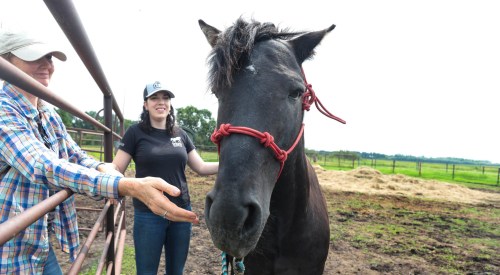
There’s a lot of expectation riding on Chase’s visit to Manitoba.
The petite black stallion is a rare breed several times over. He’s one of fewer than 200 Ojibwa horses left in the world and one of about two dozen stallions charged with keeping the endangered lineage alive.
And at 16 years old, time is of the essence. No pressure.
Standing in a paddock at Sagehill Stables, however, the affable little horse doesn’t seem fazed by the burden of legacy. He’s more concerned with the treats in his caretaker’s pocket.
Chase — whose full name is Babaaminizhikawaad or “He Chases Them Around” — arrived at the riding stable south of Winnipeg last summer from his home at Grey Raven Ranch, located on Seine River First Nation in northwestern Ontario. The goal is to breed him with compatible local mares and collect his semen for future use.
RUTH BONNEVILLE / FREE PRESS Sagehill Stables owner Gwen Donohoe was keen to support the conservation effort behind Chase’s presence after meeting several Ojibwa horses at nearby Aurora Farm.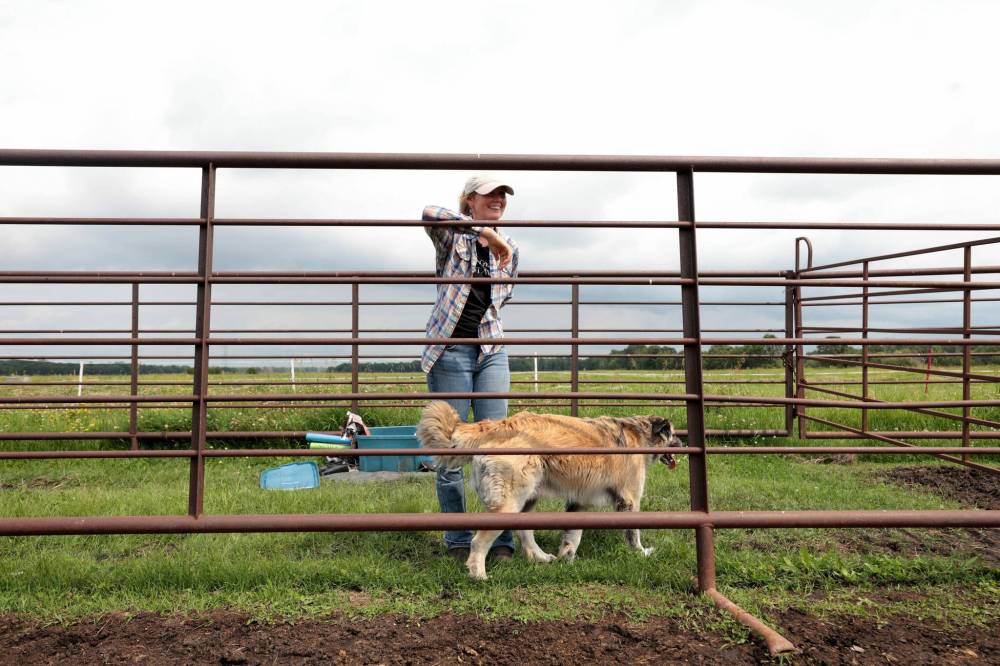
Sagehill owner Gwen Donohoe was keen to support the conservation effort after meeting several Ojibwa horses at nearby Aurora Farm.
“We wanted the business to help in some way with reconciliation. This opportunity came up and we decided to give it a try,” she says.
Taking on Chase was not without its challenges.
There are so few Ojibwa stallions because the hormone-driven intact males require special facilities and handling, making them harder to keep for the average stable or rider when compared to a gelding.
The intelligent breed is also a renowned escape artist. A new pen with double fencing had to be built for Chase, far from Sagehill’s female lesson horses. Donohoe also needed to find dedicated caretakers to tend to the new resident during his stay.
Michelle McConomy raised her hand without a second thought.
RUTH BONNEVILLE / FREE PRESS Michelle McConomy and her father, Bob McConomy are helping to look after Chase, a 16-year-old Ojibwe stallion at Winnipeg’s Sagehill Stables.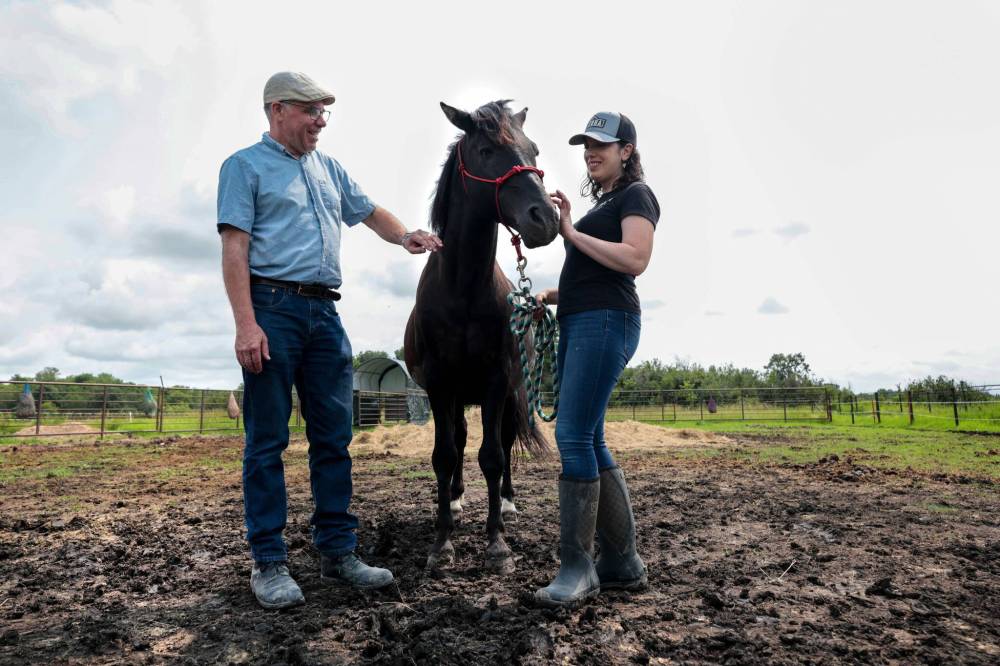
“I just found it a fascinating story,” says the elementary teacher, who first learned about the dwindling breed during a classroom workshop.
At Sagehill, Chase’s presence has opened the door to insightful conversations about colonization with day campers and riding students.
“As a teacher I feel like we do a good job of focusing on Indigenous culture and history, so kids have that base and then this is a new (chapter) they get to learn about,” McConomy says.
She and her dad, Bob McConomy, started taking riding lessons at Sagehill during the pandemic and quickly got more involved in the barn community. The father-daughter duo each lease horses and participate in stable programming on top of feeding, watering, exercising and grooming Chase and his pen pal, Rocky, on a regular basis.
“I just feel really good working with the horses,” Bob says, adding his approach to horsemanship has shifted as he’s learned more about Ojibwa horse history.
“It’s a partnership.”
RUTH BONNEVILLE / FREE PRESS At Sagehill Stables, Chase’s presence has opened the door to insightful conversations about colonization with day campers, riding students and Michelle McConomy, who volunteered to be the valuable stallion’s caretaker.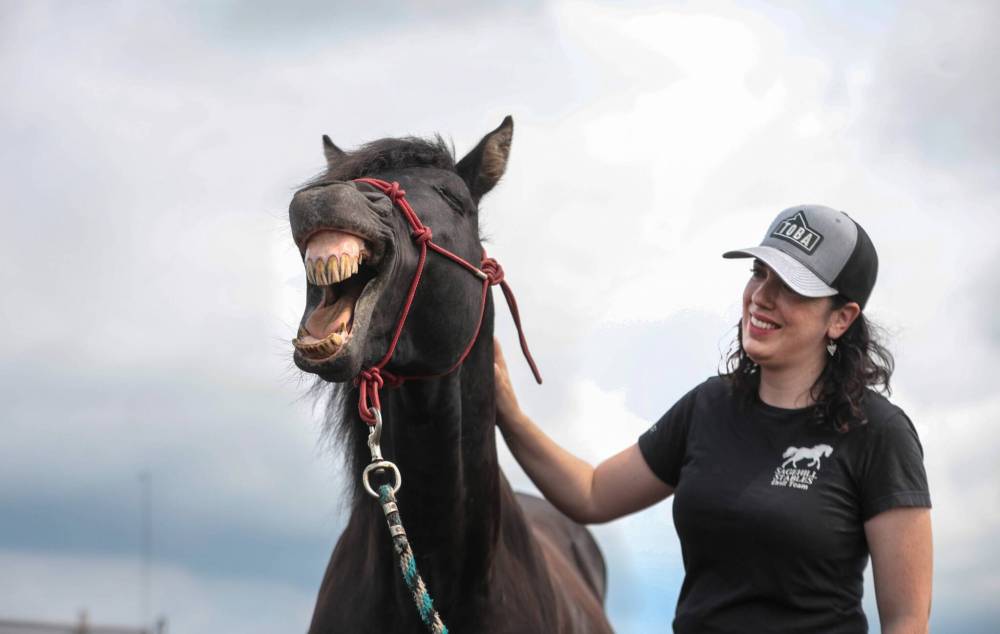
Caretaker, instead of owner, is a deliberate word choice among Ojibwa horse stewards meant to denote the mutually beneficial relationship between the animals and Indigenous communities.
Also known as Lac La Croix ponies and regarded as spirit animals, the helpful horses historically roamed free alongside human settlements in Ontario and Minnesota. They were rounded up as needed and occasionally offered food and shelter but were otherwise left to forage in the surrounding forests.
As North America was colonized by European settlers, the horses and their caretakers were removed from their traditional lands. The introduction of vehicles and government policy — which deemed the semi-feral horses invasive pests — further led to the decline of the breed.
By 1977, there were only four mares left on Lac La Croix First Nation (now called Gakijiwanong Anishinaabe Nation), which were slated to be destroyed by Canadian authorities.
The horses were saved by a small group of advocates and shuttled across the border under cover of darkness and later crossbred with Spanish mustangs — a breed with similar characteristics — thus beginning a decades-long project among small, independent breeders and family farms to bring the Ojibwa horse back from the brink.
Spirit Horse Returns
Jodi Contin first learned about Ojibwa horses during an outreach program for a chamber music festival in Ontario. The endangered breed would go on to change the trajectory of her life and career.
Contin is an Anishinaabe hand drummer from Wasauksing First Nation. In 2019, the artistic director of Parry Sound’s annual Festival of Sound introduced her to Ken MacDonald, a French horn player from Manitoba. The pair were tasked with creating an educational music presentation that combined their very different personal stories and instruments.
Jodi Contin first learned about Ojibwa horses during an outreach program for a chamber music festival in Ontario. The endangered breed would go on to change the trajectory of her life and career.
Contin is an Anishinaabe hand drummer from Wasauksing First Nation. In 2019, the artistic director of Parry Sound’s annual Festival of Sound introduced her to Ken MacDonald, a French horn player from Manitoba. The pair were tasked with creating an educational music presentation that combined their very different personal stories and instruments.
“I did laugh, I’m not gonna lie,” Contin recalls of the assignment.
In searching for common ground, MacDonald — associate principal horn with the Winnipeg Symphony Orchestra — shared the story of Asemaa’kwe, an Ojibwe mare he was caring for with his husband, Trevor Kirczenow, on their small family farm near Dugald.
Shocked that she had never heard of the breed, Contin was inspired to write a song for Asemaa’kwe.
“It’s been a very big awakening for me as an Indigenous woman in Turtle Island trying to figure out my own identity and understand the history that’s happened,” says Contin, who is a day school survivor.
“It was a song I wrote for a horse I was proud of; I was proud of her because she was reclaiming who she was.”
That song has since been expanded into a full-scale orchestral production called The Spirit Horse Returns, which features accompanying visuals by artist and Ojibwa horse advocate Rhonda Snow. The national touring show made its debut with the WSO in 2022 and is set to return to the Centennial Concert Hall in February 2025.
During research for the show and discussions with knowledge keepers, Contin discovered her grandfather kept several Ojibwa horses on Wasauksing. The story of the breed hits close to home in more ways than one.
“It’s like a parallel universe. They were taken from their land, we were taken from ours,” she says.
When Contin travels with the show she makes a point of visiting local Ojibwa horse caretakers and drumming for the herds. When she met Asemaa’kwe for the first time, the mare trotted over to listen to the beat of the drum. The connection was immediate.
Contin, who has recently joined the board of the Ojibwe Horse Society, describes Spirit Horse Returns as a safe, gentle way for audiences of all ages and backgrounds to learn about the effects of colonization. Much like the breed’s conservation efforts, the production is a collaboration between Indigenous and non-Indigenous stakeholders.
“We’re all learning this stuff at the same time because it was not taught to us the way it should have been and that cheated us out of a good relationship with one another,” says Contin. “It’s opening doors to have those conversations. It’s creating a safe space for kids to ask questions about the horses, but they’re also asking questions about the culture and the history and the language.”
Visit wso.ca for more information and to reserve tickets for the Feb. 25 children’s concert.
Saving an endangered animal isn’t easy.
“The problem with being one of the rarest horse breeds on Earth is that the genetic diversity narrows considerably,” says Kimberlee Campbell, a horse breeder and Chase’s full-time caretaker.
“In a very tight gene pool, you can end up with only the recessive genes they may carry.”
Campbell, a semi-retired Harvard languages professor, has been working with Ojibwa horses since 2011 after falling in love with the breed’s fine features and easy going temperament.
Generally standing under 14 hands (1.4 metres) high at the shoulders, the horses come in a variety of dark solid colours and are equipped with small, hard hooves, fuzzy ears and a special nose flap to protect from the cold.
Campbell also sees the preservation of the Indigenous breed as an act of resistance.
“It’s a way to push back against everything that’s been taken from Indigenous people on this continent,” she says.
Through Grey Raven Ranch in Ontario, she and longtime partner Darcy Whitecrow have been helping increase the breed’s numbers and educating the public about the Ojibwa horse story through meet-and-greets and a children’s book, titled Runs with the Stars.
Campbell has had Chase for a decade, during which time he’s sired 10 offspring (including a few unplanned oopsie babies; he’s an escape artist, remember?). She’s sent him off to stud with other Ontario breeders, but he’s now too closely related to the breedable mares in that province. Hence the move to Manitoba.
“I had nobody to breed Chase to and he has to be used,” she says.
The small breeding pool in North America is closely managed by the Ojibwe Horse Society. While the work is a lot like horse matchmaking, Trevor Kirczenow’s job as breed registrar is a decidedly unromantic combination of DNA testing and spreadsheet keeping.
“I had nobody to breed Chase to and he has to be used.”–Kimberlee Campbell
“In the last few years we’ve had an average of a dozen new Ojibwa horse foals total in the entire breed — the numbers are really tiny,” says Kirczenow, a health researcher and former Manitoba Liberal candidate who keeps a small farm near Dugald.
“It’s really important to track all of them; I try to track things to do with their health and I try really hard to connect different caretakers and breeders with each other. At this point, every single stallion in the breed is incredibly important in terms of their genetics.”
His own horse, Asemaa’kwe, is one of a handful of mares in Manitoba deemed genetically suitable matches for Chase. Kirczenow is excited to have Chase in the province for both his breeding and public-awareness potential.
With about 10 breeders nationwide, the society is in dire need of more caretakers.
While stallions have a wild and unpredictable reputation, Chase doesn’t fit that mould. The calm, human-oriented horse has been involved in equine-assisted therapy and learning programs at Grey Raven Ranch and Sagehill.
“They’re just a friendly, outgoing horse that needs to be kept with us.”–Kimberlee Campbell
“I hope that meeting a horse like Chase would encourage some (local breeders) to think about if it might be possible for them. If they would consider supporting the Ojibwa horse breed even just a little bit, it would make a huge difference,” Kirczenow says.
Campbell agrees. “We need to get more people owning these horses. They can be trained for a lot of disciplines and they’re just a friendly, outgoing horse that needs to be kept with us,” she says.
For those who would like to help, but don’t have the resources to take on a horse, Michelle McConomy has launched a GoFundMe campaign aimed at raising $3,000 to cover the veterinary costs associated with breeding Chase and collecting and freezing his semen. Excess proceeds will be donated to the Ojibwe Horse Society.
eva.wasney@winnipegfreepress.com
X: @evawasney


Eva Wasney covers environmental issues in Manitoba for The Narwhal in partnership with the Winnipeg Free Press. Read more about Eva.
Every piece of reporting Eva produces is reviewed by an editing team before it is posted online or published in print — part of the Free Press‘s tradition, since 1872, of producing reliable independent journalism. Read more about Free Press’s history and mandate, and learn how our newsroom operates.
Our newsroom depends on a growing audience of readers to power our journalism. If you are not a paid reader, please consider becoming a subscriber.
Our newsroom depends on its audience of readers to power our journalism. Thank you for your support.