This bird species was extinct in Europe. Now it’s back, and humans must help it migrate for winter

Advertisement

Advertise with us

PATERZELL, Germany (AP) — How do you teach a bird how, and where, to fly?

Read this article for free:


or

Already have an account? Log in here »

To continue reading, please subscribe:

Subscribe and receive a limited-edition Free Press branded hat or tote.

Digital Subscription

One year of digital access for only $205*

  • Enjoy unlimited reading on winnipegfreepress.com
  • Read the E-Edition, our digital replica newspaper
  • Access News Break, our award-winning app
  • Play interactive puzzles

*First annual payment billed as $205.00 + GST for one year. This annual subscription will automatically renew at $233.00 + GST every 52 weeks (10% off the regular annual price of $259.35). Offer available to new and qualified returning subscribers only. Cancel any time.

To continue reading, please subscribe:

Add Free Press access to your Brandon Sun subscription for only an additional

$1 for the first 4 weeks*

  • Enjoy unlimited reading on winnipegfreepress.com
  • Read the E-Edition, our digital replica newspaper
  • Access News Break, our award-winning app
  • Play interactive puzzles
Start now

*Your next Brandon Sun subscription payment will increase by $1.00 and you will be charged $17.95 plus GST for four weeks. After four weeks, your payment will increase to $24.95 plus GST every four weeks.

Hey there, time traveller!
This article was published 25/08/2024 (748 days ago), so information in it may no longer be current.

PATERZELL, Germany (AP) — How do you teach a bird how, and where, to fly?

The distinctive Northern Bald Ibis, hunted essentially to extinction by the 17th century, was revived by breeding and rewilding efforts over the last two decades. But the birds — known for their distinctive black-and-iridescent green plumage, bald red head and long curved beak — don’t instinctively know which direction to fly to migrate without the guidance of wild-born elders. So a team of scientists and conservationists stepped in as foster parents and flight instructors.

“We have to teach them the migration route,” said biologist Johannes Fritz.

This photo provide by Waldrappteam Conservation & Research shows the migration from Northern Bald Ibis, or the Waldrapp, supported by foster parents of the birds in a microlight aircraft, waving and shouting encouragement through a bullhorn as it flies through the air from Seekirchen am Wallersee in Austria to Oasi Laguna di Orbetello in Italy during August and September 2022. (Waldrappteam Conservation & Research via AP)

The Northern Bald Ibis once soared over North Africa, the Arabian Peninsula and much of Europe, including southern Germany’s Bavaria. The migratory birds were also considered a delicacy and the bird, known as the Waldrapp in German, disappeared from Europe, though a few colonies elsewhere survived.

The efforts of Fritz and the Waldrappteam, a conservation and research group based in Austria, brought the Central European population from zero to almost 300 since the start of their project in 2002.

The feat moved the species from a “critically endangered” classification to “endangered” and, Fritz says, is the first attempt to reintroduce a continentally extinct migratory bird species.

But while Northern Bald Ibises still display the natural urge to migrate, they don’t know which direction to fly without the guidance of wild-born elders. The Waldrappteam’s early reintroduction attempts were largely unsuccessful because, without teaching the birds the migration route, most disappeared soon after release. Instead of returning to suitable wintering grounds such as Tuscany, Italy, they flew in different directions and ultimately died.

So the Waldrappteam stepped in as foster parents and flight instructors for the Central European population, which was made up of descendants from multiple zoo colonies and released into the wild in the hopes of creating a migratory group. This year marks the 17th journey with human-led migration guides, and the second time they’ve been forced to pilot a new route to Spain due to climate change.

To prepare them for travel, the chicks are removed from their breeding colonies when they are just a few days old. They are taken to an aviary that’s overseen by the foster parents in the hopes of “imprinting” — when the birds will bond with those humans to ultimately trust them along the migration route.

Barbara Steininger, a Waldrapp team foster mother, said she acts like “their bird mom.”

“We feed them, we clean them, we clean their nests. We take good care of them and see that they are healthy birds,” she said. “But also we interact with them.”

Steininger and the other foster parents then sit on the back of a microlight aircraft, waving and shouting encouragement through a bullhorn as it flies through the air.

It’s a bizarre scene: The aircraft looks like a flying go-kart with a giant fan on the back and a yellow parachute keeping it aloft. Still, three dozen birds follow the contraption, piloted by Fritz, as it sails over alpine meadows and foothills.

Fritz was inspired by “Father Goose” Bill Lishman, a naturalist who taught Canadian geese to fly alongside his ultra-light plane beginning in 1988. He later guided endangered whooping cranes through safe routes and founded the nonprofit “Operation Migration.” Lishman’s work prompted the 1996 movie “Fly Away Home” but features a young girl as the geese’s “mother.”
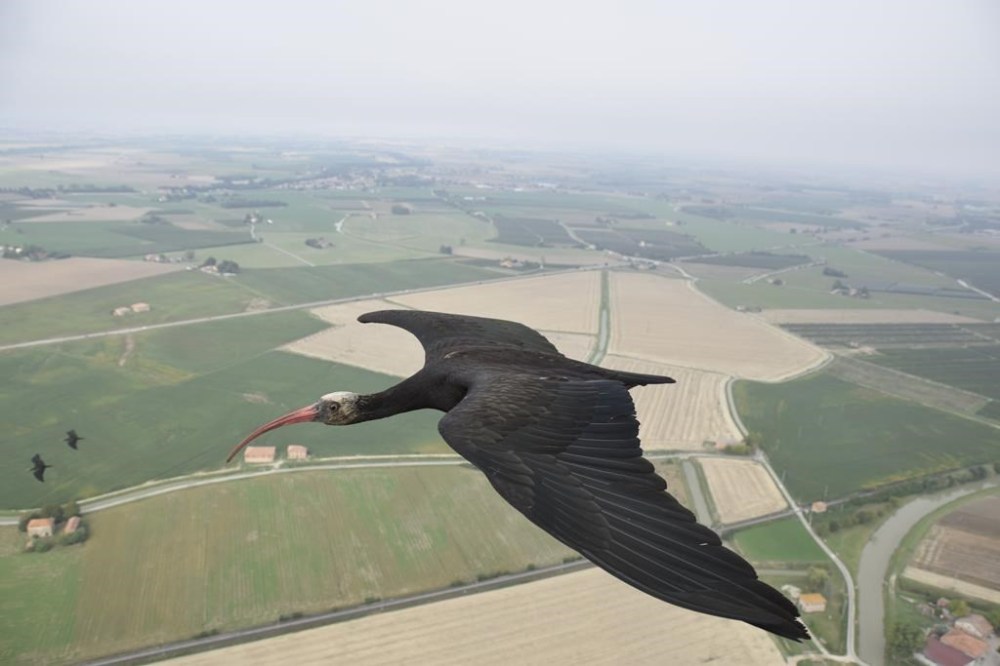
This photo provide by Waldrappteam Conservation & Research shows the migration from Northern Bald Ibis, or the Waldrapp from Seekirchen am Wallersee in Austria to Oasi Laguna di Orbetello in Italy during August and September 2022. (Waldrappteam Conservation & Research via AP)

Like Lishman, Fritz and his team’s efforts have worked. The first bird independently migrated back to Bavaria in 2011 from Tuscany. More have flown the route that’s upwards of 550 kilometers (342 miles) each year, and the team hopes the Central European population will be more than 350 birds by 2028 and become self-sustaining.

But the effects of climate change mean the Waldrapp are migrating later in the season now, which forces them to cross the Alps in colder, more dangerous weather — without the aid of warm currents of air, known as thermals, that rise upward and help the birds soar without expending extra energy.

In response, the Waldrappteam piloted a new route in 2023, from Bavaria to Andalusia in southern Spain.

This year, the route is roughly 2,800 kilometers (1,740 miles) — some 300 kilometers (186 miles) longer than last year’s path. Earlier this month from an airfield in Paterzell, in upper Bavaria, the team guided 36 birds along one stage through bright blue skies and a tailwind that increased their speed.

The entire journey to Spain could take up to 50 days and end in early October. But Fritz says the effort is bigger than just the Northern Bald Ibises: It’s about paving the way for other threatened migratory species to fly.

___

Dazio reported from Berlin.

Report Error Submit a Tip

More Stories

Artist’s inspired work brings Red River Métis story back to Portage and Main

Conrad Sweatman 8 minute read Preview

Artist’s inspired work brings Red River Métis story back to Portage and Main

Conrad Sweatman 8 minute read Updated: 2:47 PM CDT

Jennine Krauchi calls them the “grandmothers.” “They speak to you very silently. You never hear a word, but they speak,” Krauchi says, referring to the antique pieces of Métis needlework she’s carefully studied for years. But there are few precedents for her latest art project: a 85-foot-wide by 32-foot-high chain curtain of Métis needlework that drapes over the historic Bank of Montreal’s neoclassical facade.

Read
Updated: 2:47 PM CDT

Education minister’s reasons for revoking teacher’s licence ‘not good enough,’ judge decides

Maggie Macintosh 5 minute read Preview

Education minister’s reasons for revoking teacher’s licence ‘not good enough,’ judge decides

Maggie Macintosh 5 minute read Updated: 9:14 AM CDT

A Manitoba judge has rejected the education minister’s decision to end a teacher’s career because he repeatedly messaged with a 13-year-old girl on social media.

Read
Updated: 9:14 AM CDT

‘We feel lucky — and a bit traumatized’: Tornado confirmed in River Heights Sunday

Malak Abas 6 minute read Preview

‘We feel lucky — and a bit traumatized’: Tornado confirmed in River Heights Sunday

Malak Abas 6 minute read Updated: Yesterday at 6:10 PM CDT

Tanner Lemieux wasn’t surprised to learn the violent winds that tore through River Heights and reached their peak near his home Sunday night have been classified as a tornado.

While driving back to his Lindsay Street home from a shopping trip with his wife Sunday, it became clear they were not in the middle of an ordinary thunderstorm when rain and wind started coming from every direction and hit every side of their truck.

The forceful wind made it impossible for him to open his door after they had parked. He climbed through the window, over the top of his vehicle, and the couple struggled to fight the whipping winds to make it into the house.

“As we were running in, the wind started pulling me backwards out of the door,” he told the Free Press while cleaning debris from his yard Thursday.

Read
Updated: Yesterday at 6:10 PM CDT

It all comes down to the Banjo Bowl

Taylor Allen 6 minute read Preview

It all comes down to the Banjo Bowl

Taylor Allen 6 minute read 7:26 PM CDT

It all started with a comment made by a kicker.

In 2003, Troy Westwood referred to the fine folks of Saskatchewan as “banjo-pickin’ inbreds.”

The following season, the Banjo Bowl was officially born, and it quickly became one of the most notable annual events on the Prairies.

The 22nd edition kicks off today, with the Winnipeg Blue Bombers (6-6) hosting the Saskatchewan Roughriders (8-4) at 3 p.m. in a crucial West Division showdown.

Read
7:26 PM CDT

Supportive housing operator sued after man with dementia walks away

Erik Pindera 4 minute read Preview

Supportive housing operator sued after man with dementia walks away

Erik Pindera 4 minute read Yesterday at 6:00 AM CDT

The Public Guardian and Trustee of Manitoba is suing a health services company after a man with dementia under its care allegedly wandered away from an apartment it operates for vulnerable people and was later found face down in a puddle — unresponsive, hypothermic and severely injured.

The public trustee — a provincial government agency that, among other duties, makes financial and personal care decisions for vulnerable adults who cannot do so themselves — filed the lawsuit against Cambridge Health Inc. and a related numbered company in the Court of King’s Bench earlier this month.

The agency did so on behalf of a now-38-year-old man, who has been under its care since 2018, as a result of his frontotemporal dementia. The disease often starts in mid-life, rather than old age, as is the case with most other forms of dementia.

The lawsuit alleges the man, who resided at a Henderson Highway apartment complex where Cambridge Health operated a supportive residence for people with complex behavioural health issues, was in a common area of the home at about 4:30 p.m. on April 3 last year.

Read
Yesterday at 6:00 AM CDT

U of M students call for ban on far-right group

Maggie Macintosh 4 minute read Preview

U of M students call for ban on far-right group

Maggie Macintosh 4 minute read Yesterday at 6:00 AM CDT

Some University of Manitoba students are calling on their school to ban a far-right group from campus after posters promoting mass deportations were found during the summer break.

More than 50 people rallied on Wednesday, the first day of classes, to make known their concerns about a group called the Dominion Society of Canada.

The protest was organized after a supporter of the self-described nationalist group posted a video over the Labour Day weekend that shows him putting up flyers in Fort Garry.

“Canada is a really beautiful country and I have been welcomed here by a lot of beautiful people and it’s been amazing, but when I see harmful rhetoric online and now, on campus, it gives me a lot of anxiety,” said Ela Ancheta, an arts major at U of M.

Read
Yesterday at 6:00 AM CDT