

U of M students call for ban on far-right group
Dominion Society of Canada labelled a white nationalist organization, promotes mass deportations

Advertisement
Read this article for free:
or
Already have an account? Log in here »
To continue reading, please subscribe:

Digital Subscription
One year of digital access for only $205*
- Enjoy unlimited reading on winnipegfreepress.com
- Read the E-Edition, our digital replica newspaper
- Access News Break, our award-winning app
- Play interactive puzzles
*First annual payment billed as $205.00 + GST for one year. This annual subscription will automatically renew at $233.00 + GST every 52 weeks (10% off the regular annual price of $259.35). Offer available to new and qualified returning subscribers only. Cancel any time.
To continue reading, please subscribe:
Add Free Press access to your Brandon Sun subscription for only an additional
$1 for the first 4 weeks*
- Enjoy unlimited reading on winnipegfreepress.com
- Read the E-Edition, our digital replica newspaper
- Access News Break, our award-winning app
- Play interactive puzzles
*Your next Brandon Sun subscription payment will increase by $1.00 and you will be charged $17.95 plus GST for four weeks. After four weeks, your payment will increase to $24.95 plus GST every four weeks.
Read unlimited articles for free today:
or
Already have an account? Log in here »
Some University of Manitoba students are calling on their school to ban a far-right group from campus after posters promoting mass deportations were found during the summer break.
More than 50 people rallied on Wednesday, the first day of classes, to make known their concerns about a group called the Dominion Society of Canada.
The protest was organized after a supporter of the self-described nationalist group posted a video over the Labour Day weekend that shows him putting up flyers in Fort Garry.
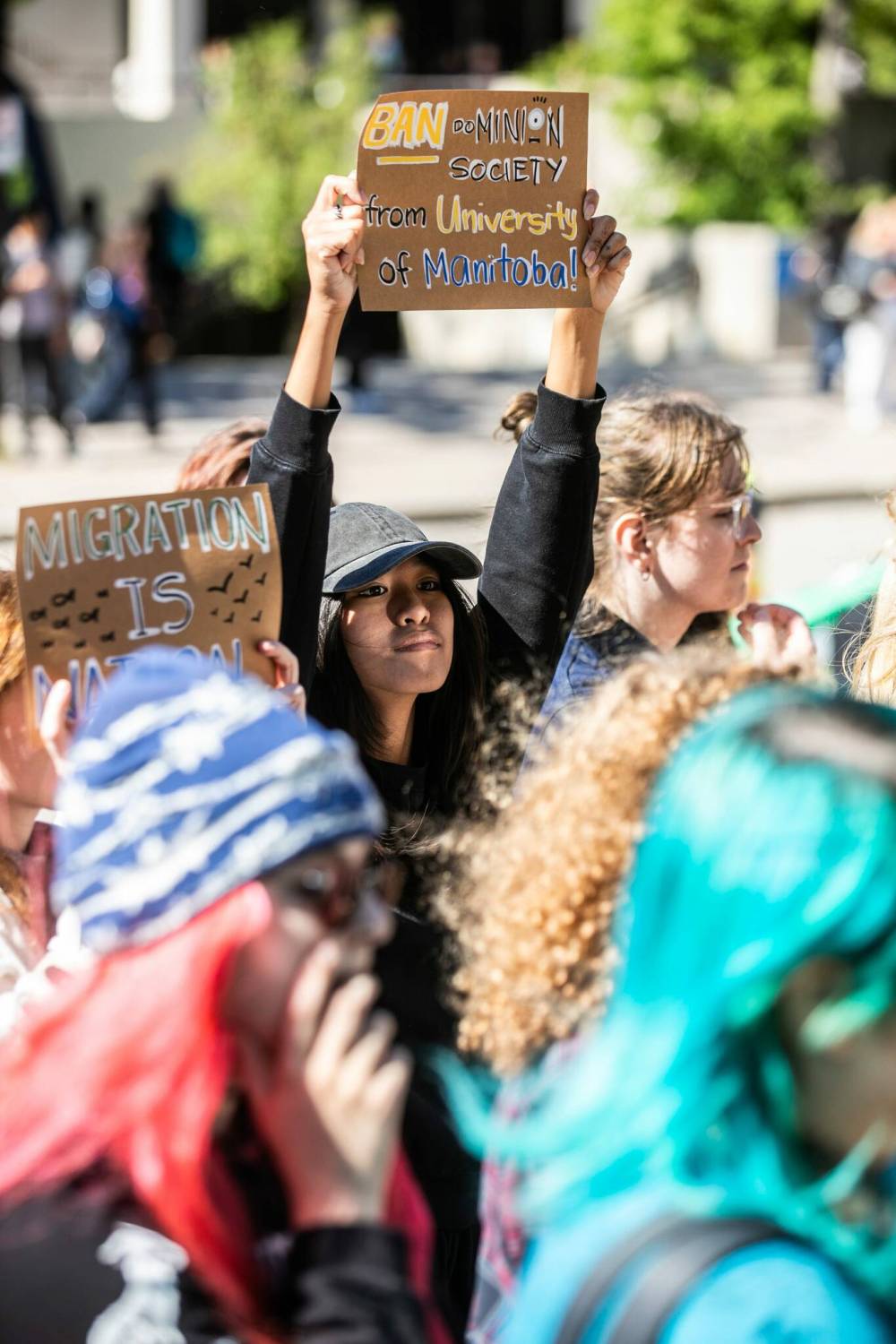
Ela Ancheta, at Wednesday's rally, says she experiences anxiety when she sees harmful rhetoric online and at the U of M campus, where she attends classes.
“Canada is a really beautiful country and I have been welcomed here by a lot of beautiful people and it’s been amazing, but when I see harmful rhetoric online and now, on campus, it gives me a lot of anxiety,” said Ela Ancheta, an arts major at U of M.
The 22-year-old student, who is a permanent resident, emigrated from the Philippines about five years ago.
Ancheta said she’s felt uneasy and compelled to protest since learning school security had to remove unauthorized signage advertising the group.
The Canadian Anti-Hate Network defines the Ottawa-based entity as a white nationalist organization.
Established as a national not-for-profit last fall, the group touts an 11-step plan “to preserve the Canadian nation.” Its members are in favour of policy changes to facilitate mass deportation, revoke permanent residency and repeal all legislation outlining Canada’s commitment to multiculturalism.
Its website calls for a legislation “that affirms Canada’s founding as a historically European, Christian and bicultural (English and French) nation with a common civic identity.”
Heaven Kaur, president of the University of Manitoba Students’ Union, said many of her peers want senior administration to issue a statement condemning the group.
“It’s concerning for folks. If our institution isn’t taking a stance on it and isn’t pushing back on organizations that are spreading hate, what are they doing to protect us?” said Kaur, who represents about 27,000 undergraduate students.

UMSU president Heaven Kaur, at a rally pushing to ban the Dominion Society from campus at the University of Manitoba, hopes the school administration condemns the group.
International students — a label that excludes permanent residents and many other first-generation immigrants — account for roughly 20 per cent of U of M’s population.
The Dominion Society’s views should worry everyone who values multiculturalism, Kaur said, noting she received upwards of 50 messages on social media in recent days from concerned community members.
In the 26-second video posted to Instagram, a man wearing the group’s merchandise — a green baseball cap with “Long Live Canada” in white lettering — tapes up a poster outside the U of M’s University Centre calling for mass deportation.
“Racial nationalism, white supremacy and anti-immigrant rhetoric are not just abstract ideas. They have real consequences,” Roheemat Ajayi-Raheem, a biology student and member of the U of M Black Students’ Community group, told the rally.
“They can make students question whether they are welcome. They can make students hesitant when participating in campus events, wearing their cultural clothing or speaking their languages here. They can create fear, isolation and exhaustion.”
U of M’s Black Students’ Community, Students for Justice in Palestine and other campus groups collaborated to put on the event.
Attendees held up signs declaring “No tolerance for intolerance,” “No one is illegal on stolen land” and “Migration is natural.”

The Dominion Society’s founder, Daniel Tyrie, accused the protesters of demanding censorship.
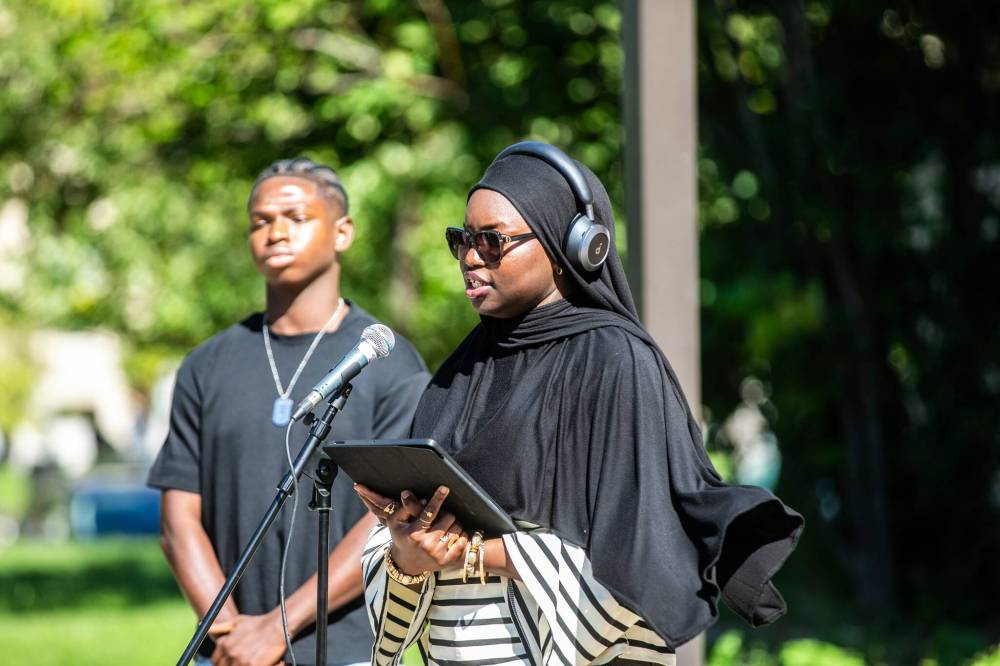
Roheemat Ajayi-Raheem says anti-immigrant rhetoric has real consequences.
“Universities are a crucial battleground for ideological debate in our society… Every attempt to cancel us only makes us more popular,” Tyrie said in an email Wednesday.
A U of M spokesperson confirmed posters that had been put up “without institutional approval” ahead of the start of the fall term have been removed.
“At this time, we do not intend to pursue a campus ban,” the spokesperson said in a statement, promising the school is committed to “fostering a respectful and inclusive environment.”
maggie.macintosh@freepress.mb.ca
Maggie Macintosh
Education reporter
Maggie Macintosh reports on education for the Free Press. Originally from Hamilton, Ont., she first reported for the Free Press in 2017. Read more about Maggie.
Funding for the Free Press education reporter comes from the Government of Canada through the Local Journalism Initiative.
Every piece of reporting Maggie produces is reviewed by an editing team before it is posted online or published in print — part of the Free Press‘s tradition, since 1872, of producing reliable independent journalism. Read more about Free Press’s history and mandate, and learn how our newsroom operates.
Our newsroom depends on a growing audience of readers to power our journalism. If you are not a paid reader, please consider becoming a subscriber.
Our newsroom depends on its audience of readers to power our journalism. Thank you for your support.
Maggie Macintosh
Education reporter
Maggie Macintosh reports on education for the Free Press. Originally from Hamilton, Ont., she first reported for the Free Press in 2017. Read more about Maggie.
Funding for the Free Press education reporter comes from the Government of Canada through the Local Journalism Initiative.
Every piece of reporting Maggie produces is reviewed by an editing team before it is posted online or published in print — part of the Free Press‘s tradition, since 1872, of producing reliable independent journalism. Read more about Free Press’s history and mandate, and learn how our newsroom operates.
Our newsroom depends on a growing audience of readers to power our journalism. If you are not a paid reader, please consider becoming a subscriber.
Our newsroom depends on its audience of readers to power our journalism. Thank you for your support.
Advertisement Advertise With Us
Advertisement Advertise With Us