

Chinese coast guard ships fire water cannons and block Philippine fisheries vessel in disputed sea
Advertisement
Read this article for free:
or
Already have an account? Log in here »
To continue reading, please subscribe:

Digital Subscription
One year of digital access for only $205*
- Enjoy unlimited reading on winnipegfreepress.com
- Read the E-Edition, our digital replica newspaper
- Access News Break, our award-winning app
- Play interactive puzzles
*First annual payment billed as $205.00 + GST for one year. This annual subscription will automatically renew at $233.00 + GST every 52 weeks (10% off the regular annual price of $259.35). Offer available to new and qualified returning subscribers only. Cancel any time.
To continue reading, please subscribe:
Add Free Press access to your Brandon Sun subscription for only an additional
$1 for the first 4 weeks*
- Enjoy unlimited reading on winnipegfreepress.com
- Read the E-Edition, our digital replica newspaper
- Access News Break, our award-winning app
- Play interactive puzzles
*Your next Brandon Sun subscription payment will increase by $1.00 and you will be charged $17.95 plus GST for four weeks. After four weeks, your payment will increase to $24.95 plus GST every four weeks.
Read unlimited articles for free today:
or
Already have an account? Log in here »
Hey there, time traveller!
This article was published 25/08/2024 (744 days ago), so information in it may no longer be current.
BEIJING (AP) — Chinese coast guard ships fired water cannons and blocked and rammed a Philippine fisheries vessel Sunday in the disputed South China Sea, where hostilities between the Asian neighbors have flared alarmingly at sea and spread into the air in recent weeks.
China and the Philippines blamed each other for the tense confrontations in the high seas off Sabina Shoal, which has become a new flashpoint, where both have deployed coast guard ships on suspicion that either one may take steps to seize the uninhabited atoll.
The Chinese coast guard said that it took action against a Philippine vessel, which entered waters in the vicinity of Sabina and ignored warnings, leading to a minor collision.
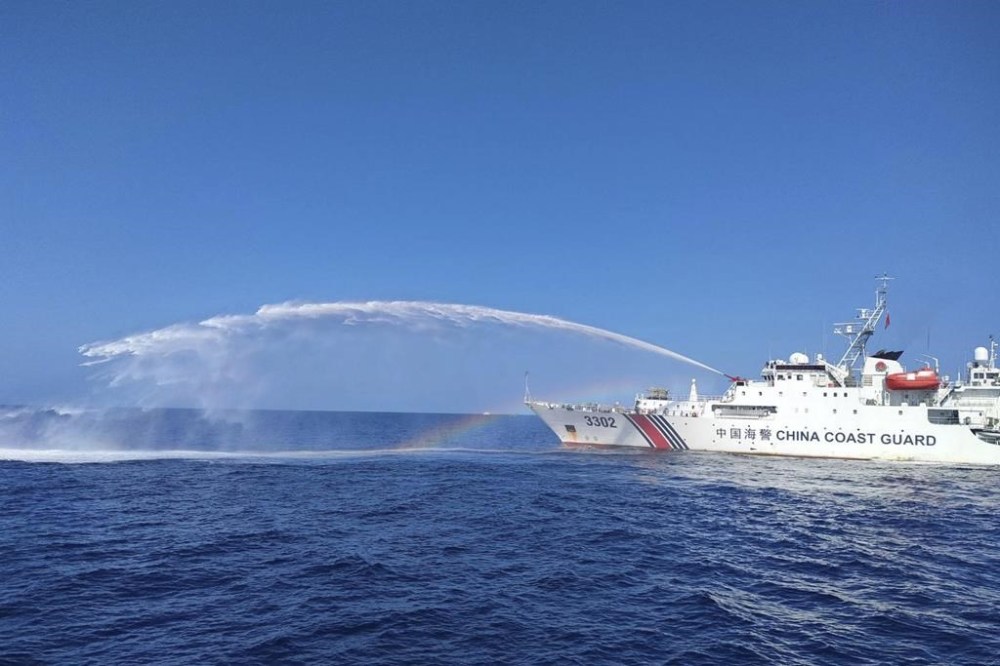
Chinese coast guard spokesperson Gan Yu said that the Philippine ship sailed toward the Chinese coast guard ship “unprofessionally” and “dangerously,” causing the two vessels to brush against each other. The Philippine vessel had journalists onboard to take pictures to “distort facts,” he said.
“The responsibility is totally on the Philippines’ side. We sternly warn that the Philippine side must immediately stop the infringement and provocation, otherwise it must bear all consequences,” Gan said without elaborating on the control measures that the Chinese side employed.
A Philippine government task force said that a vessel of the Bureau of Fisheries and Aquatic Resources, the BRP Datu Sanday, “encountered aggressive and dangerous maneuvers from eight People’s Republic of China maritime vessels” while cruising to Sabina, causing its engine to fail and hampering its effort to provide diesel, food and medical supplies to Filipino fishermen.
The Chinese coast guard ships, which were backed by a navy ship, “made close perilous maneuvers that resulted in ramming, blasted horns and deployed water cannons against the BFAR vessel,” endangering its crew, according to the Philippine task force, which oversees the territorial disputes.
“The Philippine government calls on the People’s Republic of China to halt these provocative actions that destabilize regional peace and security,” the task force said, adding that the Philippines would continue to assert its rights.
The United States expressed its support for the Philippines, its oldest treaty ally in Asia. U.S. Ambassador MaryKay Carlson said in a statement posted on X that China’s actions were “unsafe, unlawful and aggressive” and “disrupted a legal Philippine mission, endangering lives — the latest in multiple dangerous actions.”
China is rapidly expanding its military and has become increasingly assertive in pursuing its territorial claims in the South China Sea, which Beijing claims virtually in its entirety. The tensions have led to more frequent confrontations, primarily with the Philippines, though the longtime territorial disputes also involve other claimants, including Vietnam, Taiwan, Malaysia and Brunei.
The latest incident came days after Chinese and Philippine coast guard ships collided near the disputed Sabina Shoal, which Beijing calls Xianbin and Manila refers to as Escoda. Two Philippine vessels were damaged in Monday’s collision, but there were no reports of injuries.
Sabina Shoal lies about 140 kilometers (85 miles) west of the Philippine province of Palawan, in the internationally recognized exclusive economic zone of the Philippines.
Sabina is near the Second Thomas Shoal, another flashpoint where China has hampered the resupply of Philippine forces aboard a long-grounded navy ship. Last month, China and the Philippines reached an agreement to prevent increasingly hostile confrontations at the Second Thomas Shoal.