Cows obstruct Nigeria’s capital as climate change and development leave herders with nowhere to go
Advertisement
Read this article for free:
or
Already have an account? Log in here »
To continue reading, please subscribe:

Digital Subscription
One year of digital access for only $205*
- Enjoy unlimited reading on winnipegfreepress.com
- Read the E-Edition, our digital replica newspaper
- Access News Break, our award-winning app
- Play interactive puzzles
*First annual payment billed as $205.00 + GST for one year. This annual subscription will automatically renew at $233.00 + GST every 52 weeks (10% off the regular annual price of $259.35). Offer available to new and qualified returning subscribers only. Cancel any time.
To continue reading, please subscribe:
Add Free Press access to your Brandon Sun subscription for only an additional
$1 for the first 4 weeks*
- Enjoy unlimited reading on winnipegfreepress.com
- Read the E-Edition, our digital replica newspaper
- Access News Break, our award-winning app
- Play interactive puzzles
*Your next Brandon Sun subscription payment will increase by $1.00 and you will be charged $17.95 plus GST for four weeks. After four weeks, your payment will increase to $24.95 plus GST every four weeks.
Read unlimited articles for free today:
or
Already have an account? Log in here »
Hey there, time traveller!
This article was published 25/08/2024 (763 days ago), so information in it may no longer be current.
ABUJA, Nigeria (AP) — At an intersection seven miles from the presidential villa, frustrated drivers honk as a herd of cattle feeds on the grass beautifying the median strip and slowly marches across the road, their hooves clattering against the asphalt. For the teenage herder guiding them, Ismail Abubakar, it is just another day, and for most drivers stuck in the traffic, it’s a familiar scene unfolding in Nigeria’s capital Abuja.
Abubakar and his cattle’s presence in the city center is not out of choice but of necessity. His family are originally from Katsina State in northern Nigeria, where a changing climate turned grazing lands into barren desert. He moved to Idu — a rural, bushy and less developed part of Abuja — many years ago. But it now hosts housing estates, a vast railway complex and various industries.
“Our settlement at Idu was destroyed and the bush we used for grazing our cattle cut down to pave the way for new houses,” Abubakar said in a smattering of Pidgin English. It forced his family to settle on a hill in the city’s periphery and roam the main streets for pasture.
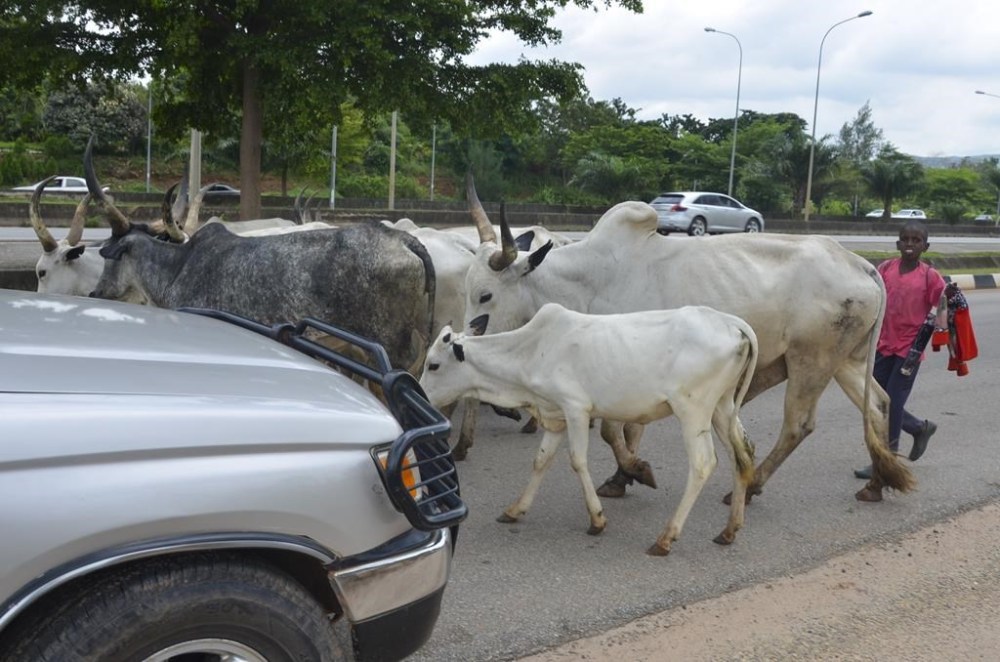
Fulani herders like Abubakar are traditionally nomadic and dominate West Africa’s cattle industry. They normally rely on wild countryside to graze their cattle with free pasture, but the pressures of modernization, the need for land for housing and crop farming and human-caused climate change are challenging their way of life. To keep cattle off of Abuja’s major roads and gardens, some suggest that herders need to start acquiring private land and operating like other businesses. But to do that, they’d need money and government incentives.
“It’s disheartening,” said Baba Ngelzarma, the president of Miyetti Allah Cattle Breeders Association of Nigeria, a Fulani pastoralists’ advocacy group. “Nigeria is presented as an unorganized people. The herders take the cattle wherever they can find green grasses and water at least for the cows to survive, not minding whether it is the city or somebody’s land.”
He added that part of the problem is the government’s failure to harness the potential of the livestock industry by offering incentives such as infrastructure like water sources and vet services at designated grazing reserves and providing subsidies.
For its part, the government has said it will address the issue, previously promising fenced-off reserves for cattle herders. President Bola Tinubu announced in July a new livestock development ministry, which Ngelzarma said would help revive the abandoned grazing reserves. No minister has been appointed.
Fewer places to go
Nigeria is home to over 20 million cows, mostly owned by Fulani herders. It has the fourth largest cattle population in Africa, and its dairy market is valued at $1.5 billion. But despite its size, almost 90% of local demand is met through imports, according to the US International Trade Administration. It’s a sign of the industry’s inefficiency, Ngelzarma said, as cows stressed from constant moving and poor diets can’t produce milk.
For Abuja, the city’s environment bears the consequence, and so do businesses when traffic grinds to a halt because cows are crossing busy roads. And in other parts of Nigeria, herders are often involved in violence with farmers over access to land, especially in central and southern Nigeria where the two industries overlap with religious and ethnic divisions.
There are four designated grazing reserves in rural areas surrounding Abuja, but they lack the needed infrastructure and have been encroached on by other farmers and illegal settlers, according to both Ngelzarma and Festus Adebayo, who’s executive secretary of the Housing Development Advocacy Network.
With those reserves not functioning, herders set up settlements anywhere and stay for as long as they can before legitimate owners claim it or the government builds on it.
Mohammed Abbas, 67, has repeatedly had to move locations over the years. Most of his current settlement in the city’s Life Camp neighborhood has been taken over by a newly constructed petrol station, and he is aware that the remaining land will soon be claimed by another owner.
As a smallholder pastoralist, he said he could not afford to buy land in Abuja for a permanent settlement and ranching. To afford one, “I have to sell all my cows and that means nothing will be left to put on the land,” he said in Hausa, sitting outside his hut.
Other pastoralists would rather resist.
“We are not going anywhere again,” said Hassan Mohammed, whose family now occupies a strip on the edge of a new estate near the Idu train station. Once a vast bush, the area has been swallowed by infrastructure and housing projects. Mohammed now also drives a lorry on the side because of the shrinking resources needed to keep cattle.
Despite repeated orders from the owners to vacate, Mohammed said that his family would stay put, using the dwindling strip as their home base while taking their cattle elsewhere each day for pasture. The landowners have repeatedly urged the government to resettle Mohammed’s family, but the government has yet to take action.
“Many don’t have anywhere to call home, so they just find somewhere to sleep at night with the cattle,” said Mohammed, in Hausa. “But for us, we are not leaving except there is a new place within Abuja.”
Making room for development and cows

Folawiyo Daniel, an Abuja-based real estate developer who has endured difficulties with pastoralists that affect his project development, said the issue is a failure of urban planning.
“Real estate development is not the problem,” he said, and the government should revive grazing reserves in the city for pastoralists.
Adebayo, from the Housing Development Advocacy Network, agreed, saying “it is time” for Abuja’s minister Nyesom Wike to take action and prove that “the problem of open grazing in the city of Abuja is solvable.”
Herders have to be moved to the place designated for their work or restricted to defined private property, he said.
The official responsible for animal husbandry in the agriculture ministry said they could not comment on a major policy issue without authorization, while the spokesperson for the ministry in charge of Abuja declined a request for an interview.
But in March, after the Belgian ambassador to Nigeria raised concerns to Wike about cattle roaming Abuja’s streets, he replied that efforts were in progress to stop the indiscriminate grazing without disclosing specific details.
Herders say they are not opposed to a restricted form of herding or practicing like a normal business that buys their own feedstock instead of using free pasture and water wherever they find them.

The problem, according to cattle association chief Ngelzarma, is that the government has neglected the sector and does not provide incentives as it does other businesses, giving the examples of irrigation systems for crop farmers and airports for private airline operators paid for by the government.
“The government should revive the gazetted grazing reserves fitted with the infrastructure for water and fodder production, training and veterinary services and generate jobs and revenues,” Ngelzarma said.
“Then, you can say stop roaming about for free pasture,” he said.
___
The Associated Press’ climate and environmental coverage receives financial support from multiple private foundations. AP is solely responsible for all content. Find AP’s standards for working with philanthropies, a list of supporters and funded coverage areas at AP.org.