Manitoba government faces more controversy over annual moose hunt numbers

Advertisement

Advertise with us

WINNIPEG - The Manitoba government is facing more controversy over Indigenous harvesting rights, as a northern First Nation has filed for a court injunction against moose-hunting licences in its area.

Read this article for free:


or

Already have an account? Log in here »

To continue reading, please subscribe:

Subscribe and receive a limited-edition Free Press branded hat or tote.

Digital Subscription

One year of digital access for only $205*

  • Enjoy unlimited reading on winnipegfreepress.com
  • Read the E-Edition, our digital replica newspaper
  • Access News Break, our award-winning app
  • Play interactive puzzles

*First annual payment billed as $205.00 + GST for one year. This annual subscription will automatically renew at $233.00 + GST every 52 weeks (10% off the regular annual price of $259.35). Offer available to new and qualified returning subscribers only. Cancel any time.

To continue reading, please subscribe:

Add Free Press access to your Brandon Sun subscription for only an additional

$1 for the first 4 weeks*

  • Enjoy unlimited reading on winnipegfreepress.com
  • Read the E-Edition, our digital replica newspaper
  • Access News Break, our award-winning app
  • Play interactive puzzles
Start now

*Your next Brandon Sun subscription payment will increase by $1.00 and you will be charged $17.95 plus GST for four weeks. After four weeks, your payment will increase to $24.95 plus GST every four weeks.

Hey there, time traveller!
This article was published 26/08/2024 (755 days ago), so information in it may no longer be current.

WINNIPEG – The Manitoba government is facing more controversy over Indigenous harvesting rights, as a northern First Nation has filed for a court injunction against moose-hunting licences in its area.

Pimicikamak Cree Nation says the moose population in its northern territory is in crisis, and its members have treaty rights to hunt.

Chief David Monias says the province should not be inviting licensed hunters — non-Indigenous people and hunters from other areas — to hunt in the region.
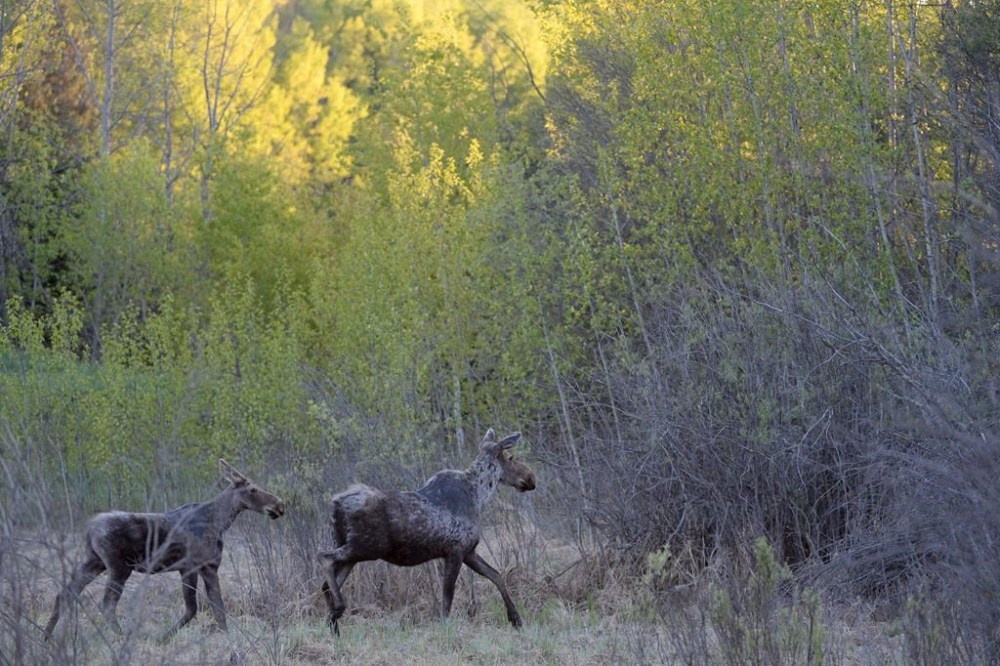
The Manitoba government is facing more controversy over Indigenous harvesting rights, as a northern First Nation has filed for a court injunction against moose-hunting licences in its area. Two moose walk into the woods along side of a road near Lac la Biche, Alta., Tuesday May 10, 2016. THE CANADIAN PRESS/Jonathan Hayward

The government announced last month it is cutting the number of fall moose-hunting licences in four northern regions, including Pimicikamak Cree Nation, by 75 per cent.

While Monias says the cut is not deep enough, the Manitoba Wildlife Federation — which represents licensed hunters — says the reduction is not justified.

The federation filed for a judicial review earlier this month, saying there is no firm data showing the moose population is in dire straits.

The NDP government would not comment directly on the court action, but said it is talking to all sides.

“We are building relationships with First Nations. We are listening to them,” Jamie Moses, minister of natural resources, said.

“And at the same time, we are listening to groups like the Manitoba Wildlife Federation and lodges and outfitters.”

Monias said Pimicikamak Cree Nation will ask a judge to cancel all licences issued by Manitoba to hunt moose in Pimicikamak territory this year.

“The Supreme Court of Canada says that we exercise our right to hunt to meet our food needs as a right of top priority over all other users where game and fish populations are limited,” he said in a news release.

This report by The Canadian Press was first published Aug. 26, 2024.

Report Error Submit a Tip

More Stories

Cabernet Sauvignon star of wine festival

Ben Sigurdson 5 minute read Preview

Cabernet Sauvignon star of wine festival

Ben Sigurdson 5 minute read Yesterday at 3:00 AM CDT

The Winnipeg Wine Festival will celebrate the king of red wine grapes next weekend — the theme of this year’s festival, which takes place Sept. 25 and 26 at the RBC Convention Centre, is Cabernet Sauvignon.

Cab Sauv, as it’s also known, is the world’s most widely planted wine grape of any colour, first coming to prominence in the 1800s in France’s Bordeaux region, where the grape is still popular. Rather than single-variety wines, Bordeaux reds tend to be blends, with those coming from the left bank of the Gironde estuary being Cabernet-dominant, while right-bank wines are Merlot-dominant, with Cabernet Sauvignon playing a supporting role. Cabernet and Merlot work well together and many other countries have followed suit in blending the two.

A team at University of California Davis put Cabernet Sauvignon through a DNA test in 1996 and discovered its parent grapes are Cabernet Franc and Sauvignon Blanc — it’s likely that at some point the two varieties, planted next to each other in some vineyard, crossed and mutated and became the grape we know today. (Someone growing grapes in the 19th century must have had an inkling of what was up, as the grape has been called Cabernet Sauvignon since long before the DNA test.)

Flavour-wise, most Cabernet Sauvignon wines are big and bold, with a core of deep dark berry flavours, some graphite and spice notes and relatively bright acidity. It’s a grape that is well-suited to barrel aging, with most examples seeing at least some time in wood.

Read
Yesterday at 3:00 AM CDT

Serious crash at West Kildonan intersection known for collisions

Nicole Buffie 3 minute read Preview

Serious crash at West Kildonan intersection known for collisions

Nicole Buffie 3 minute read 3:32 PM CDT

Residents in West Kildonan say an intersection that was the site of a serious car crash Sunday morning is notoriously dangerous.

Rob Lick heard a loud bang around 7 a.m. and rushed out of his home on Leila to see what the commotion was. He saw two crushed SUVs, a white and black one, in the intersection. Police vehicles arrived shortly after.

“It sounded like when (garbage trucks) drop a big dumpster,” he said. “I heard somebody crying or wailing, they were standing by the vehicle so I don’t know who exactly it was or if someone was injured.”

The sound of sirens followed shortly after when emergency crews came to the scene. The intersection was immediately blocked off.

Read
3:32 PM CDT

News briefs for Sunday, September 20, 2026

2 minute read Updated: 3:36 PM CDT

A collection of breaking news briefs filed on Sunday, September 20, 2026

Woman charged after Toronto Street shooting

3:18 PM

The Winnipeg Police Service Major Crimes Unit is continuing to investigate a shooting in the 600 block of Toronto Street that took place around 1 a.m. on Friday.

‘She was looking to destroy me’: convicted harasser faces new charges

Dean Pritchard 6 minute read Preview

‘She was looking to destroy me’: convicted harasser faces new charges

Dean Pritchard 6 minute read Thursday, Sep. 17, 2026

When Agnieszka Ciochon-Newton moved into the 55-plus apartment building on Stradbrook Avenue last year, she came across as “timid, soft-spoken and sensitive,” said building manager Tanya Owen.

Little did Owen know the meek-looking 58-year-old woman would soon turn her life and the lives of many of her tenants upside down and threaten her career and family.

“She was looking to destroy me for a simple tenant disagreement,” Owen said Thursday.

Court records show Ciochon-Newton was arrested earlier this month and charged with seven counts of criminal harassment, two counts of uttering threats and one count each of fraud, breaking and entering, attempting to obstruct justice, intimidation of a justice official, mischief and defamatory libel.

Read
Thursday, Sep. 17, 2026

Near-future U.S. the setting for surreal dual-world storyline

Reviewed by Morley Walker 4 minute read Preview

Near-future U.S. the setting for surreal dual-world storyline

Reviewed by Morley Walker 4 minute read Yesterday at 2:01 AM CDT

It’s not every day you encounter a seriously intended literary novel that attempts to dramatize a mind-bending physics theory like quantum entanglement.

But then the B.C.-born-and-raised Emily St. John Mandel is not your everyday Canadian literary writer.

In her late 40s, she has lived in the U.S. for her entire writing career. She is best known for her 2014 dystopian novel Station Eleven, about a Shakespearean acting troupe navigating a pandemic-ravaged America.

Her new outing, her seventh, Exit Party, shares DNA with detective and sci-fi genres more than with conventional literary fiction.

Read
Yesterday at 2:01 AM CDT

Grieving child builds backyard rocket ship

Harriet Zaidman 4 minute read Yesterday at 2:01 AM CDT

I Built a Rocket Ship (Kids Can Press, 32 pages, hardcover, $22) by Winnipegger Anna Lazowski is a tender story for children ages 4-8 about a little girl trying to make sense of her mother’s death. The child engages in conversation with her late mom, agreeing and disagreeing about things said as she carries objects (and of course, the cat) to the backyard. There, she is building a rocket ship she will pilot into the skies to find her mom again.

Jennica Lounsbury’s varied perspectives show the range of emotions the little girl experiences.

● ● ●

Northwoods Lullaby by Mary Casanova (University of Minnesota Press, 32 pages, hardover, $25) is a bedtime book for readers up to age eight, perfect to bring a busy, happy day to a close. Just like children who are listening to adults reading the book, all the animal babies are being tucked into their nests and burrows by loving parents: “Thump and scamper,/nimble clover./ Soon it’s time to rest. Baby loon/ nestles in/as Papa floats along.”