

Poland marks the 85th anniversary of Nazi Germany’s invasion at the start of World War II
Advertisement
Read this article for free:
or
Already have an account? Log in here »
To continue reading, please subscribe:
Monthly Digital Subscription
$0 for the first 4 weeks*
- Enjoy unlimited reading on winnipegfreepress.com
- Read the E-Edition, our digital replica newspaper
- Access News Break, our award-winning app
- Play interactive puzzles
*No charge for 4 weeks then price increases to the regular rate of $19.00 plus GST every four weeks. Offer available to new and qualified returning subscribers only. Cancel any time.
Monthly Digital Subscription
$4.75/week*
- Enjoy unlimited reading on winnipegfreepress.com
- Read the E-Edition, our digital replica newspaper
- Access News Break, our award-winning app
- Play interactive puzzles
*Billed as $19 plus GST every four weeks. Cancel any time.
To continue reading, please subscribe:
Add Free Press access to your Brandon Sun subscription for only an additional
$1 for the first 4 weeks*
*Your next subscription payment will increase by $1.00 and you will be charged $16.99 plus GST for four weeks. After four weeks, your payment will increase to $23.99 plus GST every four weeks.
Read unlimited articles for free today:
or
Already have an account? Log in here »
Hey there, time traveller!
This article was published 01/09/2024 (463 days ago), so information in it may no longer be current.
WARSAW, Poland (AP) — Poland’s leaders stressed the need for a strong defense in the face of war in neighboring Ukraine and redress as they led solemn ceremonies early Sunday to mark the 85th anniversary of German Nazi forces invading and bombing Polish territory at the start of World War II.
Sirens wailed and a memorial bell tolled as President Andrzej Duda and deputy ambassador of Germany, Robert Rohde, attended an observance in the town of Wielun, the first civilian target of German bombing in the small hours of Sept. 1, 1939. Some 1,200 people were killed in the attack which witnesses say began at 4:40 a.m.
“We can say that we have forgiven even though we remember, even though the pain is persisting and even though there are still tens of thousands of those who have been directly hurt by the Germans,” Duda said. He also called on Berlin to make amends.
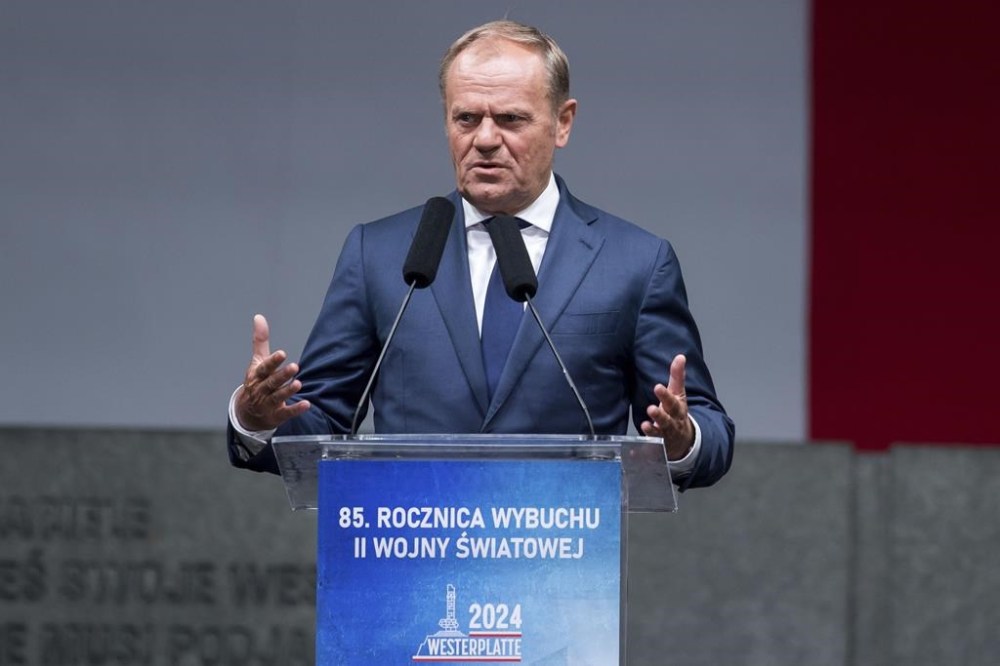
Meanwhile, at a monument on the Baltic Sea’s Westerplatte peninsula, where a military outpost was shelled by a German warship just minutes after Wielun was attacked, Prime Minister Donald Tusk and Defense Minister Wladyslaw Kosiniak-Kamysz laid wreaths and attended a memorial roll call for fallen soldiers. At the time, the outpost’s outnumbered troops fought for seven days before surrendering to the Germans, becoming a symbol of heroism and patriotism.
Tusk said war was present again in the region as the Russian invasion of Ukarine, which began in 2022, grinds on.
He said, in a clear reference to Germany, it wasn’t enough to speak about “reconciliation” or to “bend your head in a sense of guilt,” adding that the best sign of lessons learned from the past is “the readiness to organize the entire western world, Europe and NATO for the defense against aggression that we are witnessing today in the battlefields of Ukraine.”
“Today we will not say ‘Neven Again.’ Today we must say ‘Never Again Alone’,” the prime minister said.
Tusk also said Poland was building “the most modern army in Europe, one of the strongest in Europe” to actively contribute to the unity and strength of the NATO defense alliance and the European continent and “to defend our civilization” and “never again expose our homeland to any risks.”
German Foreign Minister Annalena Baerbock posted on X, saying she wished Poles and Germans become “completely normal” toward one another, adding it was the desire of former Polish foreign minister Władysław Bartoszewski who survived the German invasion.
She also wrote that it was their responsibility, “while bearing our past in mind,” to constantly work to keep their friendship alive.
In more than five years of World War II and the brutal German occupation, Poland lost 6 million citizens, or a sixth of its population, of which 3 million were Jewish. The country also suffered huge losses to its infrastructure, industry and agriculture.
Poland’s previous right-wing government demanded $1.3 trillion in damages from Germany. Tusk’s current Cabinet has toned the demand down to some form of compensation that could serve to strengthen the ties between the two neighbors. Germany insists the matter is closed as it had paid damages to the Moscow-led East Bloc after the war. Warsaw says it did not get any share of it.
Addressing attendees at the Wielun observance, the Polish president said: “Forgiveness and the admission of guilt is one thing, but compensation for the damage caused is another thing. And this issue has not been settled yet.”
__
Associated Press writer Geir Moulson in Berlin contributed to this report.