Just how rare is a rare-colored lobster? Scientists say answer could be under the shell

Advertisement

Advertise with us

BIDDEFORD, Maine (AP) — Orange, blue, calico, two-toned and ... cotton-candy colored?

Read this article for free:


or

Already have an account? Log in here »

To continue reading, please subscribe:

Subscribe and receive a limited-edition Free Press branded hat or tote.

Digital Subscription

One year of digital access for only $205*

  • Enjoy unlimited reading on winnipegfreepress.com
  • Read the E-Edition, our digital replica newspaper
  • Access News Break, our award-winning app
  • Play interactive puzzles

*First annual payment billed as $205.00 + GST for one year. This annual subscription will automatically renew at $233.00 + GST every 52 weeks (10% off the regular annual price of $259.35). Offer available to new and qualified returning subscribers only. Cancel any time.

To continue reading, please subscribe:

Add Free Press access to your Brandon Sun subscription for only an additional

$1 for the first 4 weeks*

  • Enjoy unlimited reading on winnipegfreepress.com
  • Read the E-Edition, our digital replica newspaper
  • Access News Break, our award-winning app
  • Play interactive puzzles
Start now

*Your next Brandon Sun subscription payment will increase by $1.00 and you will be charged $17.95 plus GST for four weeks. After four weeks, your payment will increase to $24.95 plus GST every four weeks.

Hey there, time traveller!
This article was published 06/09/2024 (701 days ago), so information in it may no longer be current.

BIDDEFORD, Maine (AP) — Orange, blue, calico, two-toned and … cotton-candy colored?

Those are all the hues of lobsters that have showed up in fishers’ traps, supermarket seafood tanks and scientists’ laboratories over the last year. The funky-colored crustaceans inspire headlines that trumpet their rarity, with particularly uncommon baby blue-tinted critters described by some as “cotton-candy colored” often estimated at 1 in 100 million.

A recent wave of these curious colored lobsters in Maine, New York, Colorado and beyond has scientists asking just how atypical the discolored arthropods really are. As is often the case in science, it’s complicated.
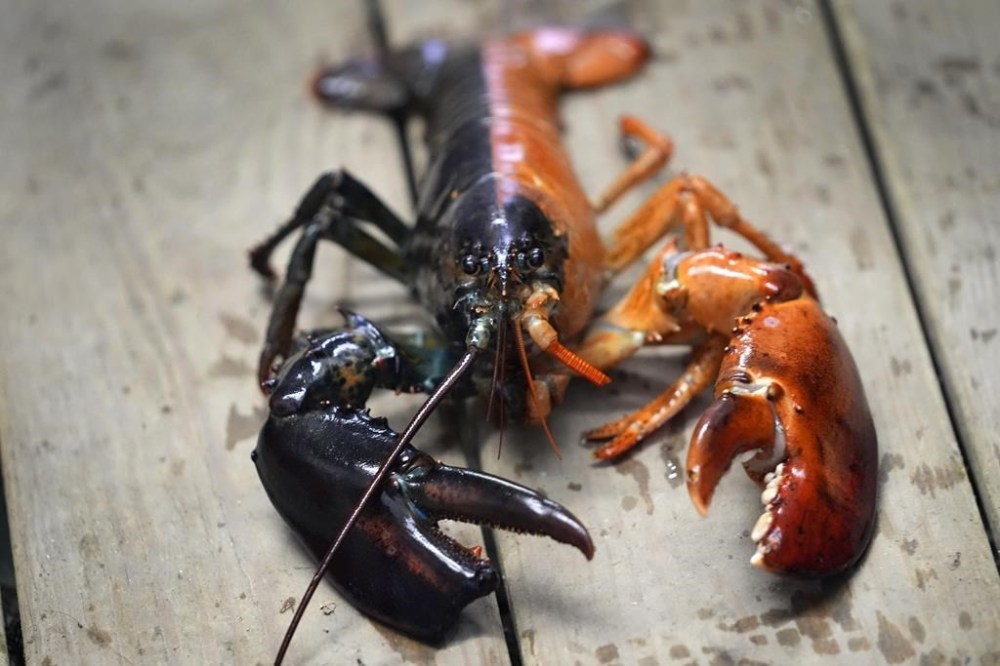
A two-toned lobster is seen in a marine sciences lab at the University of New England, Thursday, Sept. 5, 2024, in Biddeford, Maine. The rare color scheme is the result of two eggs fusing together to create a one-in-50 million lobster.(AP Photo/Robert F. Bukaty)

Lobsters’ color can vary due to genetic and dietary differences, and estimates about how rare certain colors are should be taken with a grain of salt, said Andrew Goode, lead administrative scientist for the American Lobster Settlement Index at the University of Maine. There is also no definitive source on the occurrence of lobster coloration abnormalities, scientists said.

“Anecdotally, they don’t taste any different either,” Goode said.

In the wild, lobsters typically have a mottled brown appearance, and they turn an orange-red color after they are boiled for eating. Lobsters can have color abnormalities due to mutation of genes that affect the proteins that bind to their shell pigments, Goode said.

The best available estimates about lobster coloration abnormalities are based on data from fisheries sources, said marine sciences professor Markus Frederich of the University of New England in Maine. However, he said, “no one really tracks them.”

Frederich and other scientists said that commonly cited estimates such as 1 in 1 million for blue lobsters and 1 in 30 million for orange lobsters should not be treated as rock-solid figures. However, he and his students are working to change that.

Frederich is working on noninvasive ways to extract genetic samples from lobsters to try to better understand the molecular basis for rare shell coloration. Frederich maintains a collection of strange-colored lobsters at the university’s labs and has been documenting the progress of the offspring of an orange lobster named Peaches who is housed at the university.

Peaches had thousands of offspring this year, which is typical for lobsters. About half were orange, which is not, Frederich said. Of the baby lobsters that survived, a slight majority were regular colored ones, Frederich said.

Studying the DNA of atypically colored lobsters will give scientists a better understanding of their underlying genetics, Frederich said.

“Lobsters are those iconic animals here in Maine, and I find them beautiful. Especially when you see those rare ones, which are just looking spectacular. And then the scientist in me simply says I want to know how that works. What’s the mechanism?” Frederich said.
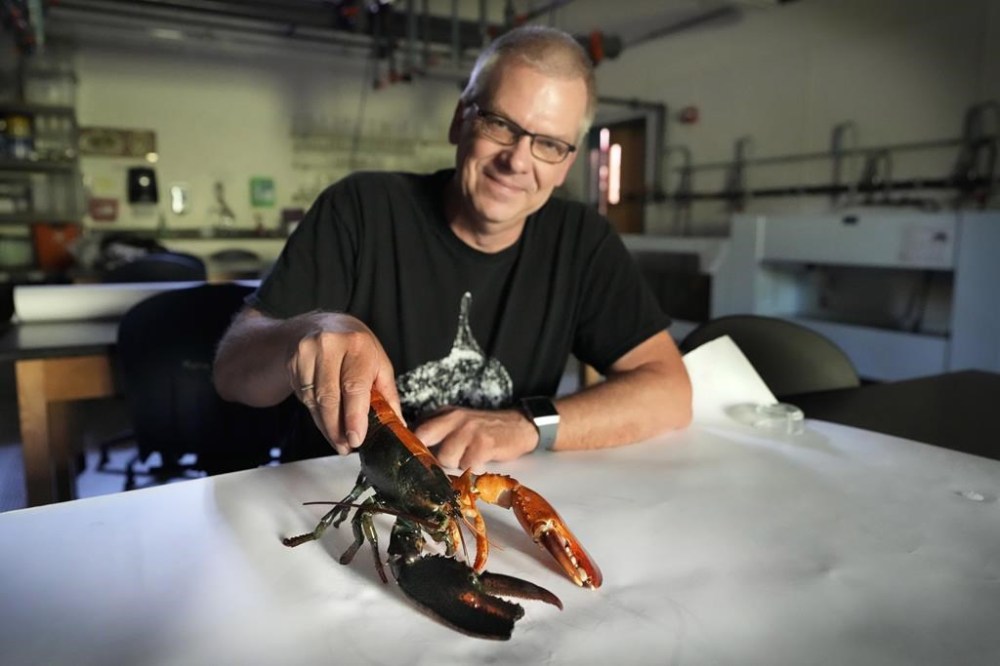
Marine sciences professor Markus Frederich holds Tamarind, a two-toned lobster he is studying at the University of New England, Thursday, Sept. 5, 2024, in Biddeford, Maine. (AP Photo/Robert F. Bukaty)

He does eat lobster but “never any of those colorful ones,” he said.

One of Frederich’s lobsters, Tamarind, is the typical color on one side and orange on the other. That is because two lobster eggs fused and grew as one animal, Frederich said. He said that’s thought to be as rare as 1 in 50 million.

Rare lobsters have been in the news lately, with an orange lobster turning up in a Long Island, New York, Stop & Shop last month, and another appearing in a shipment being delivered to a Red Lobster in Colorado in July.

The odd-looking lobsters will likely continue to come to shore because of the size of the U.S. lobster fishery, said Richard Wahle, a longtime University of Maine lobster researcher who is now retired. U.S. fishers have brought more than 90 million pounds (40,820 metric tons) of lobster to the docks in every year since 2009 after only previously reaching that volume twice, according to federal records that go back to 1950.

“In an annual catch consisting of hundreds of millions of lobster, it shouldn’t be surprising that we see a few of the weird ones every year, even if they are 1 in a million or 1 in 30 million,” Wahle said.

Report Error Submit a Tip

More Stories

Just how rare is a rare-colored lobster? Scientists say answer could be under the shell

Patrick Whittle, The Associated Press 4 minute read Preview

Just how rare is a rare-colored lobster? Scientists say answer could be under the shell

Patrick Whittle, The Associated Press 4 minute read Saturday, Sep. 7, 2024

BIDDEFORD, Maine (AP) — Orange, blue, calico, two-toned and ... cotton-candy colored?

Those are all the hues of lobsters that have showed up in fishers' traps, supermarket seafood tanks and scientists' laboratories over the last year. The funky-colored crustaceans inspire headlines that trumpet their rarity, with particularly uncommon baby blue-tinted critters described by some as "cotton-candy colored" often estimated at 1 in 100 million.

A recent wave of these curious colored lobsters in Maine, New York, Colorado and beyond has scientists asking just how atypical the discolored arthropods really are. As is often the case in science, it's complicated.

Lobsters' color can vary due to genetic and dietary differences, and estimates about how rare certain colors are should be taken with a grain of salt, said Andrew Goode, lead administrative scientist for the American Lobster Settlement Index at the University of Maine. There is also no definitive source on the occurrence of lobster coloration abnormalities, scientists said.

Read
Saturday, Sep. 7, 2024

Family hopes police alert will bring missing woman home

Morgan Modjeski 3 minute read Preview

Family hopes police alert will bring missing woman home

Morgan Modjeski 3 minute read Thursday, Aug. 6, 2026

The family of Ashley Arason has made a desperate plea for her to come home.

The 41-year-old last had contact with her family on April 6, 2019, which was her 34th birthday.

“I’ve got a place for her,” said her older sister, Pamela Arason, through tears on Thursday. “She has a place to go, a home to come to.”

On Thursday, Winnipeg Police Service renewed the call for help from the public to solve the missing person case.

Read
Thursday, Aug. 6, 2026

Watching while we work

Tory McNally 7 minute read Preview

Watching while we work

Tory McNally 7 minute read 2:01 AM CDT

For many employees, the idea that their employer might be tracking how long they spend at their keyboard, how often they move their mouse, or whether they are actively working throughout the day feels unsettling. For many employers, however, workplace surveillance is increasingly viewed as another management tool, particularly as hybrid and remote work become more common. The recent news that TD plans to monitor certain employees’ activity during the workday has reignited a conversation that has been quietly growing for several years: where is the line between legitimate oversight and excessive monitoring?

The reality is that workplace surveillance is nothing new. Employers have long monitored attendance, reviewed security camera footage, tracked company vehicles using GPS, audited expense reports, and reviewed internet usage on company-owned devices. What has changed is the sophistication of the technology. Today’s software can record login times, monitor application usage, track keystrokes, capture screenshots, analyze email activity, and even generate reports ranking employees based on their perceived productivity.

This naturally raises an important question. Does increased surveillance actually make people work harder?

The answer is not nearly as straightforward as many organizations hope.

Read
2:01 AM CDT

Mayoral race grows to 11 candidates

Joyanne Pursaga 2 minute read Yesterday at 3:21 PM CDT

Realtor Brad Gross is the 11th candidate to register for the race to become Winnipeg’s next mayor.

Gross, 60, said improving public safety and renewing roads will be key goals in his campaign.

“I just don’t like the direction the city’s going and it doesn’t seem to be getting better…. A lot of seniors, a lot of people are worried about crime. (And) the streets are just horrible again,” he said.

He said the city should not invest in bike lanes until Winnipeg’s roads are in better condition. He also hopes to provide free bus fares for seniors and gradually add security cameras at all bus shacks with known safety concerns, if elected.

The view from here: Phyllis Green. Boob Tree, 1975

2 minute read Preview

The view from here: Phyllis Green. Boob Tree, 1975

2 minute read 2:01 AM CDT

Staycation: The Art of Being Here feautres more than 100 Manitoba-related artworks from the Winnipeg Art Gallery-Qaumajuq collection, spanning the past 50 years. These pieces reveal how the places around us are layered with memory, story and lived experience. Over the coming weeks, the Free Press will spotlight works from this eclectic exhibition, each one offering a new way of seeing home. Experience it in person and enjoy some staycation time at the gallery, on view until December.

Phyllis Green. Boob Tree, 1975

(Yarn, wood. Collection of the Winnipeg Art Gallery; Acquired with funds from the Estate of Mr. and Mrs. Bernard Naylor, funds administered by The Winnipeg Foundation, 2014-128. Photo: Ernest Mayer.)

The year 1975 was designated International Women’s Year by the United Nations, and in celebration, the WAG staged the show Images of Women, which explored how women had historically been depicted, an impressive selection but by mostly male artists. Amid pushback from the community, Sharron Zenith Corne and Marian Yeo organized a second exhibition, Woman as Viewer, which challenged those portrayals by only featuring works by women. It was called the first Canadian exhibition of feminist art. American artist Phyllis Green’s Boob Tree, a four-foot-tall crochet sculpture of a cluster of breasts, adorned the exhibit posters, which were so popular they were snatched by passersby! The sculpture is playful and unsettling, re-appropriating the objectification of women’s bodies.

Read
2:01 AM CDT

Puzzles Palace

1 minute read Monday, Jul. 27, 2026

To solve our puzzles, please subscribe with this special offer: |