One jellyfish arrived in B.C. decades ago. Thousands of clones spread to 34 waterways

Advertisement

Advertise with us

VANCOUVER - Some time more than 30 years ago, a single Chinese peach blossom jellyfish made its way into a lake in British Columbia.

Read this article for free:


By clicking the button above, an account will be created and you will begin to receive some of our recommended newsletters. You may opt out of any newsletter by visiting your Email and Communication Preferences page or by clicking "unsubscribe" at the bottom of any email.

or

Already have an account? Log in here »

To continue reading, please subscribe:

Digital Subscription

One year of digital access for only $1.44 a week*

  • Enjoy unlimited reading on winnipegfreepress.com
  • Read the E-Edition, our digital replica newspaper
  • Access News Break, our award-winning app
  • Play interactive puzzles

*Billed as $5.77 plus GST every four weeks. After 52 weeks, price increases to the regular rate of $19.95 plus GST every four weeks. Offer available to new and qualified returning subscribers only. Cancel any time.

To continue reading, please subscribe:

Add Free Press access to your Brandon Sun subscription for only an additional

$1 for the first 4 weeks*

  • Enjoy unlimited reading on winnipegfreepress.com
  • Read the E-Edition, our digital replica newspaper
  • Access News Break, our award-winning app
  • Play interactive puzzles
Start now

*Your next Brandon Sun subscription payment will increase by $1.00 and you will be charged $17.95 plus GST for four weeks. After four weeks, your payment will increase to $24.95 plus GST every four weeks.

Hey there, time traveller!
This article was published 11/09/2024 (774 days ago), so information in it may no longer be current.

VANCOUVER – Some time more than 30 years ago, a single Chinese peach blossom jellyfish made its way into a lake in British Columbia.

Exactly how it arrived is not clear, researchers say — perhaps it was in aquarium water — but decades later, thousands of genetic clones of the same organism have been spotted in 34 waterways around the province.

Scientists are now trying to understand the impact of the gelatinous invaders, that are about the size of a quarter.
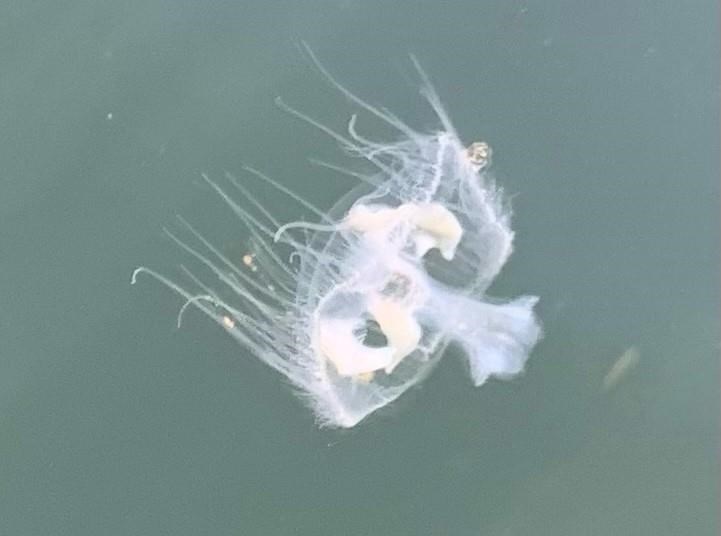
A peach blossom jellyfish is shown in Hotel Lake, B.C. in this September 2022 handout photo. Some time more than 30 years ago, a single Chinese peach blossom jellyfish made its way into a lake in British Columbia. THE CANADIAN PRESS/HO, Tarren Mckay *MANDATORY CREDIT*

A peach blossom jellyfish is shown in Hotel Lake, B.C. in this September 2022 handout photo. Some time more than 30 years ago, a single Chinese peach blossom jellyfish made its way into a lake in British Columbia. THE CANADIAN PRESS/HO, Tarren Mckay *MANDATORY CREDIT*

Evgeny Pakhomov, a University of British Columbia biological oceanographer studying the phenomenon, said in an interview that the actual numbers of the jellyfish were unknown, but sightings could increase rapidly in coming years due to a warming climate.

“This species actually thrives in the water which is more than 27 degrees Celsius. It’s really likes that kind of warm water,” he said, noting they only become observable around 25 degrees Celsius.

Pakhomov said the risk was a huge explosion in their numbers — called a jelly bloom — with the potential to disrupt ecosystems and fisheries, as well as to make for unpleasant swimming.

Their spread could threaten indigenous species by outcompeting them, he said, consuming the plankton that juvenile salmon or trout feed upon.

Peach blossom jellyfish originate in rivers and freshwater systems in China but have been turning up in other regions for centuries. Pakhomov said the earliest documented case occurred in France during the building of the Palace of Versailles in the 17th century, when waterlilies were imported from China for the palace ponds.

“A couple of years later, they started noticing jellyfish in those ponds in France, and then it was spreading all over the world,” he said. “It’s now essentially in every continent except Antarctica.”

Pakhomov, who also serves as a University of British Columbia professor in the Department of Earth, Ocean and Atmospheric Sciences, said the phenomenon was largely unstudied in British Columbia until about five years ago when his team decided to start analyzing the creatures.

Their research, published last month in the Canadian Journal of Zoology, says peach blossom jellyfish have been reported in B.C. since 1990, mainly in the Lower Mainland, on Vancouver Island, around the Sunshine Coast and more recently, as far inland as Osoyoos Lake.

As of 2023, there had been 85 sightings, meaning they were spotted in a separate location or year, although each sighting could represent one or thousands of jellyfish.

After analyzing their genetic makeup, Pakhomov said his team made an interesting discovery.

“They look like clones although we collected them from different places, so obviously, at some point, there was one introduction,” he said.

He said researchers speculate that the fateful introduction was likely due to aquarium trade with another nation, either China or another country where the species had already been introduced.

Pakhomov said there are two ways that the jellyfish can reproduce: asexually and sexually. Because the genetic material of the jellyfish they have studied shows they are all male clones, he said researchers determined they were all products of asexual reproduction.

The lack of females means the males can’t complete sexual reproduction.

“I don’t know whether or not the conditions are such that females do not develop or only male polyps (a stage of the jellyfish life cycle) are being introduced into the systems and then kind of spread widely,” Pakhomov said, raising the possibility that certain water temperatures may only allow for one sex to develop.

Pakhomov hypothesized that the jellyfish were being spread to different bodies of water by boating practices or by birds. He said if researchers were able to it figure out how, they might be able to predict when and where they appear next.

He said his team’s goal was to properly map the distribution of the jellyfish in B.C. and better quantify their impact on freshwater ecosystems and fish populations.

He stressed the importance of so-called citizen science, where people collect data and report sightings. If more people knew to report sightings of the jellyfish, “we would be able to map distribution of the species much better.”

This report by The Canadian Press was first published Sept. 11, 2024.
Report Error Submit a Tip

More Stories

Pedestrian dies after being struck by truck

1 minute read Yesterday at 12:24 PM CDT

A man in his 60s has died after he was struck by a pickup truck at a Main Street crosswalk Friday evening.

Police officers arrived at Main and Jarvis Avenue at 7:45 p.m. Investigators believe the man was crossing Main when he was hit by the truck,  the Winnipeg Police Service said in a news release Saturday.

The man was taken to hospital and later died.

The driver remained at the scene, police said.

Opening of Portage and Main shows even seemingly insurmountable impasses can be overcome

Jason Syvixay 10 minute read Preview

Opening of Portage and Main shows even seemingly insurmountable impasses can be overcome

Jason Syvixay 10 minute read Yesterday at 2:00 AM CDT

There are places in a city that become more than places. Portage and Main is one of them. For generations of Winnipeggers, the intersection has represented downtown, traffic, development and civic identity. Its reopening to pedestrians in 2025, after 46 years of closure, was about more than crossing a street. It was a reminder that decisions made by one generation can shape the choices available to another — and that even seemingly permanent decisions can be reconsidered.

I have spent much of my professional life thinking about Winnipeg as a planner, working in public, private and non-profit settings. My PhD research gave me an opportunity to examine Portage and Main differently: not simply as a debate about cars and pedestrians, but as a window into how power operates in a city. I reviewed 569 archival documents spanning the 1960s to the present, interviewed 48 planners with experience in Winnipeg, and mapped the relationships between planners, politicians, developers, engineers, residents, businesses and advocacy groups.

What emerged was a story about how planning decisions become embedded in a city’s institutions, agreements, infrastructure, professional practices and political expectations — shaping not only what gets built, but who gets to influence what gets built.

The closure of Portage and Main in 1979 did not remain a decision confined to a particular political moment. Over time, it was reinforced by development agreements, physical infrastructure, property relationships, traffic-engineering practices, administrative routines, and public narratives about mobility and downtown revitalization. The people who made many of those original decisions eventually left office. The arrangements they created remained. Later planners inherited them.

Read
Yesterday at 2:00 AM CDT

Dustin Byfuglien gets warm welcome at alumni game

Ken Wiebe 9 minute read Preview

Dustin Byfuglien gets warm welcome at alumni game

Ken Wiebe 9 minute read Yesterday at 1:56 PM CDT

To say that Dustin Byfuglien wasn’t a fan of the spotlight is an understatement of epic proportions.

The guy with the personality that was larger than life preferred to keep that side of him mostly contained behind the hallowed halls of the Winnipeg Jets locker room.

Since he unexpectedly stepped away from the game in the fall of 2019, Byfuglien has limited his rare interviews to discussions about fishing, happily leaving the NHL game in his rearview mirror.

But on Saturday morning, there was Byfuglien standing in the newly-renovated Jets’ dressing room, holding court with a group of reporters hanging on his every word prior to the alumni game that was part of the 2026 Heritage Classic.

Read
Yesterday at 1:56 PM CDT

First Crumbl cookie shop opens in Winnipeg

Gabrielle Piché 3 minute read Preview

First Crumbl cookie shop opens in Winnipeg

Gabrielle Piché 3 minute read Friday, Oct. 23, 2026

The early birds got their cookies.

Klaudia and Jayson Ballantyne were the first in line for the grand opening of Winnipeg’s first Crumbl location at 1570 Regent Ave. West, arriving at 2 a.m. Friday — six hours before the cookie chain was set to open.

The brother and sister brought their lawn chairs and blankets and hunkered down.

Roughly 90 minutes later, by their count, the next customers arrived.

Read
Friday, Oct. 23, 2026

Echoes of Idle No More as Carney set to meet with First Nations

Niigaan Sinclair 5 minute read Preview

Echoes of Idle No More as Carney set to meet with First Nations

Niigaan Sinclair 5 minute read 10:29 AM CDT

The prime minister, premiers and First Nations leaders will meet in Ottawa Monday to discuss a host of issues, including Indigenous involvement in energy and resource development projects.

Read
10:29 AM CDT

New Jet looking forward to ‘special’ debut

Ken Wiebe 7 minute read Preview

New Jet looking forward to ‘special’ debut

Ken Wiebe 7 minute read Yesterday at 10:38 PM CDT

Dawson Mercer is doing his best to get acclimated as quickly as possible.

After spending his first five NHL seasons and change with the New Jersey Devils, Mercer was informed on Friday morning that he was on his way to the Winnipeg Jets as part of a blockbuster deal for goalie Connor Hellebuyck.

That led to a mad scramble, as Mercer loaded up a suitcase with his belongings, jumped on a private jet with goalie Nico Daws and landed in the Manitoba capital on Friday night.

“Pretty busy and hectic. Pretty much, I was at the rink in Jersey, and then got the news,” said Mercer, who was the 18th overall pick in the 2020 NHL Draft. “Then, you go home, pack everything up, get on the jet, and then come here and come into a big game here at this classic. It’s pretty special, though. I’d rather do it this way than any other.”

Read
Yesterday at 10:38 PM CDT