Scientists detect longest pair of jets streaming from a supermassive black hole
Advertisement
Read this article for free:
or
Already have an account? Log in here »
To continue reading, please subscribe:

Digital Subscription
One year of digital access for only $205*
- Enjoy unlimited reading on winnipegfreepress.com
- Read the E-Edition, our digital replica newspaper
- Access News Break, our award-winning app
- Play interactive puzzles
*First annual payment billed as $205.00 + GST for one year. This annual subscription will automatically renew at $233.00 + GST every 52 weeks (10% off the regular annual price of $259.35). Offer available to new and qualified returning subscribers only. Cancel any time.
To continue reading, please subscribe:
Add Free Press access to your Brandon Sun subscription for only an additional
$1 for the first 4 weeks*
- Enjoy unlimited reading on winnipegfreepress.com
- Read the E-Edition, our digital replica newspaper
- Access News Break, our award-winning app
- Play interactive puzzles
*Your next Brandon Sun subscription payment will increase by $1.00 and you will be charged $17.95 plus GST for four weeks. After four weeks, your payment will increase to $24.95 plus GST every four weeks.
Read unlimited articles for free today:
or
Already have an account? Log in here »
Hey there, time traveller!
This article was published 18/09/2024 (713 days ago), so information in it may no longer be current.
NEW YORK (AP) — Scientists have discovered the longest pair of jets streaming from a black hole in a distant galaxy.
The jets shooting hot plasma are the largest ever spotted – about as long as 140 Milky Way galaxies lined up end-to-end.
“This one has managed to reach a size that’s so big,” said Eileen Meyer, who studies black holes at University of Maryland, Baltimore County and who was not involved in the study.
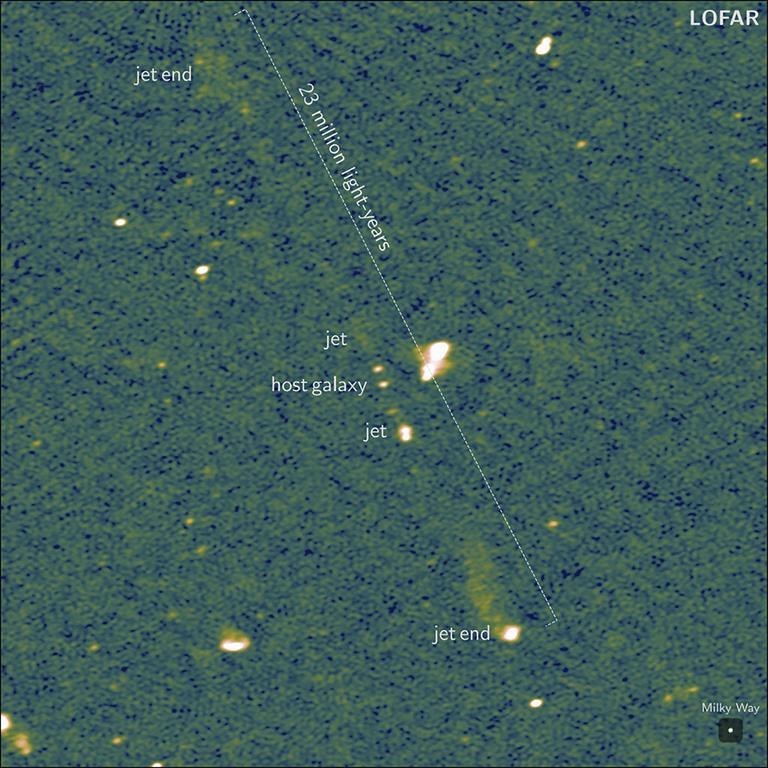
The discovery, made using images from a European radio telescope, was reported Wednesday in the journal Nature.
Black holes eat most space debris that falls their way. Sometimes, heated-up plasma makes a narrow escape by spewing out in thin, high-energy jets.
The jets can break apart soon after their creation, jostled by space turbulence or starved in the absence of new matter. But jets from supermassive black holes can become supersized.
The latest combined jets from a faraway supermassive black hole are around 23 million light-years long. That’s about 7 million light-years longer than the previous recordholder. A light-year is 5.8 trillion miles.
Study co-author Martijn Oei said researchers weren’t expecting to find long black hole jets so early in the universe’s history. The jets date back to when the universe was less than half its current age.
Studying the jets could reveal whether they had an influence on how the early universe came to be, said Oei with the California Institute of Technology.
___
The Associated Press Health and Science Department receives support from the Howard Hughes Medical Institute’s Science and Educational Media Group. The AP is solely responsible for all content.