The exploding device attacks dealt a major but not crippling blow to Hezbollah, analysts say
Advertisement
Read this article for free:
or
Already have an account? Log in here »
To continue reading, please subscribe:

Digital Subscription
One year of digital access for only $205*
- Enjoy unlimited reading on winnipegfreepress.com
- Read the E-Edition, our digital replica newspaper
- Access News Break, our award-winning app
- Play interactive puzzles
*First annual payment billed as $205.00 + GST for one year. This annual subscription will automatically renew at $233.00 + GST every 52 weeks (10% off the regular annual price of $259.35). Offer available to new and qualified returning subscribers only. Cancel any time.
To continue reading, please subscribe:
Add Free Press access to your Brandon Sun subscription for only an additional
$1 for the first 4 weeks*
- Enjoy unlimited reading on winnipegfreepress.com
- Read the E-Edition, our digital replica newspaper
- Access News Break, our award-winning app
- Play interactive puzzles
*Your next Brandon Sun subscription payment will increase by $1.00 and you will be charged $17.95 plus GST for four weeks. After four weeks, your payment will increase to $24.95 plus GST every four weeks.
Read unlimited articles for free today:
or
Already have an account? Log in here »
Hey there, time traveller!
This article was published 19/09/2024 (686 days ago), so information in it may no longer be current.
BEIRUT (AP) — The waves of remotely triggered explosions that hit pagers and walkie-talkies carried by Hezbollah members in grocery stores, on streets and at a funeral procession this week made for an eerie and shocking spectacle.
Analysts said Hezbollah will be able to regroup militarily and find communications workarounds after the attack, but the psychological effects will likely run deep.
The explosions — widely blamed on Israel, which has neither confirmed nor denied involvement — killed at least 37 people, including two children, wounded more than 3,000 and deeply unsettled even Lebanese who have no Hezbollah affiliation.
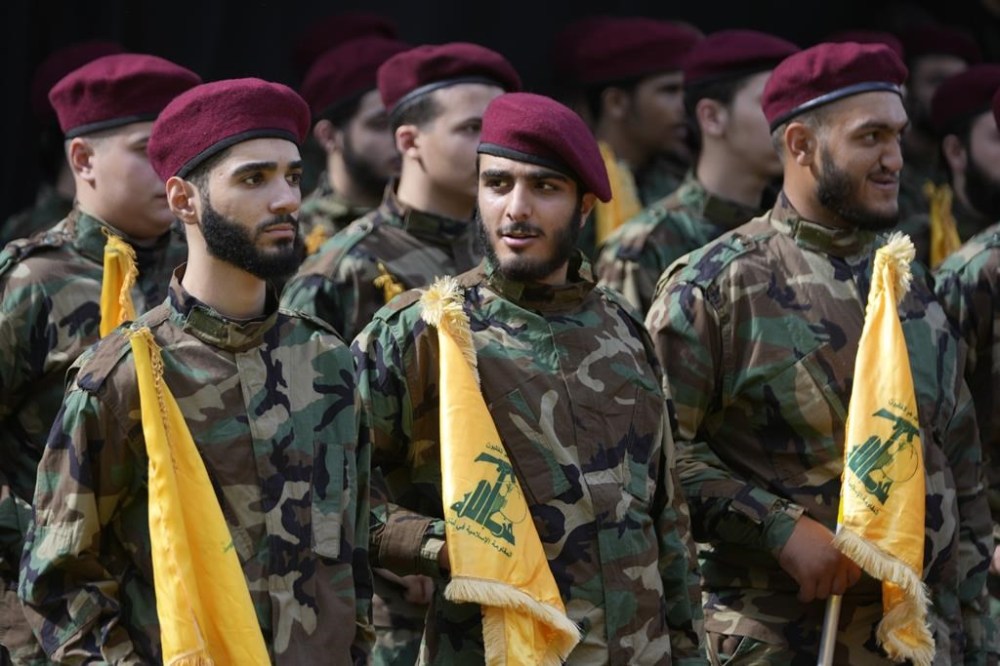
The detonating devices hit workers in Hezbollah’s civilian institutions, including its health care and media operations, as well as fighters, dealing a blow to the militant group’s operations beyond the battlefield. It is not clear how many civilians with no link to Hezbollah were injured.
The attacks also exposed the weaknesses in the low-tech communications system the group had turned to in an attempt to avoid Israeli surveillance of cellphones.
Retired Lebanese army Gen. Elias Hanna described the attacks as the “Pearl Harbor or 9/11 of Hezbollah.”
Mohanad Hage Ali, a senior fellow at the Carnegie Middle East Center think tank who researches Hezbollah, said that because the blasts hit people across the group’s institutions, the attack was “like a sword in the guts of the organization.” Hundreds of people were severely wounded, including many who lost eyes or hands.
“It will require time to heal and replace those who were targeted,” he said.
But Hage Ali and other analysts agreed that the loss of manpower is not a crippling blow. Hezbollah leader Hassan Nasrallah has said the group’s fighting force numbers more than 100,000, meaning that the attack — as dramatic as it was — would have put only a small percentage of its militants out of commission even if all those wounded and killed were fighters.
Qassim Qassir, a Lebanese analyst close to Hezbollah, said the detonating devices actually struck mostly civilian workers within the group and not military or security officials, which has allowed it to contain the impacts on its war effort.
Hezbollah, which is Lebanon’s strongest armed force, has exchanged fire with Israel’s military almost daily since Oct. 8, the day after a deadly Hamas-led assault in southern Israel triggered a massive Israeli counteroffensive and the ongoing war in Gaza.
Since then, hundreds have been killed in strikes in Lebanon and dozens in Israel, while tens of thousands on each side of the border have been displaced. Hezbollah said its strikes are in support of its ally, Hamas, and that it will halt its attacks if a cease-fire is implemented in Gaza.
Speaking Thursday, Nasrallah acknowledged that the pager and walkie-talkie attacks represented a “severe blow,” but he vowed that the group would emerge stronger than before.
Hezbollah continued to launch rockets over the border Wednesday and Thursday after the pager and walkie-talkie attacks, including one that killed two Israeli soldiers.
The impacts on Hezbollah’s communications network are likely to be more disruptive than the human loss.
“Telecommunications is the nerve of military operations and communications,” said retired Lebanese army Gen. Naji Malaeb, an expert on security affairs. A delay in communication could spell disaster, he said.
In February, Nasrallah warned members not to carry cellphones, which he said could be used to track them and monitor their communications.
But long before that, Hezbollah relied on pagers and its own private fiber-optic landline network to avoid the monitoring of its communications.
The pagers that detonated Tuesday were a new model the group recently began using. It appears that small quantities of explosives had been implanted in the devices at some stage in the manufacturing or shipping process and then remotely detonated.
Hanna said the group might rely more heavily on its landline network — which Israel has attempted to tap into on multiple occasions — going forward, or on even lower-tech solutions such as hand-delivered letters.
“Maybe you have to go back to human communication, the postman,” he said. “This is what is really helping (Hamas leader) Yahya Sinwar not to be targeted” in his hiding spot in Gaza.
Orna Mizrahi, a senior researcher at the Tel Aviv-based think tank Institute for National Security Studies and former intelligence analyst for the Israeli military and prime minister’s office, said losing the ability to communicate through pagers is a “dramatic blow,” but the militant group has other communication methods and will rebuild their communication network.
The bigger damage to Hezbollah was psychological, she said.
“It’s the humiliation of having such an operation, it shows how much the organization is exposed to the Israeli intelligence,” she said.

Amal Saad, a lecturer in politics and international relations at Cardiff University in Wales who researches Hezbollah, said much of the attack’s impact was the “demoralization and the fear” it sowed.
“It’s not just a security breach against the military,” she said. “Hezbollah’s entire society is going to be extremely concerned because everything is liable now to being hacked and rigged.”
The group will “be rethinking many things now, not just the pagers,” Saad said.
___
Associated Press reporter Melanie Lidman in Jerusalem contributed to this report.