

New Caledonia marks anniversary of French colonization with tight security and simmering tensions
Advertisement
Read this article for free:
or
Already have an account? Log in here »
To continue reading, please subscribe:

Digital Subscription
One year of digital access for only $205*
- Enjoy unlimited reading on winnipegfreepress.com
- Read the E-Edition, our digital replica newspaper
- Access News Break, our award-winning app
- Play interactive puzzles
*First annual payment billed as $205.00 + GST for one year. This annual subscription will automatically renew at $233.00 + GST every 52 weeks (10% off the regular annual price of $259.35). Offer available to new and qualified returning subscribers only. Cancel any time.
To continue reading, please subscribe:
Add Free Press access to your Brandon Sun subscription for only an additional
$1 for the first 4 weeks*
- Enjoy unlimited reading on winnipegfreepress.com
- Read the E-Edition, our digital replica newspaper
- Access News Break, our award-winning app
- Play interactive puzzles
*Your next Brandon Sun subscription payment will increase by $1.00 and you will be charged $17.95 plus GST for four weeks. After four weeks, your payment will increase to $24.95 plus GST every four weeks.
Read unlimited articles for free today:
or
Already have an account? Log in here »
Hey there, time traveller!
This article was published 24/09/2024 (710 days ago), so information in it may no longer be current.
NOUMEA, New Caledonia (AP) — New Caledonia marked the anniversary on Tuesday of France’s takeover of the Pacific archipelago with tight security and simmering tensions between the pro-independence Indigenous Kanak people and the white settler communities loyal to Paris.
The 171st anniversary of the French colonization of New Caledonia, which is east of Australia and 10 time zones ahead of Paris, comes four months after protests by Kanaks against French President Emmanuel Macron’ s voting reforms in New Caledonia turned violent, leaving 13 people dead and widespread destruction.
The violence on the archipelago of about 300,000 people widened the gap between communities that have long faced an existential dilemma over New Caledonia’s status within France. At least 6,000 police officers were deployed around the capital, Noumea, on Tuesday to prevent any violence during the Sept. 24 anniversary, a public holiday known as Citizenship Day.
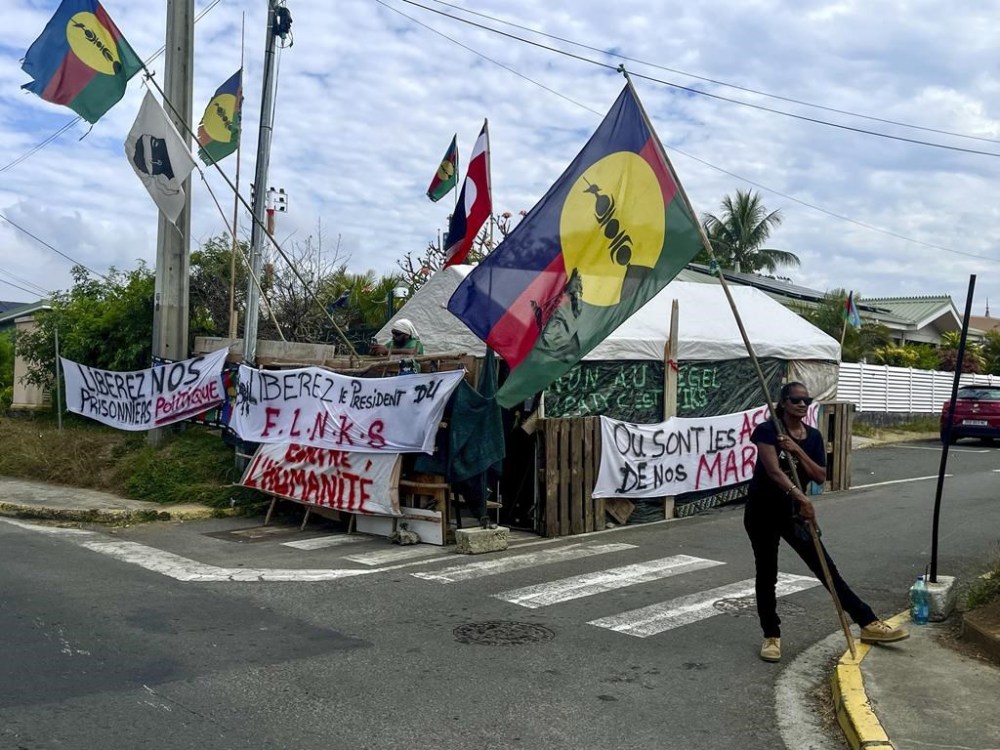
It marks the day in 1853 when French Admiral Auguste Febvrier-Despointes declared French sovereignty over New Caledonia in the name of Emperor Napoleon III, Napoleon’s nephew and heir. It became an overseas territory after World War II, with French citizenship granted to all Kanaks in 1957.
Underlining how far apart the communities stand on the territory’s future, the loyalists in Noumea on Tuesday celebrated New Caledonia’s French identity, waving national flags, honking car horns to the sounds of the French national anthem, La Marseillaise, and other patriotic songs, blasting from a radio broadcast, and vehicles carrying police officers and firefighters joining in.
For the Indigenous people, who once suffered from strict segregation policies and widespread discrimination, Sept. 24 is a reminder to continue their struggle for independence. The National Council of Chiefs of the Kanak people was meeting on Mare Island, across from Noumea, and was expected to unilaterally declare sovereignty over the Kanak nation on their customary territories.
In Paris, New Caledonia’s pro-independence Kanak lawmaker, Emmanuel Tjibaou, hailed people in his faraway homeland for “peacefully marking this Citizenship Day” and showing that “we stand steadfast in our fight for dignity … that is non-negotiable,” he said in a social media post.
Nicolas Metzdorf, New Caledonia’s loyalist lawmaker, was beaming with pride over the Pacific archipelago’s French identity and vowed that his supporters have every intention of keeping the territory a part of France.
On Citizenship Day, New Caledonia “celebrates our attachment to France,” Metzdorf said. “It’s a celebration of all citizens, including those who are still excluded from voting,” he said in reference to those residents, who have recently settled in the archipelago but can’t vote in local elections in line with the 1989 Noumea Accord that gives New Caledonia more political power and broader autonomy.
In spring, President Macron rushed a bill through Parliament aimed at amending France’s constitution and changing the electoral register in New Caledonia to grant voting rights to residents who have settled there in the last decade, leaving the Indigenous people in fear of further erosion of their rights and erasure of their identity.
The adoption of the controversial bill by both houses of the French Parliament in May led to mass demonstrations that turned violent, prompting Macron to declare a state of emergency and fly thousands of police and army reinforcements to the faraway territory. Macron sidelined the controversial voting reform in June after he dissolved Parliament and called early legislative elections.
France held three referendums in New Caledonia on independence between 2018 and 2021 as part of an agreement known as the Noumea Accords that followed a 1988 peace deal that ended violence between rival factions.
A majority of voters chose to remain part of France instead of backing independence. The pro-independence Kanak people rejected the results of the last referendum in 2021, which they boycotted because it was held at the height of the COVID-19 pandemic that severely affected the Kanak community.
Tensions deepened early this year when Macron rushed through Parliament a bill aimed at amending France’s Constitution and changing voting lists in New Caledonia. It granted voting rights in local elections to residents who have settled there in the last decade, leaving the Indigenous people in fear of a further erosion of their rights and erasure of their identity.
The adoption of the legislation by both houses of the French Parliament in May led to mass demonstrations that turned violent, prompting Macron to declare a state of emergency and fly thousands of police and army reinforcements to the distant territory. Thirteen people, mostly Kanaks, and two police officers were killed and nearly 3,000 people have been arrested.
Among those detained in broad police raids were 11 Kanak activists with the pro-independence group known as The Field Action Coordination Unit, which has organized protests against French rule since April. Seven of the detained activists, including Christian Tein, a Kanak leader, were flown 17,000 kilometers (10,500 miles) away from home to seven prisons in mainland France for pretrial detention.
___
Associated Press writer Barbara Surk in Nice, France, contributed to this report.