

California Gov. Gavin Newsom vetoes bill to help Black families reclaim taken land
Advertisement
Read this article for free:
or
Already have an account? Log in here »
To continue reading, please subscribe:
Monthly Digital Subscription
$0 for the first 4 weeks*
- Enjoy unlimited reading on winnipegfreepress.com
- Read the E-Edition, our digital replica newspaper
- Access News Break, our award-winning app
- Play interactive puzzles
*No charge for 4 weeks then price increases to the regular rate of $19.00 plus GST every four weeks. Offer available to new and qualified returning subscribers only. Cancel any time.
Monthly Digital Subscription
$4.75/week*
- Enjoy unlimited reading on winnipegfreepress.com
- Read the E-Edition, our digital replica newspaper
- Access News Break, our award-winning app
- Play interactive puzzles
*Billed as $19 plus GST every four weeks. Cancel any time.
To continue reading, please subscribe:
Add Free Press access to your Brandon Sun subscription for only an additional
$1 for the first 4 weeks*
*Your next subscription payment will increase by $1.00 and you will be charged $16.99 plus GST for four weeks. After four weeks, your payment will increase to $23.99 plus GST every four weeks.
Read unlimited articles for free today:
or
Already have an account? Log in here »
Hey there, time traveller!
This article was published 25/09/2024 (443 days ago), so information in it may no longer be current.
SACRAMENTO, Calif. (AP) — California Gov. Gavin Newsom vetoed a bill Wednesday that would have helped Black families reclaim or be compensated for property that was unjustly taken by the government.
The bill would have created a process for families to file a claim with the state if they believe the government seized their property through eminent domain due to discriminatory motives and without providing fair compensation.
The proposal by itself would not have been able to take full effect because lawmakers blocked another bill to create a reparations agency that would have reviewed claims.
“I thank the author for his commitment to redressing past racial injustices,” Newsom said in a statement. “However, this bill tasks a nonexistent state agency to carry out its various provisions and requirements, making it impossible to implement.”
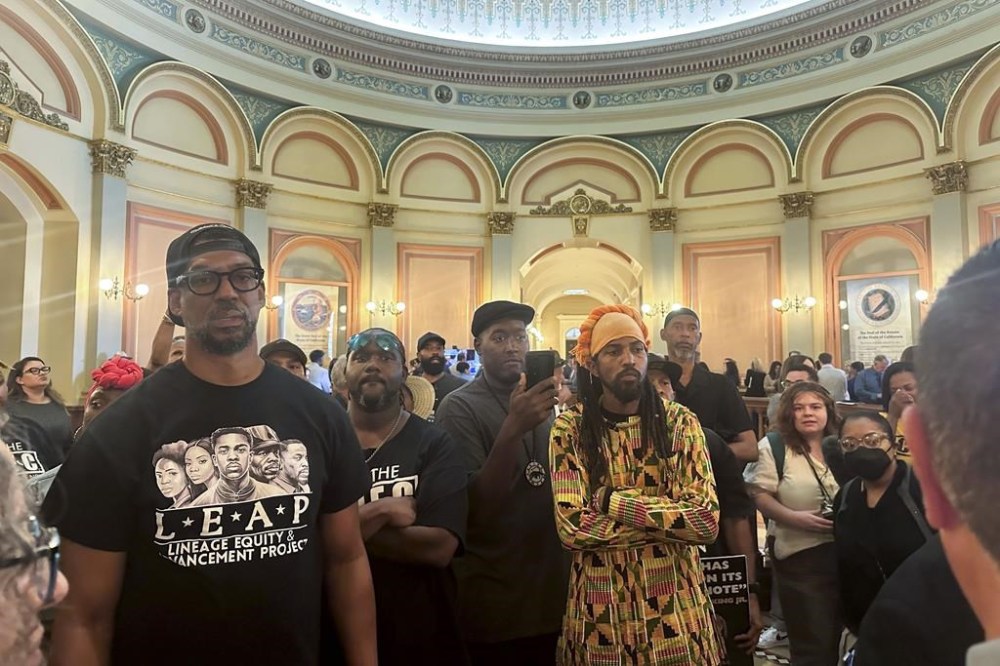
The veto dealt a blow to a key part of a package of reparations bills the California Legislative Black Caucus backed this year in an effort to help the state atone for decades of policies that drove racial disparities for Black Americans. The caucus sent other proposals to Newsom’s desk that would require the state to formally apologize for slavery and its lingering impacts, improve protections against hair discrimination for athletes and combat the banning of books in state prisons.
Democratic state Sen. Steven Bradford introduced the eminent domain bill after Los Angeles-area officials in 2022 returned a beachfront property to a Black couple a century after it was taken from their ancestors through eminent domain. Bradford said in a statement earlier this year that his proposal was part of a crucial “framework for reparations and correcting a historic wrong.”
Bradford also introduced a bill this year to create an agency to help Black families research their family lineage and implement reparations programs that become law, and a measure to create a fund for reparations legislation.
But Black caucus members blocked the reparations agency and fund bills from receiving a final vote in the Assembly during the last week of the legislative session last month. The caucus cited concerns that the Legislature would not have oversight over the agency’s operations and declined to comment further on the reparations fund bill because it wasn’t part of the caucus’ reparations priority package.
The move came after the Newsom administration pushed for the agency bill to be turned into legislation allocating $6 million for California State University to study how to implement the reparations task force’s recommendations, according to a document with proposed amendments shared by Bradford’s office.
Newsom’s office declined to comment to The Associated Press last month on the reparations agency and fund proposals, saying it doesn’t typically weigh in publicly on pending legislation.
The administration’s Department of Finance said earlier this year it opposed the eminent domain bill because it was not specifically included in the budget. The agency said the cost to implement it was unknown but could have ranged “from hundreds of thousands of dollars to low millions of dollars annually, depending on the workload required to accept, review, and investigate applications.”