Teaching truth From writing letters to Orange Shirt Day creator to cooking Indigenous dishes, teachers — from early years to high school — educate students on residential schools
Read this article for free:
or
Already have an account? Log in here »
To continue reading, please subscribe:

Digital Subscription
One year of digital access for only $205*
- Enjoy unlimited reading on winnipegfreepress.com
- Read the E-Edition, our digital replica newspaper
- Access News Break, our award-winning app
- Play interactive puzzles
*First annual payment billed as $205.00 + GST for one year. This annual subscription will automatically renew at $233.00 + GST every 52 weeks (10% off the regular annual price of $259.35). Offer available to new and qualified returning subscribers only. Cancel any time.
To continue reading, please subscribe:
Add Free Press access to your Brandon Sun subscription for only an additional
$1 for the first 4 weeks*
- Enjoy unlimited reading on winnipegfreepress.com
- Read the E-Edition, our digital replica newspaper
- Access News Break, our award-winning app
- Play interactive puzzles
*Your next Brandon Sun subscription payment will increase by $1.00 and you will be charged $17.95 plus GST for four weeks. After four weeks, your payment will increase to $24.95 plus GST every four weeks.
Read unlimited articles for free today:
or
Already have an account? Log in here »
Hey there, time traveller!
This article was published 27/09/2024 (719 days ago), so information in it may no longer be current.
Teachers were singled out in the Truth and Reconciliation Commission of Canada’s 94 calls to action.
Faculties of education and government ministries in charge of creating curriculum were given specific marching orders to confront Canada’s history and improve relations between Indigenous and non-Indigenous people, too.
“Education got us into this mess and education will get us out,” chief commissioner Murray Sinclair said when the TRC completed its work in 2015, which exposed the wide-ranging abuse that took place at residential schools.
Sinclair has echoed those sentiments since the commission’s deep dive into the government and church-run institutions, the last of which closed in Canada in 1996.
“Education got us into this mess and education will get us out.”–Murray Sinclair, chief commissioner of the Truth and Reconciliation Commission
“When he speaks, everyone listens,” said Alysa Ferguson, a teacher who heard those renowned remarks in-person at a conference in Winnipeg last year.
Ferguson said she and her colleagues at Thompson’s Juniper School, where the overwhelming majority of students are Indigenous, and others across the province are well-positioned to lead “reconcili-action” efforts because they know children are changemakers and have both the time and tools to empower them.

Call to action No. 62 of 94 highlights the importance of age-appropriate curriculum on residential schools, treaties, and Indigenous peoples’ historical and contemporary contributions to society.
For much of the last month, Manitoba teachers have focused their attention on answering that call and the others laid out by the TRC — the namesake of Monday’s statutory holiday in Manitoba.

They have facilitated knowledge keeper visits and read storybooks about the institutions created to “take the Indian out of the child.” They have also celebrated drum circles, Indigenous languages and cultural symbols that were banned in those sites.
“I can see the slow changes,” said Ferguson, who entered the profession 17 years ago. “We have a powwow group now. We have kids that are dancing in our school community, and that wasn’t even a thought nine years ago.”
The Free Press took a peek at lesson plans in early years, middle years and senior years levels to see how educators are undertaking the challenging task of reframing history and carrying out Sinclair’s vision.
Early years
Reanna Korade made a pledge to parents when she gave them a heads-up about the hard truths their Grade 3 and 4 students would be exposed to this month.
“I promise you that our learning around these topics will be filled with dignity, respect, compassion and sensitivity,” she told parents at Victory School in a memo that acknowledged her personal history and understanding of how triggering Orange Shirt Day can be.
Korade’s great-grandmother on her maternal side — her mother is a member of Peguis First Nation — was hidden from authorities rounding up children to forcibly remove them from their communities and attend residential schools.
A decade ago, when she was watching an orientation video for new teachers in the Seven Oaks School Division on the subject at-large, “a lightbulb went off” and she began to understand the far reaches of intergenerational fallout, she said.

Korade said that moment has inspired her to help others begin to find their “aha moments.”
Her elementary students have done lots of learning throughout September about the institutions that were created to strip First Nations, Métis and Inuit children of their culture, language and pride in their identity.
The lessons began with a brainstorming session on what makes their school a safe and happy place. A study of pictures of residential schools revealed many of those elements — smiling children, playground equipment and healthy snacks — were missing.
Another exercise involved learning about the story of Orange Shirt Day founder Phyllis Webstad, whose shirt was taken from her on her first day of residential school and never returned.
The nine- and 10-year-olds penned letters to Webstad and walked them over to a nearby community mailbox in Winnipeg’s Jefferson neighbourhood.
“I am sorry for what happened to you,” one letter reads.
Another student wrote: “I hope that when you go home now, someone is waiting for you and you’re having a great life.”
The students have watched videos of survivors, including a clip of a woman who recalled throwing up rotten food and being forced to eat the mush, which their teacher said has stuck with many of them who try to wrap their heads around how school staff could possibly allow for such harm.
“I have deep respect for all my students, including their intelligence. I’m never going to sugarcoat something like residential school or MMIWG2S,” said Korade, who is of Anishinaabe, Métis and Croatian ancestry.
“If we sugarcoat it, we’re losing the meaning behind it and the importance of it.”
With their young ages in mind, she previews all materials before using them in class and leaves the specifics of abuse that occurred, specifically the sexual abuses, for older grades.

Just as she alerted parents about the difficult content that would be discussed this month, she also spoke with her young students to let them know she was at-the-ready to give hugs upon request and answer questions.
Middle years
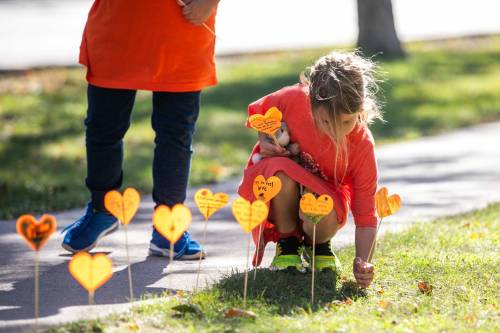
Grade 7 and 8 students from Linden Woods oversaw the installation of about 600 palm-sized orange hearts, each of which displays a message of love, hope or solidarity written by them and their younger peers, in their schoolyard this week.
The exercise is but one of many that École Van Walleghem’s Reconcili-Action Club is supporting this year, said Suzanne Beauregard, who runs the group for social justice-minded middle schoolers.
“You don’t just whip off your orange shirt and say ‘OK, I checked off the box, I reconciled for the year’ because that’s not what this is,” said Beauregard, a teacher-librarian and self-described settler.

Twenty-five years into her career, Beauregard said she is actively “unlearning” the skewed narrative she grew up with — a tale of colonizers discovering Canada and civilizing the Indigenous peoples they met.
There was no mention of residential schools in a Canadian history course she took in university nor in any previous classes.
“We don’t know what we don’t know, but when you do know what the truth is, this is your opportunity to do better,” she said, adding teachers now have the opportunity to help students form a more holistic worldview.
“We don’t know what we don’t know, but when you do know what the truth is, this is your opportunity to do better.”–teacher-librarian Suzanne Beauregard
Van Walleghem’s lunchtime club is continuing its partnership with Mama Bear Clan this year to fundraise and recruit volunteers for patrols in North Point Douglas.
Bernadette Folster, a patrol captain who works at the North Point Douglas Women’s Centre, visited last fall to speak to middle schoolers about their privilege and the role of community-serving organizations.
“If you took someone away from their parents and put them in an environment where they received no love and felt unsafe, they don’t know how to parent and so, they have kids and don’t know how to parent and this cycle continues,” Beauregard said, recalling the discussions surrounding the parenting classes at the women’s centre.
The teacher-librarian said she wants students to practise empathy and understand the history that is linked to many of the social issues that exist in their city today.
In recent days, her discussions have centered on systemic racism and attempts to hide “Canada’s dark secret,” as well as how Winnipeg was home to a residential school between 1958 and 1973.

All of the school’s Grade 7s and 8s were scheduled to walk to the Rooster Town Kettle on Friday and learn about the Métis road-allowance community that inspired the public art installation at the rapid transitway’s Beaumont Station.
The residents of Rooster Town (1901-1960), which stood in and around the land now occupied by Grant Park Shopping Centre, were no strangers to poverty and often subject to racism.
The five-foot-tall structure was erected as a symbol of Métis hospitality, water rights and resilience.
Beauregard noted staff across the Pembina Trails School Division are mindful of balancing lessons so they do not only associate Indigenous peoples with tragedy.
Hoop dancers and other artists from the Aboriginal School of Dance performed at an assembly Monday.
Van Walleghem teachers have also been learning how to embed the seven sacred teachings — truth, love, respect, bravery, honesty, humility and wisdom — and the Indigenous medicine wheel into their programming.
The latter contains black, white, yellow and red paint and represents the connectedness of humans to each other and their natural environment, as well as one’s physical, mental and spiritual well-being.
Senior years
A pungent smell emanated from camping stoves burning under a canopy outside Windsor Park Collegiate as teenagers tried their hand at making “cranberry ketchup” Thursday.
Grade 11 and 12 students handpicked the main ingredient, American Highbush Cranberries — whose tart flavour pairs perfectly with poultry, despite their misleading stench of dirty socks in the bog and whilst boiling — on a trail just north of Winnipeg.
Sean Oliver enlisted his mother, keeper of their beloved family recipes and whom his students have come to know as “mémère,” a synonym for kookum and grandma, to co-teach his land-based education course this week.
The duo spoke to students about the medicinal properties of the fruit that is native to Manitoba, high in Vitamin A and C, and rich in antioxidants.
For Oliver, outdoor education — be it in the forest or a makeshift kitchen — is an act of reclamation.
“If colonization was essentially about taking land away, taking language away, then we decolonize that learning experience by introducing folks back to the land so they can gain a new connection or increase their connection,” said the teacher, who is Red River Métis.

Every period begins with a smudge. A sharing circle among students, who identify as Indigenous, settler and new to Canada, takes place after the opening cleanse of their environment of the day.
Oliver, a father of three who has been teaching teens for a dozen years, said he has found age is not always the No. 1 determining factor when it comes to students’ understanding of truth and reconciliation.
The majority of students are entering high school now with basic knowledge about the government policies enacted to disenfranchise the country’s original inhabitants and the negative narratives fed to non-Indigenous students, although newcomers need a summary, he said.
“Cranberry picking is not the answer to reconciliation,” but, rather, a hands-on activity that has served as an entry point for in-depth discussion, Oliver said.
He noted students are gaining a better understanding of life before residential schools, as well as the historical and ongoing harms of government policies, such as the wiping of traditional knowledge about the “pharmacy” that is their local forest.

The relationship building that happens on the land has led to students being empowered to speak about their family’s experiences with residential schools, the dispossession of the Métis homeland, and “cows and ploughs,” he said.
The federal government rarely fulfilled its agricultural benefits obligations under treaty to support First Nations’ transitions from nomadic farming to European-style harvesting, and as a result, hampered their ability to grow their economies.
“Cows and ploughs” settlements symbolize an attempt to acknowledge the harms caused and begin to make amends.
“What we do to one, we do to all” is a traditional teaching that was passed on to Oliver by elders, which he now passes on to students in the Louis Riel School Division.
“One example might be: if we are harming people, it’s helpful to dehumanize people in order for us to feel like that’s OK,” he said.
“But if we respect and value people, we can’t treat each other terribly because we’re in relationship with one another — and the same thing goes for the land.”
maggie.macintosh@freepress.mb.ca

Maggie Macintosh
Education reporter
Maggie Macintosh reports on education for the Free Press. Originally from Hamilton, Ont., she first reported for the Free Press in 2017. Read more about Maggie.
Funding for the Free Press education reporter comes from the Government of Canada through the Local Journalism Initiative.
Every piece of reporting Maggie produces is reviewed by an editing team before it is posted online or published in print — part of the Free Press‘s tradition, since 1872, of producing reliable independent journalism. Read more about Free Press’s history and mandate, and learn how our newsroom operates.
Our newsroom depends on a growing audience of readers to power our journalism. If you are not a paid reader, please consider becoming a subscriber.
Our newsroom depends on its audience of readers to power our journalism. Thank you for your support.
Related Articles
How was my week? Satisfyingly orange, thanks




History
Updated on Saturday, September 28, 2024 9:16 AM CDT: Updates photo caption for accuracy