

France’s new premier postpones election in New Caledonia until next year
Advertisement
Read this article for free:
or
Already have an account? Log in here »
To continue reading, please subscribe:

Digital Subscription
One year of digital access for only $205*
- Enjoy unlimited reading on winnipegfreepress.com
- Read the E-Edition, our digital replica newspaper
- Access News Break, our award-winning app
- Play interactive puzzles
*First annual payment billed as $205.00 + GST for one year. This annual subscription will automatically renew at $233.00 + GST every 52 weeks (10% off the regular annual price of $259.35). Offer available to new and qualified returning subscribers only. Cancel any time.
To continue reading, please subscribe:
Add Free Press access to your Brandon Sun subscription for only an additional
$1 for the first 4 weeks*
- Enjoy unlimited reading on winnipegfreepress.com
- Read the E-Edition, our digital replica newspaper
- Access News Break, our award-winning app
- Play interactive puzzles
*Your next Brandon Sun subscription payment will increase by $1.00 and you will be charged $17.95 plus GST for four weeks. After four weeks, your payment will increase to $24.95 plus GST every four weeks.
Read unlimited articles for free today:
or
Already have an account? Log in here »
Hey there, time traveller!
This article was published 01/10/2024 (707 days ago), so information in it may no longer be current.
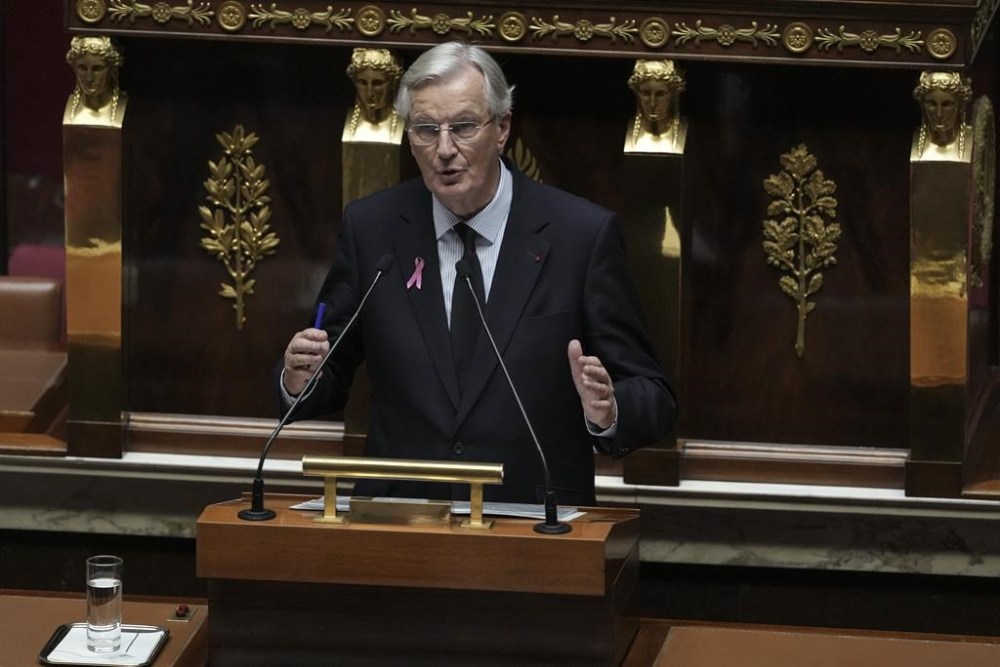
NICE, France (AP) — France’s new Prime Minister Michel Barnier announced Tuesday that a provincial election scheduled for December in the restive French Pacific territory of New Caledonia has been postponed for a year.
During his inaugural address to parliament, Barnier also said a controversial bill proposed by President Emmanuel Macron to amend the constitution to change voting lists in the territory would not be forwarded to a joint meeting of parliament for ratification. The territory’s Indigenous Kanak people fear changes to the voting registry would favor recent arrivals to the Pacific archipelago.
Tensions in New Caledonia have long been simmering between white settler communities loyal to Paris and pro-independence Kanak people.
The adoption of the voter list bill in May by both houses of French parliament led to mass demonstrations by pro-independence groups that turned violent, prompting Macron to declare a state of emergency and fly thousands of police and army reinforcements to the Pacific territory.
Thirteen people, mostly Kanaks, and two police officers, have been killed and nearly 3,000 people have been arrested since New Caledonia’s police launched an investigation just days after the unrest started in May.
Barnier said the provincial election would be postponed from its scheduled date of Dec. 15 until the end of 2025.
New Caledonia has been living through an “exceptionally grave crisis,” Barnier said and added that he will tackle the issues early next year when he plans to convene a government committee on France’s overseas territories. Its priority will be addressing and remedying “the high cost of living that affects our compatriots” in the overseas territories that extend from the Indian Ocean and the Pacific to the Caribbean.
Last month, violent protests broke out on the French island of Martinique over the high cost of living, with gunfire injuring at least six police officers and one civilian. France sent a group of special anti-riot police to quell the unrest on its Caribbean territory, where protesters have gathered despite the government barring demonstrations in parts of the island.
“I am aware of the suffering and anguish felt by the people of New Caledonia and I want to reiterate that the state and my government will be at their side,” Barnier said during Tuesday’s layout of his government’s polices to lawmakers in the National Assembly, France’s influential lower house of parliament.
New Caledonia became French in 1853 under Emperor Napoleon III, Napoleon’s nephew and heir. It became an overseas territory after World War II, with French citizenship granted to all Kanaks in 1957. Kanaks have long sought to break free from France after suffering from strict segregation policies and widespread discrimination.