A spacecraft is on its way to a harmless asteroid slammed by NASA in a previous save-the-Earth test

Advertisement

Advertise with us

CAPE CANAVERAL, Fla. (AP) — A spacecraft blasted off Monday to investigate the scene of a cosmic crash.

Read this article for free:


or

Already have an account? Log in here »

To continue reading, please subscribe:

Subscribe and receive a limited-edition Free Press branded hat or tote.

Digital Subscription

One year of digital access for only $205*

  • Enjoy unlimited reading on winnipegfreepress.com
  • Read the E-Edition, our digital replica newspaper
  • Access News Break, our award-winning app
  • Play interactive puzzles

*First annual payment billed as $205.00 + GST for one year. This annual subscription will automatically renew at $233.00 + GST every 52 weeks (10% off the regular annual price of $259.35). Offer available to new and qualified returning subscribers only. Cancel any time.

To continue reading, please subscribe:

Add Free Press access to your Brandon Sun subscription for only an additional

$1 for the first 4 weeks*

  • Enjoy unlimited reading on winnipegfreepress.com
  • Read the E-Edition, our digital replica newspaper
  • Access News Break, our award-winning app
  • Play interactive puzzles
Start now

*Your next Brandon Sun subscription payment will increase by $1.00 and you will be charged $17.95 plus GST for four weeks. After four weeks, your payment will increase to $24.95 plus GST every four weeks.

Hey there, time traveller!
This article was published 07/10/2024 (711 days ago), so information in it may no longer be current.

CAPE CANAVERAL, Fla. (AP) — A spacecraft blasted off Monday to investigate the scene of a cosmic crash.

The European Space Agency’s Hera spacecraft rocketed away on a two-year journey to the small, harmless asteroid rammed by NASA two years ago in a dress rehearsal for the day a killer space rock threatens Earth. It’s the second part of a planetary defense test that could one day help save the planet.

SpaceX’s Falcon rocket quickly disappeared with Hera into the late morning clouds. An hour later, applause erupted in the control center in Germany as the spacecraft separated from the rocket’s upper stage and then called home. “It’s an amazing day,” the space agency’s director general Josef Aschbacher said afterward.
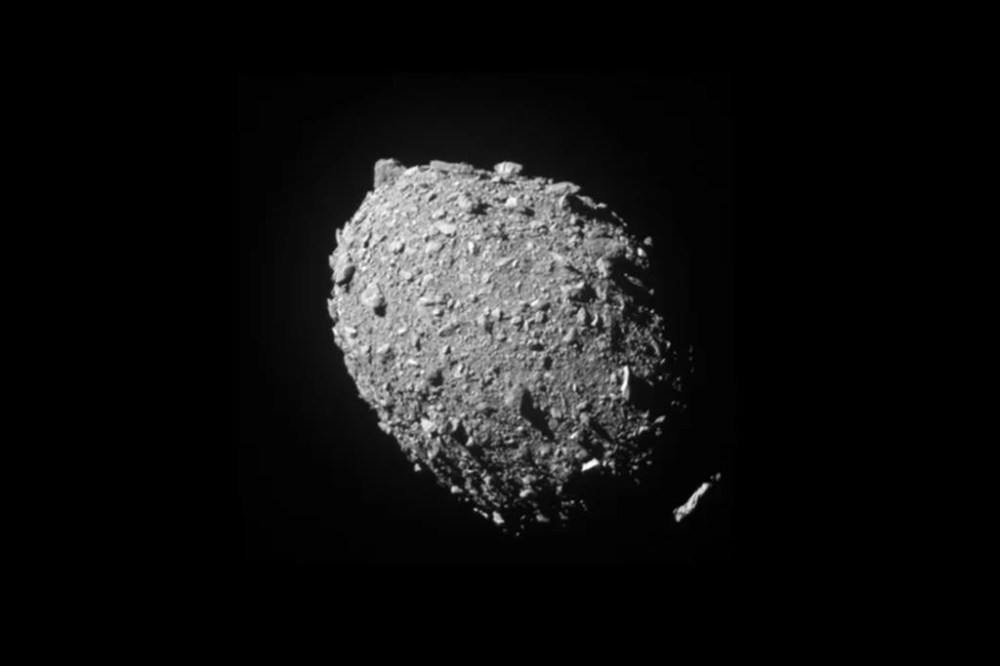
This image provided by NASA shows the asteroid Dimorphos, captured by NASA’s DART mission just two seconds before the spacecraft struck its surface, on Sept. 26, 2022. (NASA/Johns Hopkins APL via AP)

The 2022 crash by NASA’s Dart spacecraft shortened Dimorphos’ orbit around its bigger companion, demonstrating that if a dangerous rock was headed our way, there’s a chance it could be knocked off course with enough advance notice.

Scientists are eager to examine the impact’s aftermath up close to know exactly how effective Dart was and what changes might be needed to safeguard Earth in the future.

“The more detail we can glean the better as it may be important for planning a future deflection mission should one be needed,” University of Maryland astronomer Derek Richardson said before launch.

Researchers want to know whether Dart — short for Double Asteroid Redirection Test — left a crater or perhaps reshaped the 500-foot (150-meter) asteroid more dramatically. It looked something like a flying saucer before Dart’s blow and may now resemble a kidney bean, said Richardson, who took part in the Dart mission and is helping with Hera.

Dart’s wallop sent rubble and even boulders flying off Dimorphos, providing an extra kick to the impact’s momentum. The debris trail extended thousands of miles (more than 10,000 kilometers) into space for months.

Some boulders and other debris could still be hanging around the asteroid, posing a potential threat to Hera, said flight director Ignacio Tanco.

“We don’t really know very well the environment in which we are going to operate,” said Tanco. “But that’s the whole point of the mission is to go there and find out.”

European officials describe the $400 million (363 million euro) mission as a “crash scene investigation.”

Hera “is going back to the crime site and getting all the scientific and technical information,” said project manager Ian Carnelli.

Carrying a dozen science instruments, the small car-sized Hera will need to swing past Mars in 2025 for a gravity boost, before arriving at Dimorphos by the end of 2026. It’s a moonlet of Didymos, Greek for twin, a fast-spinning asteroid that’s five times bigger. At that time, the asteroids will be 120 million miles (195 million kilometers) from Earth.

Hera will attempt to go into orbit around the rocky pair, with the flyby distances gradually dropping from 18 miles (30 kilometers) all the way down to a half-mile (1 kilometer). The spacecraft will survey the moonlet for at least six months to ascertain its mass, shape and composition, as well as its orbit around Didymos.
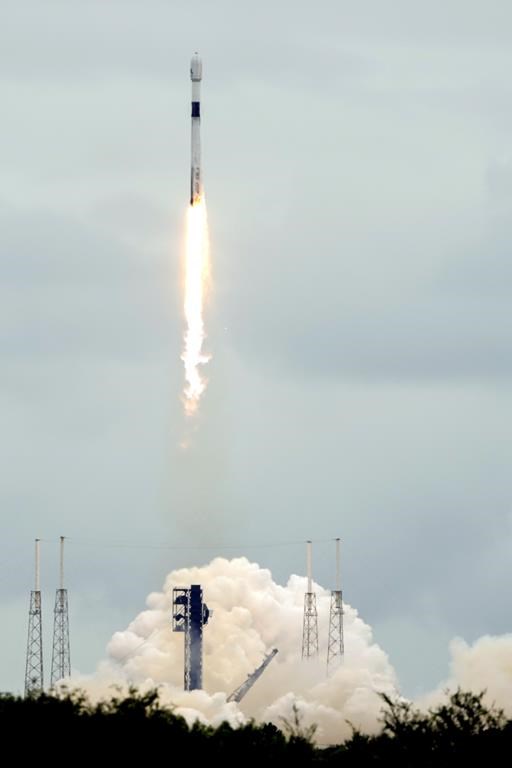
A SpaceX Falcon 9 rocket lifts off from the Cape Canaveral Space Force Station, Monday, Oct. 7, 2024 at Cape Canaveral, Fla., carrying a European spacecraft to an asteroid. (AP Photo/John Raoux)

Before the impact, Dimorphos circled its larger companion from three-quarters of a mile (1,189 meters) out. Scientists believe the orbit is now tighter and oval-shaped, and that the moonlet may even be tumbling.

Two shoebox-sized Cubesats will pop off Hera for even closer drone-like inspections, with one of them using radar to peer beneath the moonlet’s boulder-strewn surface. Scientists suspect Dimorphos was formed from material shed from Didymos. The radar observations should help confirm whether Didymos is indeed the little moon’s parent.

The Cubesats will attempt to land on the moonlet once their survey is complete. If the moonlet is tumbling, that will complicate the endeavor. Hera may also end its mission with a precarious touchdown, but on the larger Didymos.

Neither asteroid poses any threat to Earth — before or after Dart showed up. That’s why NASA picked the pair for humanity’s first asteroid-deflecting demo.

Leftovers from the solar system’s formation 4.6 billion years ago, asteroids primarily orbit the sun between Mars and Jupiter in what’s known as the main asteroid belt, where millions of them reside. They become near-Earth objects when they’re knocked out of the belt and into our neck of the woods.

NASA’s near-Earth object count currently tops 36,000, almost all asteroids but also some comets. More than 2,400 of them are considered potentially hazardous to Earth.

___

The Associated Press Health and Science Department receives support from the Howard Hughes Medical Institute’s Science and Educational Media Group. The AP is solely responsible for all content.


Report Error Submit a Tip

More Stories

Snowbird replacements ‘extremely manoeuverable, powerful,’ RCAF commander says

Kyle Duggan, The Canadian Press 4 minute read Preview

Snowbird replacements ‘extremely manoeuverable, powerful,’ RCAF commander says

Kyle Duggan, The Canadian Press 4 minute read Updated: Yesterday at 3:48 PM CDT

GATINEAU - The Royal Canadian Air Force welcomed on Thursday the first two of its new trainer aircraft, the CT-157 Siskin II — the same planes that will replace the old Tutor jets flown by the Snowbirds aerial demonstration team.

The turboprop planes will soon be headed to 15 Wing Moose Jaw, where the air force eventually will station 19 of them to serve as its main training fleet.

Acquiring the Siskin II, also known as the Pilatus PC-21, is part of the RCAF's plan to modernize its fleets and overhaul its training.

RCAF Commander Lt.-Gen. Jamie Speiser-Blanchet said the modern aircraft are well suited both to aerial acrobatics and to preparing pilots for the more advanced aircraft the air force is bringing online.

Read
Updated: Yesterday at 3:48 PM CDT

Space war and other distractions

Gwynne Dyer 5 minute read 2:00 AM CDT

When Troy Meink, the chief of the U.S. Space Force, announces for no obvious reason that the United States “now has on-orbit space-control weapons,” people naturally assume that something is up. Why is Meink admitting the truth now? He’s even boasting about it!

It can’t be to frighten the Chinese or the Russians, because they have long been watching U.S. military activities in space. They regularly monitor the flights of the semi-secret X-37B Orbital Test Vehicle, the re-usable uncrewed spaceplane that the U.S. Space Force launches from Florida but sometimes lands at Vandenberg in California (eight missions so far).

The Chinese can’t complain, because they have their own ‘secret’ spaceplane, and sometimes they even play ‘silly buggers’ in orbit with their American and British counterparts. (‘Silly buggers’ is the old naval game of high-speed manoeuvres of warships in formation, a frequent cause of collisions.)

Reuters reported a year ago on a joint U.S.-British operation in which the U.S. Space Force, working from a base in Colorado, directed an American military satellite to swoop in close to a British satellite just as China’s Shiyan 12-01 satellite passed beneath it. What for? Who knows? They may have done it just because they could.

United Way, other charities fight for dollars as donor base shrinks

Scott Billeck 8 minute read Preview

United Way, other charities fight for dollars as donor base shrinks

Scott Billeck 8 minute read 2:00 AM CDT

Winnipeg’s charitable sector is being squeezed from both sides: demand for help is growing while the pool of donors to meet that need is shrinking.

The imbalance is increasingly being carried by a relatively small group of deep-pocketed donors. Last year, 600 people — about three per cent of United Way Winnipeg’s individual donors — accounted for roughly $8 million, or 55 per cent of individual donations.

The fundraising pitch isn’t getting any easier.

Homelessness and public drug use have become increasingly visible, household budgets remain strained and the problems charities are trying to address can seem so entrenched that donors may reasonably wonder what difference another contribution can make.

Read
2:00 AM CDT

‘She was looking to destroy me’: convicted harasser faces new charges

Dean Pritchard 6 minute read Preview

‘She was looking to destroy me’: convicted harasser faces new charges

Dean Pritchard 6 minute read Yesterday at 6:54 PM CDT

When Agnieszka Ciochon-Newton moved into the 55-plus apartment building on Stradbrook Avenue last year, she came across as “timid, soft-spoken and sensitive,” said building manager Tanya Owen.

Little did Owen know the meek-looking 58-year-old woman would soon turn her life and the lives of many of her tenants upside down and threaten her career and family.

“She was looking to destroy me for a simple tenant disagreement,” Owen said Thursday.

Court records show Ciochon-Newton was arrested earlier this month and charged with seven counts of criminal harassment, two counts of uttering threats and one count each of fraud, breaking and entering, attempting to obstruct justice, intimidation of a justice official, mischief and defamatory libel.

Read
Yesterday at 6:54 PM CDT

His blissful kiss is well worth the risk

Maureen Scurfield 4 minute read 2:00 AM CDT

DEAR MISS LONELYHEARTS: The best kisser I ever met knocked me off balance. My little joke was, “That’s why we have to go home now and lie down in a hurry!” We’ve been seeing each other for almost six months. This man can convince me to do almost anything — so much fun!

But, now he’s been transferred out of province for bigger money at a new company.

He’s leaving soon and he could have asked me to move with him, as his trucking partner, but he didn’t! Other women will soon have their hands on him, believe me!

I’m already 27 and I don’t want to date any more guys — just him. Now what can I do? I feel sadder every day.

Lauded Manitoba author chronicled life in the Interlake

By Sheldon Birnie 5 minute read Preview

Lauded Manitoba author chronicled life in the Interlake

By Sheldon Birnie 5 minute read Wednesday, Sep. 16, 2026

Longtime Manitoba author, editor and professor David Arnason died on Monday at age 86.

Read
Wednesday, Sep. 16, 2026