Google adds first Indigenous language in Canada to its translation service

Advertisement

Advertise with us

One of the most widely spoken Indigenous languages in this country is now available through Google's translation service, the first time the tech giant has included a First Nations, Métis or Inuit language spoken in Canada on its platform.

Read this article for free:


or

Already have an account? Log in here »

To continue reading, please subscribe:

Subscribe and receive a limited-edition Free Press branded hat or tote.

Digital Subscription

One year of digital access for only $205*

  • Enjoy unlimited reading on winnipegfreepress.com
  • Read the E-Edition, our digital replica newspaper
  • Access News Break, our award-winning app
  • Play interactive puzzles

*First annual payment billed as $205.00 + GST for one year. This annual subscription will automatically renew at $233.00 + GST every 52 weeks (10% off the regular annual price of $259.35). Offer available to new and qualified returning subscribers only. Cancel any time.

To continue reading, please subscribe:

Add Free Press access to your Brandon Sun subscription for only an additional

$1 for the first 4 weeks*

  • Enjoy unlimited reading on winnipegfreepress.com
  • Read the E-Edition, our digital replica newspaper
  • Access News Break, our award-winning app
  • Play interactive puzzles
Start now

*Your next Brandon Sun subscription payment will increase by $1.00 and you will be charged $17.95 plus GST for four weeks. After four weeks, your payment will increase to $24.95 plus GST every four weeks.

Hey there, time traveller!
This article was published 17/10/2024 (665 days ago), so information in it may no longer be current.

One of the most widely spoken Indigenous languages in this country is now available through Google’s translation service, the first time the tech giant has included a First Nations, Métis or Inuit language spoken in Canada on its platform.

Inuktut, a broad term encompassing different dialects spoken by Inuit in Canada, Greenland and Alaska, has been added to Google Translate, which translates text, documents and websites from one language into another.

The latest addition is part of a Google initiative to develop a single artificial intelligence language model to support 1,000 of the most spoken languages in the world.
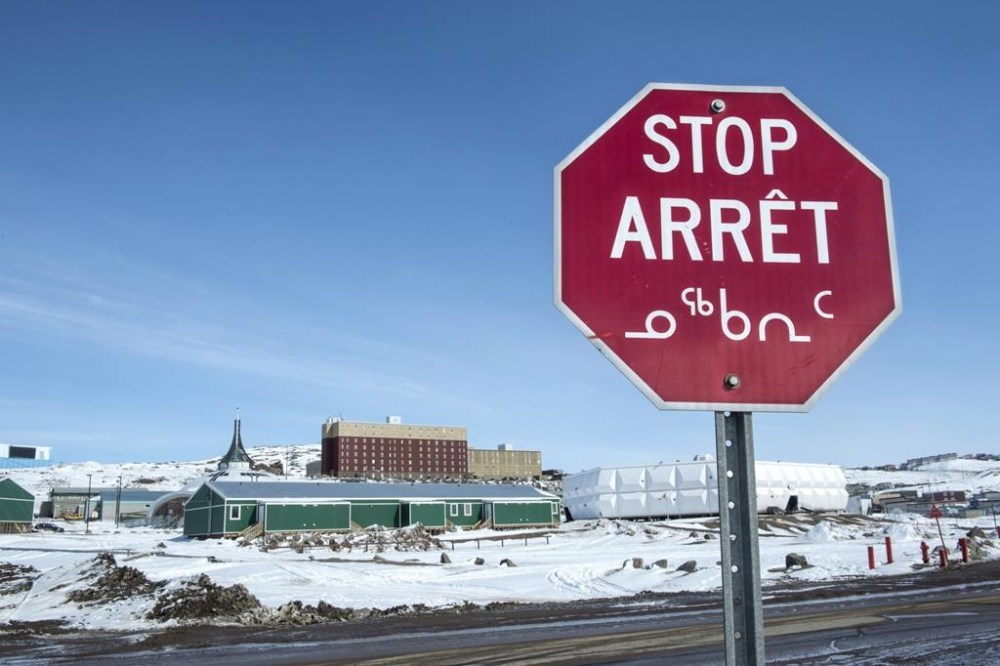
A stop sign in English, French and Inuktut syllabics is seen in Iqaluit, on April 25, 2015. One of the most widely spoken Indigenous languages in this country is now available through Google's translation service, the first time the tech giant has included a First Nations, Métis or Inuit language spoken in Canada on its platform. THE CANADIAN PRESS/Paul Chiasson

There are roughly 40,000 Inuktut speakers in Canada, data from Statistics Canada suggests.

The number of speakers alone is not enough to determine whether a language can be included in Google Translate, said Isaac Caswell, a senior software engineer with the platform.

There also has to be enough online text data to pull from to create a language model.

Other Indigenous languages in Canada have “had simply too little data to have any usable machine translation model,” said Caswell.

For example, engineers looked at adding Cree, which is spoken by more than 86,000 people in Canada, but there were fewer websites in the language to pull from.

“We don’t want to put anything on the product which just produces broken text or nonsense,” said Caswell.

“Inuktut really stands out in that it has a lot of clean and a lot of well written data, because, I think, the community is increasingly online.”

When adding a language to Google Translate, the tech company looks at two main things: whether there’s a desire or need from the community and how technically feasible is it.

After Google determined its model could recognize Inuktut, it began to consult with language speakers and organizations.

The company reached out to Inuit Tapiriit Kanatami, the national organization that represents about 70,000 Inuit in Canada, to ensure development of the model was true to the Inuktut language, including the ability to translate both of the language’s writing systems.

Inuktut uses qaniujaaqpait, or syllabics, and qaliujaaqpait, based on the Roman alphabet.

Inuit Tapiriit Kanatami has developed its own data set of common characters that can be used to write in any dialect of Inuktut to help ease written communication among the different Inuit regions.

“If we hadn’t had their help, we would have just been able to launch in syllabics, which undermines some of their current work,” said Caswell.

The organization welcomed Google’s work to include Inuktut, citing the need to revitalize, protect and promote Inuit languages.

“This is another way in which to make our language relevant, easily accessible and for those who don’t know it at all, to be able to interact with it,” Natan Obed, president of Inuit Tapiriit Kanatami, said in an interview.

“This is reconciliation in action and I really appreciate those who’ve taken the time to work with us to keep our language strong and to celebrate our language.”

With the introduction of Inuktut, Google aims to be more representative of a group often overlooked by the tech sector.

“I hope, maybe if anything, it will make them feel a little bit more seen by a big tech (company). Because, in general, Indigenous communities have had a lot of experiences being overlooked by technology,” said Caswell.

Users will have the ability to translate written Inuktut to English and vice versa through Google Translate. Other options, including the verbal translation tool, may come at a later time, said Caswell.

The use of AI in promoting Indigenous languages is not without its limitations, said Caswell, but he suspects this will change as more and more languages are unlocked with improved technology.

This report by The Canadian Press was first published Oct. 17, 2024.
Report Error Submit a Tip

More Stories

A new chapter: Renamed Winnipeg Book Festival takes to The Forks this fall

Ben Sigurdson 5 minute read Preview

A new chapter: Renamed Winnipeg Book Festival takes to The Forks this fall

Ben Sigurdson 5 minute read Tuesday, Aug. 11, 2026

Winnipeg’s long-running annual literary festival returns this fall, once again featuring a slate of authors, local and beyond, ready to engage with readers.

New this year is pretty much everything else, including a new name, executive director and team of staff — as well as a shift to a tight, condensed timeline and a move to hold all events under one roof.

The festival formerly known as Thin Air/Livres en fête is now the Winnipeg Book Festival; the event takes place Oct. 1-4 at The Forks Market, with most events offering free admission.

It’s a lot of changes for the stalwart literary festival, which was run for more than two decades by Charlene Diehl, who stepped away in late 2025.

Read
Tuesday, Aug. 11, 2026

Moving rail lines outside city would make Winnipeg ‘major transportation hub’

Carol Sanders 6 minute read Preview

Moving rail lines outside city would make Winnipeg ‘major transportation hub’

Carol Sanders 6 minute read Updated: Yesterday at 7:33 PM CDT

After decades of calls to move rail traffic to the outskirts of Winnipeg, a plan that would benefit residents, railways and taxpayers is now on track, says the former Winnipegger leading the way.

A rail line bypass south of the city, using Crown-owned land and the Manitoba Hydro corridor, would take 20 years to complete, remove 120 railway crossings that are a safety risk and free up about 250 acres of Winnipeg land over time for development, Lloyd Axworthy said Wednesday.

“The visions that we have have to be implemented,” Axworthy said at a news conference announcing the launch of a 90-day feasibility study to move freight rail traffic out of Winnipeg’s urban core along Manitoba Hydro’s southern transmission corridor, connecting east to west along the Perimeter Highway.

The former federal transport minister and Manitoba MP was tasked by Premier Wab Kinew in October 2024 to lead a two-year rail relocation feasibility study.

Read
Updated: Yesterday at 7:33 PM CDT

‘No CUSMA, no booze-ma’: Kinew

Malak Abas 4 minute read Preview

‘No CUSMA, no booze-ma’: Kinew

Malak Abas 4 minute read Updated: Yesterday at 6:20 PM CDT

With the next round of tariffs set to hit Canadian goods next week, and a new report suggesting Manitobans could be severely impacted if the Canada-U.S.-Mexico agreement on trade breaks down, Premier Wab Kinew pledged Wednesday to keep working with the U.S. ambassador — and keep American booze off Manitoba shelves, for now.

Read
Updated: Yesterday at 6:20 PM CDT

Differing goals of religion, politics

John R. Wiens 5 minute read 2:00 AM CDT

Kudos to David Driedger for modelling a more appropriate and constructive role for religion in politics than the one that has become commonplace today (“Take care of them; there is enough”, Think Tank, July 27).

Resisting the temptation to preach, coerce and control, he has chosen to remind, persuade and challenge. It could hardly more different to what we are witnessing everyday to the south of us. I thank him for his humility, courage and sense of responsibility to humanity.

Our recent experiences with religion’s forays into the political realm, both in the U.S. and parts of Canada have done little to endear us to either one. Religious fundamentalism, in its many forms, has wrought untold havoc on governments across the globe, with some of the most toxic iterations being right on our doorsteps — we might even call it a form of domestic terrorism.

In the U.S., Christian nationalism, represented by MAGA, has contaminated government and ordinary lives like a hazardous toxin escaping containment — corroding and poisoning the presidency, the legislature, the court system and law enforcement, and in the process threatening the very relationships which make a civilized society possible. Simply put, the positive ideal of godliness in the American constitution, which emphasized tolerance for, acceptance of and upheld the equal worth of all peoples is in peril.

Quiet opening fitting for controversial site

Melissa Martin 4 minute read Preview

Quiet opening fitting for controversial site

Melissa Martin 4 minute read Yesterday at 2:00 AM CDT

One of this city’s most loudly debated facilities — after all the angst, all the opposition and all the vocal support — began operations in the most low-key way possible.

Read
Yesterday at 2:00 AM CDT

You’re not alone on journey of self-discovery

Maureen Scurfield 5 minute read 2:01 AM CDT

DEAR MISS LONELYHEARTS: I am bisexual. I was in love with another woman for half the summer, and now I’m not. How can that be? I thought she was perfect for me, and now a great guy has come along, and I’m in love with him.

I don’t mean to sound weird, but that’s how my crazy feelings are. I’m 17 now and in Grade 12 this fall. Maybe I’ll be totally different when I’m older. My parents just shake their heads and smile — they are no help at all. They are open-minded people, but they don’t totally get me, and they don’t seem to worry about it. I’m a weirdo with a new idea about who I should be every month.

My grandma, an old hippie, says she loves me the way I am, and with all my changes. The problem is I just don’t “get” me either, and I can’t talk to anybody else about me. She says it will “all come clear” in the end, but I’m not so sure about that.

— Totally Confused, West Kildonan