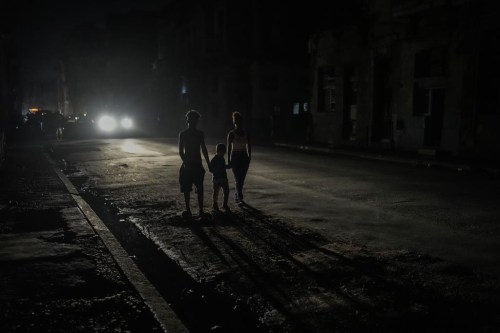
Sweeping blackouts in Cuba raise the question: Why has the island’s solar buildout been so slow?
Advertisement
Read this article for free:
or
Already have an account? Log in here »
To continue reading, please subscribe:

Digital Subscription
One year of digital access for only $205*
- Enjoy unlimited reading on winnipegfreepress.com
- Read the E-Edition, our digital replica newspaper
- Access News Break, our award-winning app
- Play interactive puzzles
*First annual payment billed as $205.00 + GST for one year. This annual subscription will automatically renew at $233.00 + GST every 52 weeks (10% off the regular annual price of $259.35). Offer available to new and qualified returning subscribers only. Cancel any time.
To continue reading, please subscribe:
Add Free Press access to your Brandon Sun subscription for only an additional
$1 for the first 4 weeks*
- Enjoy unlimited reading on winnipegfreepress.com
- Read the E-Edition, our digital replica newspaper
- Access News Break, our award-winning app
- Play interactive puzzles
*Your next Brandon Sun subscription payment will increase by $1.00 and you will be charged $17.95 plus GST for four weeks. After four weeks, your payment will increase to $24.95 plus GST every four weeks.
Read unlimited articles for free today:
or
Already have an account? Log in here »
Hey there, time traveller!
This article was published 23/10/2024 (719 days ago), so information in it may no longer be current.
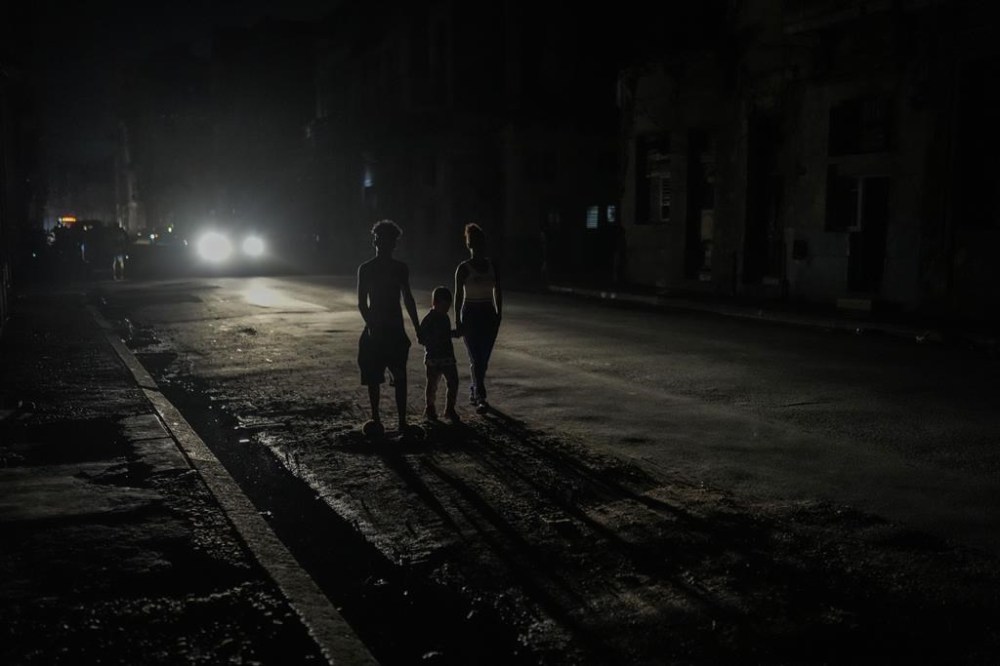
HAVANA (AP) — Cuba’s large-scale blackouts that left 10 million people without power this month may not have happened if the government had built out more solar power to boost its failing electric grid as promised, some experts say.
In a nation with plentiful sunshine, Cuban officials have long had the opportunity to encourage solar power as one solution to national energy problems. But October’s sweeping outages — the island’s worst power failure in years — show little progress has been made.
“If you had extensive buildout of solar, solar farms, residential solar and storage, for the most part, you could avoid the problems they have,” said Dan Whittle, associate vice president of the resilient Caribbean practice at the Environmental Defense Fund, an advocacy group. “But they haven’t really built the policies to get there.”
Cuban officials blame the blackouts on the U.S. trade embargo and other sanctions, the pandemic’s effect on tourism, and emigration all inhibiting Cuba’s economy.
But experts say the government hasn’t updated its internal policies regarding foreign ownership and private financing, especially for critical solar projects, and are still focused on petroleum fuels. That’s despite the fact that as part of the 2015 Paris Agreement, the Cuban government committed to 37% of its power coming from renewable energy by 2030, an ambitious increase from an initial 24% target.
John Kavulich, president of U.S.-Cuba Trade and Economic Council Inc., said there was much hope in the business community two years ago when the U.S. changed policies enabling U.S. investment in private Cuban companies. But the Cuban government has failed to issue regulations necessary to allow the money to start flowing to the private sector, he said.
“So all of this investment and financing, not just from the U.S. but from other countries … that are ready to take a chance in Cuba, sit idle, and that is hundreds and hundreds of millions of dollars,” he said.
The share of Cuba’s electricity that comes from renewable sources like solar and burning sugar cane waste has increased only slightly, from 3.8% in 2012 to 5% as of 2022, according to research from the Sabin Center for Climate Change Law at Columbia Law School and EDF. That’s a very small change during a time when solar and wind have ramped up sharply globally and costs have come down.
Nearly all of the country’s power — 95% — comes from burning fossil fuels. Much of that is from burning crude oil, a particularly polluting form of generation.
One of Cuba’s biggest trading partners, China, makes 80% of the world’s solar panels, according to the energy data and analytics firm Wood Mackenzie, and they are inexpensive. China committed in March to building 92 solar farms on the island that are expected to add more than 2,000 megawatts of energy, and reports in June said China donated three solar parks expected to add 1,000 more. But that trade relationship has not yet led to a buildout that would at least keep the lights on during the day. The whole country had only 252 megawatts of solar power at the end of 2022.
Kavulich said even China has its limits. The view of China’s private sector, he said, is that Cuba “seems to make no effort whatsoever to pay money that it owes.”
“The Cuban utility is the only buyer and it’s a risky investment,” said Whittle. European leaders tell him they “just can’t in good faith encourage businesses in their countries to invest in Cuba.”
Cuban officials acknowledged in recent days that more widespread solar power would have helped alleviate some of the misery from the recent outages. The minister of energy and head of the nation’s electric utility encouraged Cubans to buy rooftop solar systems paired with batteries, instead of the gas and diesel generators purchased by Cubans who can afford them.
“We are thinking about” some regulations that would stimulate these solar purchases, the chief of the nation’s electric utility, Alfredo López, said.
Cuba has struggled with frequent power outages for decades. Besides the U.S. economic embargo, officials have cited aging and insufficiently maintained power plants, increased demand for air conditioning and a lack of fuel for the lack of electricity. The nation relies on imported fuel to meet electric needs, including from oil-rich ally Venezuela, Mexico and Russia.
This month’s crisis, which shut down institutions including schools, closed gas stations and left people cooking their food on wood stoves on the streets, began with one of the island’s major power plants failing.
Human-driven climate change has contributed to extreme weather events that also regularly affect Cuba’s electrical grid. Desperation over the inability to carry out basic activities has sparked recent street protests.
Whittle noted the country has no shortage of good climate scientists. Korey Silverman-Roati, senior fellow of carbon management and negative emissions at the Sabin Center, said the Cuban government is trying. “There certainly has been a will and attempts to build out renewable energy infrastructure,” he said. “It just hasn’t happened.”
On the island, technicians are working to install 26 solar projects in different provinces, López told official media last week.
Installations will ramp up fivefold over the next decade, said Lídice Vaillant, head of the Photovoltaic Research Laboratory at the University of Havana.
Besides the strong sunlight, there is another way that Cuba is a good candidate for solar. A significant share of its electricity comes from smaller power plants distributed around the country. Solar could be added or switched out in those locations. But it hasn’t happened yet.
“There is still sort of this, I think, this lingering belief at the highest levels of government that, you know, fossil fuels is really the best solution,” Whittle said.
___

Rodriguez reported from Havana, St. John from Detroit and Lobet from New York.
___
Read more of AP’s climate coverage at http://www.apnews.com/climate-and-environment
___
The Associated Press’ climate and environmental coverage receives financial support from multiple private foundations. AP is solely responsible for all content. Find AP’s standards for working with philanthropies, a list of supporters and funded coverage areas at AP.org.