Autonomous tech is coming to farming. What will it mean for crops and workers who harvest them?
Advertisement
Read this article for free:
or
Already have an account? Log in here »
To continue reading, please subscribe:

Digital Subscription
One year of digital access for only $205*
- Enjoy unlimited reading on winnipegfreepress.com
- Read the E-Edition, our digital replica newspaper
- Access News Break, our award-winning app
- Play interactive puzzles
*First annual payment billed as $205.00 + GST for one year. This annual subscription will automatically renew at $233.00 + GST every 52 weeks (10% off the regular annual price of $259.35). Offer available to new and qualified returning subscribers only. Cancel any time.
To continue reading, please subscribe:
Add Free Press access to your Brandon Sun subscription for only an additional
$1 for the first 4 weeks*
- Enjoy unlimited reading on winnipegfreepress.com
- Read the E-Edition, our digital replica newspaper
- Access News Break, our award-winning app
- Play interactive puzzles
*Your next Brandon Sun subscription payment will increase by $1.00 and you will be charged $17.95 plus GST for four weeks. After four weeks, your payment will increase to $24.95 plus GST every four weeks.
Read unlimited articles for free today:
or
Already have an account? Log in here »
Hey there, time traveller!
This article was published 28/10/2024 (691 days ago), so information in it may no longer be current.
HOMESTEAD, Fla. (AP) — Jeremy Ford hates wasting water.
As a mist of rain sprinkled the fields around him in Homestead, Florida, Ford bemoaned how expensive it had been running a fossil fuel-powered irrigation system on his five-acre farm — and how bad it was for the planet.
Earlier this month, Ford installed an automated underground system that uses a solar-powered pump to periodically saturate the roots of his crops, saving “thousands of gallons of water.” Although they may be more costly up front, he sees such climate-friendly investments as a necessary expense — and more affordable than expanding his workforce of two.
It’s “much more efficient,” said Ford. “We’ve tried to figure out ‘How do we do it?’ with the least amount of adding labor.”
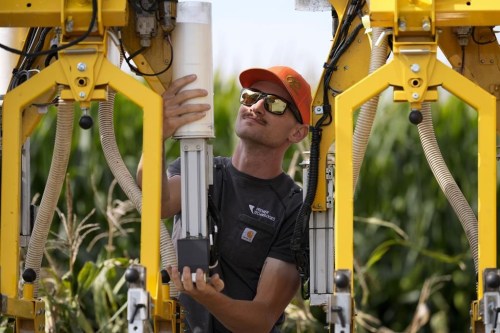
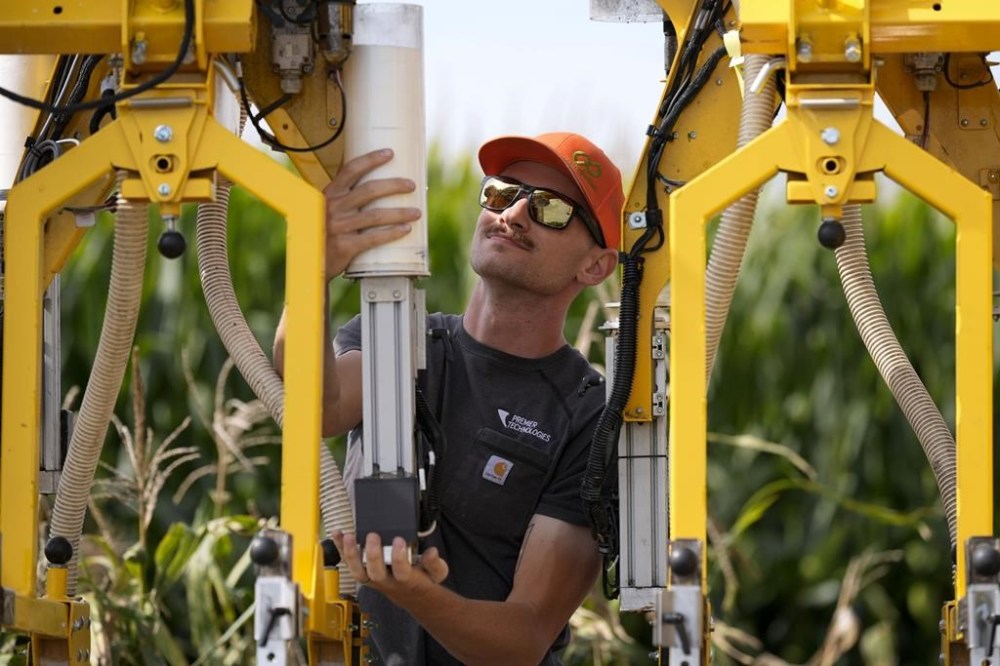
A growing number of companies are bringing automation to agriculture. It could ease the sector’s deepening labor shortage, help farmers manage costs, and protect workers from extreme heat. Automation could also improve yields by bringing greater accuracy to planting, harvesting, and farm management, potentially mitigating some of the challenges of growing food in an ever-warmer world.
But many small farmers and producers across the country aren’t convinced. Barriers to adoption go beyond steep price tags to questions about whether the tools can do the jobs nearly as well as the workers they’d replace. Some of those same workers wonder what this trend might mean for them, and whether machines will lead to exploitation.
How autonomous is farm automation? Not completely – yet
On some farms, driverless tractors churn through acres of corn, soybeans, lettuce and more. Such equipment is expensive, and requires mastering new tools, but row crops are fairly easy to automate. Harvesting small, non-uniform and easily damaged fruits like blackberries, or big citruses that take a bit of strength and dexterity to pull off a tree, would be much harder.
That doesn’t deter scientists like Xin Zhang, a biological and agricultural engineer at Mississippi State University. Working with a team at Georgia Institute of Technology, she wants to apply some of the automation techniques surgeons use, and the object recognition power of advanced cameras and computers, to create robotic berry-picking arms that can pluck the fruits without creating a sticky, purple mess.
The scientists have collaborated with farmers for field trials, but Zhang isn’t sure when the machine might be ready for consumers. Although robotic harvesting is not widespread, a smattering of products have hit the market, and can be seen working from Washington’s orchards to Florida’s produce farms.
“I feel like this is the future,” Zhang said.
But where she sees promise, others see problems.
Frank James, executive director of grassroots agriculture group Dakota Rural Action, grew up on a cattle and crop farm in northeastern South Dakota. His family once employed a handful of farmhands, but has had to cut back due, in part, to the lack of available labor. Much of the work is now done by his brother and sister-in-law, while his 80-year-old father occasionally pitches in.
They swear by tractor autosteer, an automated system that communicates with a satellite to help keep the machine on track. But it can’t identify the moisture levels in the fields which can hamstring tools or cause the tractor to get stuck, and requires human oversight to work as it should. The technology also complicates maintenance. For these reasons, he doubts automation will become the “absolute” future of farm work.
“You build a relationship with the land, with the animals, with the place that you’re producing it. And we’re moving away from that,” said James.
Some farmers say automation answers labor woes
Tim Bucher grew up on a farm in Northern California and has worked in agriculture since he was 16. Dealing with weather issues like drought has always been a fact of life for him, but climate change has brought new challenges as temperatures regularly hit triple digits and blankets of smoke ruin entire vineyards.
The toll of climate change compounded by labor challenges inspired him to combine his farming experience with his Silicon Valley engineering and startup background to found Agtonomy in 2021. It works with equipment manufacturers like Doosan Bobcat to make automated tractors and other tools.
Since pilot programs started in 2022, Bucher says the company has been “inundated” with customers, mainly vineyard and orchard growers in California and Washington.
Those who follow the sector say farmers, often skeptical of new technology, will consider automation if it will make their business more profitable and their lives easier. Will Brigham, a dairy and maple farmer in Vermont, sees such tools as solutions to the nation’s agricultural workforce shortage.
“A lot of farmers are struggling with labor,” he said, citing the “high competition” with jobs where “you don’t have to deal with weather.”
Since 2021, Brigham’s family farm has been using Farmblox, an AI-powered farm monitoring and management system that helps them get ahead of issues like leaks in tubing used in maple production. Six months ago, he joined the company as a senior sales engineer to help other farmers embrace technology like it.
Workers worry about losing jobs, or their rights, to automation
Detasseling corn used to be a rite of passage for some young people in the Midwest. Teenagers would wade through seas of corn removing tassels – the bit that looks like a yellow feather duster at the top of each stalk – to prevent unwanted pollination.
Extreme heat, drought and intense rainfall have made this labor-intensive task even harder. And it’s now more often done by migrant farmworkers who sometimes put in 20-hour days to keep up. That’s why Jason Cope, co-founder of farm tech company PowerPollen, thinks it’s essential to mechanize arduous tasks like detasseling. His team created a tool a tractor can use to collect the pollen from male plants without having to remove the tassel. It can then be saved for future crops.
“We can account for climate change by timing pollen perfectly as it’s delivered,” he said. “And it takes a lot of that labor that’s hard to come by out of the equation.”
Erik Nicholson, who previously worked as a farm labor organizer and now runs Semillero de Ideas, a nonprofit focused on farmworkers and technology, said he has heard from farm workers concerned about losing work to automation. Some have also expressed worry about the safety of working alongside autonomous machines but are hesitant to raise issues because they fear losing their jobs. He’d like to see the companies building these machines, and the farm owners using them, put people first.
Luis Jimenez, a New York dairy worker, agrees. He described one farm using technology to monitor cows for sicknesses. Those kinds of tools can sometimes identify infections sooner than a dairy worker or veterinarian.
They also help workers know how the cows are doing, Jimenez said, speaking in Spanish. But they can reduce the number of people needed on farms and put extra pressure on the workers who remain, he said. That pressure is heightened by increasingly automated technology like video cameras used to monitor workers’ productivity.
Automation can be “a tactic, like a strategy, for bosses, so people are afraid and won’t demand their rights,” said Jimenez, who advocates for immigrant farmworkers with the grassroots organization Alianza Agrícola. Robots, after all, “are machines that don’t ask for anything,” he added. “We don’t want to be replaced by machines.”
___

This story has corrected the style for the company name Agtonomy.
___
Associated Press reporters Amy Taxin in Santa Ana, California, and Dorany Pineda in Los Angeles contributed. Walling reported from Chicago.
___
The Associated Press’ climate and environmental coverage receives financial support from multiple private foundations. AP is solely responsible for all content. Find AP’s standards for working with philanthropies, a list of supporters and funded coverage areas at AP.org.