Quebec plans to force new doctors to stay in the province and work in public system

Advertisement

Advertise with us

MONTREAL - The Quebec government is planning to force new doctors trained in the province to work in Quebec's public health-care system for the first few years of their practice, in a bid to slow the loss of physicians to the private sector and to other provinces.

Read this article for free:


or

Already have an account? Log in here »

To continue reading, please subscribe:

Subscribe and receive a limited-edition Free Press branded hat or tote.

Digital Subscription

One year of digital access for only $205*

  • Enjoy unlimited reading on winnipegfreepress.com
  • Read the E-Edition, our digital replica newspaper
  • Access News Break, our award-winning app
  • Play interactive puzzles

*First annual payment billed as $205.00 + GST for one year. This annual subscription will automatically renew at $233.00 + GST every 52 weeks (10% off the regular annual price of $259.35). Offer available to new and qualified returning subscribers only. Cancel any time.

To continue reading, please subscribe:

Add Free Press access to your Brandon Sun subscription for only an additional

$1 for the first 4 weeks*

  • Enjoy unlimited reading on winnipegfreepress.com
  • Read the E-Edition, our digital replica newspaper
  • Access News Break, our award-winning app
  • Play interactive puzzles
Start now

*Your next Brandon Sun subscription payment will increase by $1.00 and you will be charged $17.95 plus GST for four weeks. After four weeks, your payment will increase to $24.95 plus GST every four weeks.

Hey there, time traveller!
This article was published 04/11/2024 (703 days ago), so information in it may no longer be current.

MONTREAL – The Quebec government is planning to force new doctors trained in the province to work in Quebec’s public health-care system for the first few years of their practice, in a bid to slow the loss of physicians to the private sector and to other provinces.

Health Minister Christian Dubé says he will table a bill by the end of the legislative session, to be debated next spring, that would require family doctors and specialists to start their careers in Quebec’s public network.

“While too many Quebecers are still waiting to be treated, too many doctors decide, from the start of their career, to leave the Quebec public network,” he said in a statement Sunday evening. “We will take steps to ensure that the population has access to the care for which they pay.”
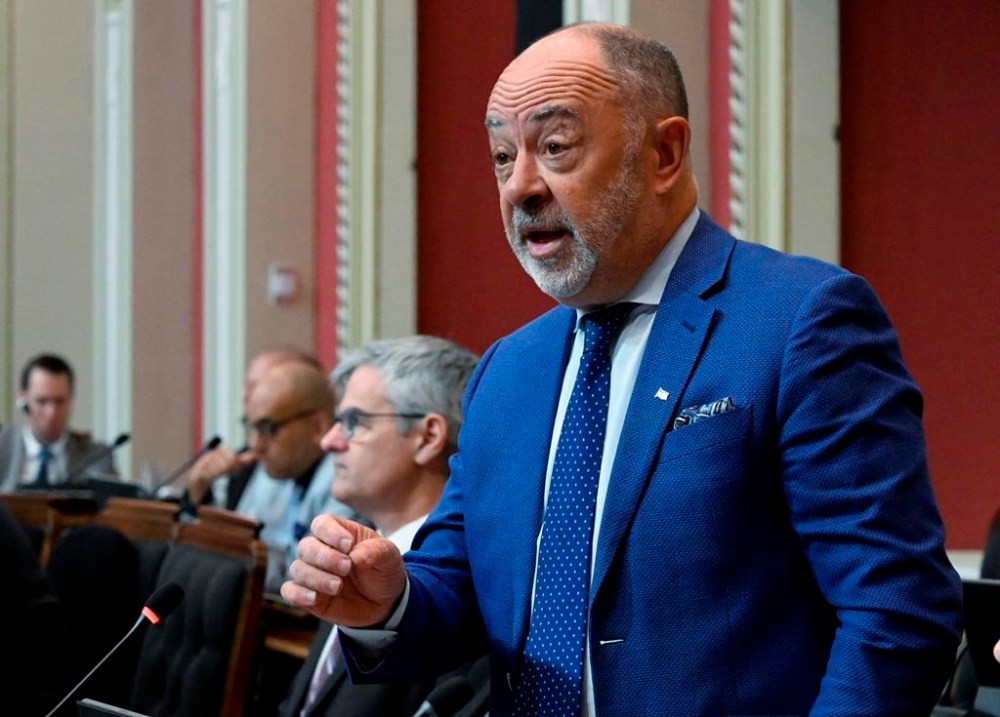
Quebec Health Minister Christian Dubé responds to the Opposition during question period Thursday, Oct. 24, 2024, at the legislature in Quebec City. New doctors trained in Quebec universities will have to spend the first years of their practice in the province and in the public health care system, the Quebec government says. THE CANADIAN PRESS/Jacques Boissinot

Dubé told a Montreal radio station on Monday morning that those who want to leave Quebec or work in the private system will face “consequences,” though he offered no details. It’s also unclear how long new doctors would be required to practise in Quebec’s public network.

The Quebec government estimates it costs between $435,000 and $790,000 to train a doctor, including during their residency. It says that 775 of Quebec’s 22,479 practising physicians are working exclusively in the private sector, a 70 per cent increase since 2020. The trend is especially notable among new doctors, according to the province.

A spokesperson for Dubé told The Canadian Press that 400 of the 2,536 doctors who completed their studies between 2015 and 2017 have left Quebec for other jurisdictions. Moreover, 2,355 doctors trained in Quebec are practising in Ontario, including 1,675 who attended McGill University.

Data from the Canadian Institute for Health Information show that just 60 per cent of family doctors who had recently graduated in Quebec were still practising in the province in 2022, while nearly 20 per cent had moved to Ontario. The number was higher for specialists, with 77 per cent of recent graduates still practising in Quebec.

In Ontario, 85 per cent of recently graduated family doctors and 80 per cent of specialists were still in the province in 2022. In Nova Scotia, however, just 42 per cent of family doctors and 38 per cent of specialists remained in the province.

Krystle Wittevrongel, director of research with the Montreal Economic Institute, said the new proposal doesn’t address the underlying issues that are pushing doctors toward the private system, including the prospect of dealing with less red tape and having greater power to set their own schedules. The government’s plan “is actually putting more constraints on them and making it more rigid,” she said.

Quebec is unique in Canada for the high number of doctors migrating to private medicine, in large part due to provincial rules that let doctors easily opt in and out of the public network. “It’s virtually none (leaving) or very few in the rest of Canada compared to hundreds, and it’s a growing number, in Quebec,” Wittevrongel said.

She said a better solution would be to allow doctors to have a “mixed practice,” which would let them work in both the public and private sectors.

Quebec’s college of physicians said it supports the government’s plan. “For us, this is a question of social responsibility,” it said in a statement. “But we will want to see the terms of this bill.”

On Monday, the college released a set of guiding principles for the role of the private sector in health care, which included a call for the expansion of the private health system to be “suspended immediately.”

This report by The Canadian Press was first published Nov. 4, 2024.

Report Error Submit a Tip

More Stories

Khan’s abrupt departure presents desperate Tories with a valuable opportunity

Tom Brodbeck 5 minute read Preview

Khan’s abrupt departure presents desperate Tories with a valuable opportunity

Tom Brodbeck 5 minute read Tuesday, Oct. 6, 2026

If the Manitoba Progressive Conservatives are serious about getting out of the political wilderness, they should start by electing a progressive conservative leader.

Read
Tuesday, Oct. 6, 2026

Duo accused in random Osborne Village attacks no strangers to police

Dean Pritchard and Chris Kitching 5 minute read Preview

Duo accused in random Osborne Village attacks no strangers to police

Dean Pritchard and Chris Kitching 5 minute read Tuesday, Oct. 6, 2026

A man arrested following a violent, random attack on two men in Osborne Village late Sunday night was released from jail a week earlier after a dozen charges, including crimes of violence, were stayed against him, court records show.

A man in his 40s was sent to hospital in critical condition and another man in his 20s in stable condition following separate attacks shortly before midnight in the vicinity of River Avenue and Osborne Street.

Police have charged Reginald Owen, 26, and Meaghan Owen, 32, both from Little Grand Rapids, with assault with a weapon and aggravated assault. They both remain in custody.

Court records show Reginald Owen was sentenced Sept. 24 to 30 days time served after pleading guilty to simple possession of magic mushrooms. Owen remained in custody until the following day when he was set to apply for bail on charges including assault, sexual assault, choking to overcome resistance, pointing a firearm, and carrying a concealed weapon.

Read
Tuesday, Oct. 6, 2026

Manitoba spends, what comes next?

Rafiq Andani 4 minute read 2:00 AM CDT

Whatever Manitobans think of this government’s health-care record, its willingness to spend is impressive. The promise to rebuild care has inspired a massive mobilization of public money.

Health, Seniors and Long-Term Care spending reached $9.66 billion in 2025-26. Next year’s budget allocates $10.59 billion, an almost 10 per cent increase above last year’s actual spending, following increases of approximately 5.6 and 6.8 per cent in the preceding years. The government has found room for another $931 million in a single year.

That allocation stands roughly $2 billion above spending in 2023-24, the year the government changed, and represents an increase of nearly one-quarter. At $10.59 billion, the budget amounts to approximately $29 million a day.

Let’s consider the province’s reported additions and funding commitments:

Kids deserve better

Jordan Laidlaw 4 minute read 2:00 AM CDT

As much as I cling to hope, I recognize the ominous circumstances and questionable future that our young people stand to inherit.

Youth are navigating a world plagued with the existential dangers of climate change, artificial intelligence, political polarization and rising military armament, among other disconcerting trends. While schools cannot entirely ameliorate these issues, I am inspired by the words of Amina Mohammed, the United Nations deputy secretary-general, who declared teachers to be the “guardians of our future.”

Our future integrally depends on the learning, healthy development and empowerment of young people. With the upcoming Manitoba school board elections, I invite readers, voters and prospective candidates to consider how to support the practices of these guardians so we may ensure a brighter tomorrow.

First, I believe we are in — or entering — a community mental-health crisis. There is a resounding body of peer-reviewed research outlining the declining trends in the mental health of youth, parents and teachers. In May 2026, Doctors Manitoba stated its concern that the technology consumption habits of youth rivalled the health detriments of drinking and smoking. Many parents are stressed, economically struggling and need assistance. How might schools mitigate these precarious developments?

Don’t let pyjama jibes sour your bedtime bond

Maureen Scurfield 5 minute read Yesterday at 2:01 AM CDT

DEAR MISS LONELYHEARTS: I got married in August and my new husband just bought himself old-man striped flannel pyjamas to wear to bed now that it’s getting colder out. He didn’t do this before we were married. What a turn-off. Should I buy him a nightcap as well?

He used to be a sexy guy who just dumped his clothes on the chair beside the bed and jumped in naked.

But last night I watched him come out of the bathroom in a ratty old robe. I thought, “He looks like my grandfather, not my husband.”

I called out sarcastically, “Hey, gramps, are you lost?” and he said, “Not anymore.” Then he walked into the spare bedroom and slept there all night without me. Help.

Kinew, two NDP caucus members file lawsuit defence, deny defaming former party MLA Wasyliw to expel him

Erik Pindera 4 minute read Preview

Kinew, two NDP caucus members file lawsuit defence, deny defaming former party MLA Wasyliw to expel him

Erik Pindera 4 minute read Yesterday at 5:22 PM CDT

The premier and two New Democrat caucus members have denied they conspired to defame another politician as an excuse to oust him from the party.

Mark Wasyliw, now an independent Member of the Legislative Assembly representing Fort Garry, was booted from the NDP in September 2024, which the party claimed was due to Wasyliw’s former law partner representing convicted sex offender and disgraced fashion mogul Peter Nygard.

The independent MLA, who’s a defence lawyer, claims statements his former colleagues made in September 2024 linking him to Nygard or accusing him of lying, harmed him and his reputation.

Wasyliw filed his lawsuit in December last year, naming Premier Wab Kinew, Natural Resources Minister Ian Bushie and Seine River MLA Billie Cross as defendants. The claim was later amended to remove Bushie as a defendant and add Environment Minister Mike Moyes, who was at the time chair of the NDP caucus, in his place.

Read
Yesterday at 5:22 PM CDT