Ship strikes kill thousands of whales. A study of hot spots could map out solutions
Advertisement
Read this article for free:
or
Already have an account? Log in here »
To continue reading, please subscribe:

Digital Subscription
One year of digital access for only $205*
- Enjoy unlimited reading on winnipegfreepress.com
- Read the E-Edition, our digital replica newspaper
- Access News Break, our award-winning app
- Play interactive puzzles
*First annual payment billed as $205.00 + GST for one year. This annual subscription will automatically renew at $233.00 + GST every 52 weeks (10% off the regular annual price of $259.35). Offer available to new and qualified returning subscribers only. Cancel any time.
To continue reading, please subscribe:
Add Free Press access to your Brandon Sun subscription for only an additional
$1 for the first 4 weeks*
- Enjoy unlimited reading on winnipegfreepress.com
- Read the E-Edition, our digital replica newspaper
- Access News Break, our award-winning app
- Play interactive puzzles
*Your next Brandon Sun subscription payment will increase by $1.00 and you will be charged $17.95 plus GST for four weeks. After four weeks, your payment will increase to $24.95 plus GST every four weeks.
Read unlimited articles for free today:
or
Already have an account? Log in here »
Hey there, time traveller!
This article was published 22/11/2024 (641 days ago), so information in it may no longer be current.
A study of hot spots for collisions between ships and whales around the world, including Canadian waters, offers a map for measures to prevent the deadly strikes that could drive some species to extinction, one of the British Columbia-based authors says.
Chloe Robinson said reported strikes represent a fraction of their true extent, and a lack of protection measures leaves whales vulnerable as global shipping expands.
The study found shipping takes place across 92 per cent of the ranges for humpback, blue, fin and sperm whales worldwide, but measures to reduce vessel strikes have been implemented in less than seven per cent of high-risk areas.
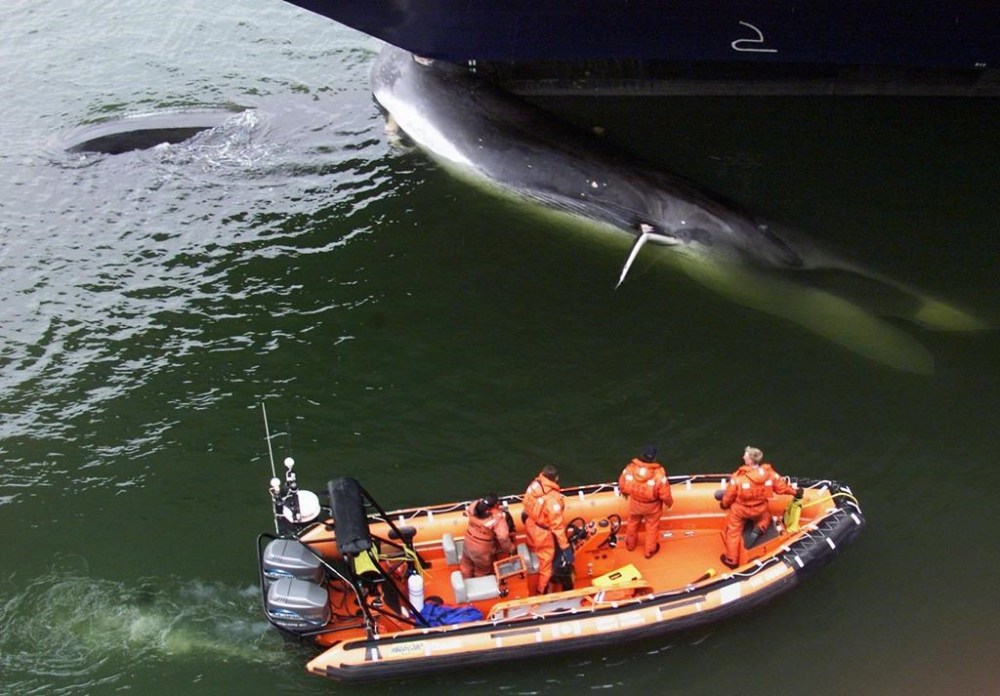
“That could really spell, you know, potential extinction for some of these species,” said Robinson,director of whales for Ocean Wise, a B.C.-based organization that provided data for the paper published in the peer-reviewed journal Science.
“A recent study estimated anything up to 20,000 whales are killed a year through ship strikes, globally, and that’s just an estimate, a best-case estimate.”
Robinson said she was surprised to see Swiftsure Bank, off the west coast of Vancouver Island, emerge as a risk hot spot for strikes of fin, blue and humpback whales. The area is a “migration highway” for humpbacks, she noted.
The study also identified a hot spot for the same three species in the Gulf of St. Lawrence between Quebec, New Brunswick and Newfoundland.
“This is something that Ocean Wise has been looking into because a lot of the management measures occur offshore and not sort of within the Gulf of St. Lawrence itself and even the St. Lawrence Seaway, (which) leads down to the Great Lakes,” she said. “That was a huge hot spot, which was really interesting for me.”
Robinson said there have been smaller studies on the risk of ship strikes in different regions, but the study published Thursday is the first to map the distribution of the four whale species, using a variety of data sources, then compare it with the Automatic Identification System, a tool used for tracking vessels worldwide.
“This was really the first of its kind to map these two on top of each other,” she said.
The researchers found the highest levels of risk in the Indian, western North Pacific and Mediterranean, while it also identified high-risk areas in the eastern North Pacific, North and South Atlantic Ocean along with the South China Sea.
The Southern Ocean was the only region that did not contain any ship-strike hot spots due to low levels of shipping, despite high use by whales, the study found.
Robinson said the findings support a strong case for maritime authorities to adopt measures such as whale alert systems, speed limits and no-go zones.
“We know where there are areas where there are lots of whales and lots of ships, so this is where we need to target for management,” she said in an interview.
Robinson said Canada is home to many “eyes on the water” and researchers exploring innovative techniques for monitoring whales.
But the country lacks mandatory mitigation measures, and it’s not alone.
“Next to none of the measures globally are mandatory. So, having voluntary measures (is) great, provided people comply,” Robinson said.
Ocean Wise launched an alert system in 2018 that notifies large vessels of the presence of whales in Pacific Northwest waters, and Robinson said about 80 per cent of mariners from Washington state up to Alaska have signed up.
The WhaleReport alert system mainly functions in what she describes as “inshore” waters around busy ports in Seattle, Vancouver and Prince Rupert.
The Port of Vancouver has also seen a high rate of compliance for its ECHO program, Robinson noted. The program encourages vessels to take voluntary steps, such as slowing down or staying farther away from whales, in order to reduce underwater noise and the potential for strikes in busy shipping areas.
Robinson favours a multi-pronged approach to reducing ship strikes, but she said one single measure she believes could have a big impact would be equipping vessels with an infrared camera to detect whales within several kilometres.
“Maybe some mariners … respond better to knowing there 100 per cent is a whale 200 metres in front of your vessel, versus, ‘slow down, there might be a whale here.'”
Robinson said such cameras can cost betweenUS$50,000 and $75,000. But the cost was a “drop in the bucket” of major companies’ profits, she said.
The cameras also present a public-relations opportunity for businesses to advertise themselves as operating in a more whale-friendly manner, Robinson said.
“I know people who have had to go and have therapy after killing a humpback whilst at the helm,” she added. “I think there’s a lot to be said (for) the long-term benefits of this kind of technology.”
The study also found areas with lower traffic that could provide refuge for whales, especially with added protections.
It shows the Arctic Ocean, for example, has very few high-risk areas for vessel strikes, and Robinson said some researchers view it as potential sanctuary.
But without protections, Robinson said Arctic waters could become the next high-risk hot spot as sea ice melts with climate change, opening up shipping routes.
“Knowing the plans to expand shipping routes into these areas to cut shipping time, make things faster, right through prime whale habitat, I think this is a really good opportunity to get ahead of the issue before it becomes an issue,” she said.
Whales play crucial roles in their ecosystems, including cycling nutrients that support other species, and they’re a boon for tourism, Robinson said.
They’re also “magical” creatures that people feel connected to, she said, and they remain vulnerable after many species were hunted to the brink of extinction.
This report by The Canadian Press was first published Nov. 22, 2024.