Peacemaking and Canada’s international reputation

Advertisement
Read this article for free:
or
Already have an account? Log in here »
To continue reading, please subscribe:

Digital Subscription
One year of digital access for only $205*
- Enjoy unlimited reading on winnipegfreepress.com
- Read the E-Edition, our digital replica newspaper
- Access News Break, our award-winning app
- Play interactive puzzles
*First annual payment billed as $205.00 + GST for one year. This annual subscription will automatically renew at $233.00 + GST every 52 weeks (10% off the regular annual price of $259.35). Offer available to new and qualified returning subscribers only. Cancel any time.
To continue reading, please subscribe:
Add Free Press access to your Brandon Sun subscription for only an additional
$1 for the first 4 weeks*
- Enjoy unlimited reading on winnipegfreepress.com
- Read the E-Edition, our digital replica newspaper
- Access News Break, our award-winning app
- Play interactive puzzles
*Your next Brandon Sun subscription payment will increase by $1.00 and you will be charged $17.95 plus GST for four weeks. After four weeks, your payment will increase to $24.95 plus GST every four weeks.
Read unlimited articles for free today:
or
Already have an account? Log in here »
Hey there, time traveller!
This article was published 23/11/2024 (673 days ago), so information in it may no longer be current.
For many years, Canada had a much-lauded and highly respected reputation for peacekeeping — it helped define our national identity.
It started back in 1956. That’s when Lester Pearson, then minister of external affairs, proposed the creation of a United Nations peacekeeping force to resolve a crisis in Egypt when Great Britain, France and Israel attacked that country after it nationalized the Suez Canal.
The introduction of peacekeeping troops, including from Canada, stabilized the situation and allowed the belligerents to work out an agreement to end the fighting. For his efforts, Pearson was awarded the 1957 Nobel Peace Prize.
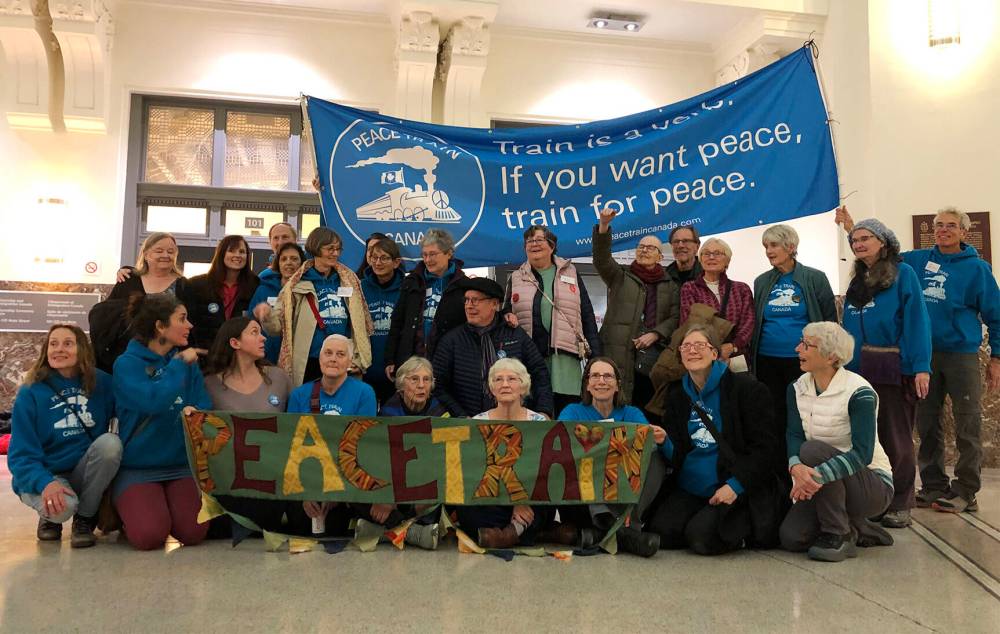
JOHN LONGHURST / FREE PRESS
The Peace Train stopped in Winnipeg on Nov. 17.
For decades after that crisis, Canada remained at the forefront of international peacekeeping operations. Altogether, the country sent about 125,000 trained peacekeepers on over 50 peacekeeping missions around the globe.
Through those missions, Canada came to be seen as an honest and reliable broker in international affairs. At the same time, Canadians proudly identified with the nation’s peacekeeping tradition and role, seeing it as a key way we could contribute to the world.
Today, however, Canada has virtually no involvement in peacekeeping. In 1992, it had over 3,800 peacekeepers around the globe; today there are fewer than 20.
Keith and Bernadette Wyton think Canada can and should do better. Earlier this year, the retired couple from Port Alberni, B.C., came up with the idea of a Peace Train that would travel from Vancouver to Ottawa to call on the government to renew support for peacekeeping efforts.
In particular, they wanted to see Canada spend a tiny fraction of the money it devotes to the military to establish and fund a Centre of Excellence for Peace and Justice focused on research, education and training in conflict resolution, diplomacy and peace operations around the world.
The proposed centre would pick up the mantle of the former Lester B. Pearson Canadian International Peacekeeping Training Centre. Created in 1994 with a mandate to support Canada’s contribution to international peace and security, it was closed under prime minister Stephen Harper in 2011.
During its years of operation, the Centre trained soldiers and police officers from various countries to serve as peacekeepers around the world — and also to protect the human rights of people impacted by mining operations in the developing world.
On Nov. 15, 40 people boarded the Peace Train in Vancouver — in actuality, VIA Rail’s regularly scheduled the Canadian between the West Coast and Toronto — and travelled to Ottawa to ask the government to do more for peace.
Along the way, they held rallies with supporters at train stations. This included in Edmonton on Nov. 16, where Douglas Roche, a former Canadian senator, parliamentarian and diplomat told Peace Train participants that Canada needs “to find a new way to stop militarism. We need new diplomatic initiatives for peace.”
Noting the election of Donald Trump might mean Canada can expect pressure to spend more on the military, Roche said money would be better spent on housing, education and health care at home. “That’s where Canadians want their tax dollars to go, not more militarism,” he said.
Among the participants were five Winnipeggers. For Gordon Matties, being part of the trip was about imagining “a hopeful future, a future without war, a future of peace with justice for all of creation.”
For Lori Matties, it was about contributing to the recovery of Canada’s voice for peace. “History has shown that war never results in lasting peace,” she said. “More than ever, I believe we are all called to love our neighbours and the only way to get rid of our enemies is to make them our friends.”
Val Falk wanted to see Canada reclaim the peacekeeping tradition she remembers growing up as a child in the 1960s. “Our world is in desperate need of more peacemaking,” she said, adding she grew up Mennonite and peace was always a strong value in her home.
Agnes Hubert was inspired by her Anabaptist background to “highlight peacemaking and diplomacy as a role that Canada can make its own in a more substantive way … I think it is a faithful interpretation of Jesus’ teachings.”

Bev Hindle appreciates that the government is under a lot of pressure to decide where to spend its money. But if Canada cares about its international reputation, then it needs to prioritize things like “justice, peace and climate,” she said.
Will the Peace Train make a difference? That’s the big unknown. There’s an election next year, and politicians know foreign affairs rarely is on the mind of voters. Plus, the change in government in the U.S. has left everyone uncertain about the future.
But an increased emphasis on peacemaking may be good for both the Liberals, who need to keep their progressive supporters onside and for the Conservatives, who need to show undecided voters they aren’t scary warmongers.
As for Bernadette Wyton, her goal is to just see Canada again play a leading role in promoting peace in the world today. Along with that, she also hopes the Peace Train is an encouragement to other Canadians who feel the same way.
faith@freepress.mb.ca
The Free Press is committed to covering faith in Manitoba through our Religion in the News project. This reporting continues because readers like you step forward to fund it.
Donate now to support our reporting on religion.
Your donation is eligible for a charitable tax receipt.
BECOME A FAITH JOURNALISM SUPPORTER
Our newsroom depends on a growing audience of readers to power our journalism. If you are not a paid reader, please consider becoming a subscriber.
Our newsroom depends on its audience of readers to power our journalism. Thank you for your support.
The Free Press is committed to covering faith in Manitoba through our Religion in the News project. This reporting continues because readers like you step forward to fund it.
Donate now to support our reporting on religion.
Your donation is eligible for a charitable tax receipt.
BECOME A FAITH JOURNALISM SUPPORTER
Our newsroom depends on a growing audience of readers to power our journalism. If you are not a paid reader, please consider becoming a subscriber.
Our newsroom depends on its audience of readers to power our journalism. Thank you for your support.
Advertisement Advertise With Us
Advertisement Advertise With Us
The Free Press acknowledges the financial support it receives from members of the city’s faith community, which makes our coverage of religion possible.