
Scientists gather to decode puzzle of the world’s rarest whale in ‘extraordinary’ New Zealand study

Advertisement

Advertise with us

WELLINGTON, New Zealand (AP) — It is the world’s rarest whale, with only seven of its kind ever spotted. Almost nothing is known about the enigmatic species. But on Monday a small group of scientists and cultural experts in New Zealand clustered around a near-perfectly preserved spade-toothed whale hoping to decode decades of mystery.

Read this article for free:


or

Already have an account? Log in here »

To continue reading, please subscribe:

Subscribe and receive a limited-edition Free Press branded hat or tote.

Digital Subscription

One year of digital access for only $205*

  • Enjoy unlimited reading on winnipegfreepress.com
  • Read the E-Edition, our digital replica newspaper
  • Access News Break, our award-winning app
  • Play interactive puzzles

*First annual payment billed as $205.00 + GST for one year. This annual subscription will automatically renew at $233.00 + GST every 52 weeks (10% off the regular annual price of $259.35). Offer available to new and qualified returning subscribers only. Cancel any time.

To continue reading, please subscribe:

Add Free Press access to your Brandon Sun subscription for only an additional

$1 for the first 4 weeks*

  • Enjoy unlimited reading on winnipegfreepress.com
  • Read the E-Edition, our digital replica newspaper
  • Access News Break, our award-winning app
  • Play interactive puzzles
Start now

*Your next Brandon Sun subscription payment will increase by $1.00 and you will be charged $17.95 plus GST for four weeks. After four weeks, your payment will increase to $24.95 plus GST every four weeks.

Hey there, time traveller!
This article was published 02/12/2024 (680 days ago), so information in it may no longer be current.

WELLINGTON, New Zealand (AP) — It is the world’s rarest whale, with only seven of its kind ever spotted. Almost nothing is known about the enigmatic species. But on Monday a small group of scientists and cultural experts in New Zealand clustered around a near-perfectly preserved spade-toothed whale hoping to decode decades of mystery.

“I can’t tell you how extraordinary it is,” said a joyful Anton van Helden, senior marine science adviser for New Zealand’s conservation agency, who gave the spade-toothed whale its name to distinguish it from other beaked species. “For me personally, it’s unbelievable.”

Van Helden has studied beaked whales for 35 years, but Monday was the first time he has participated in a dissection of the spade-toothed variety. In fact, the careful study of the creature — which washed up dead on a New Zealand beach in July — is the first ever to take place.
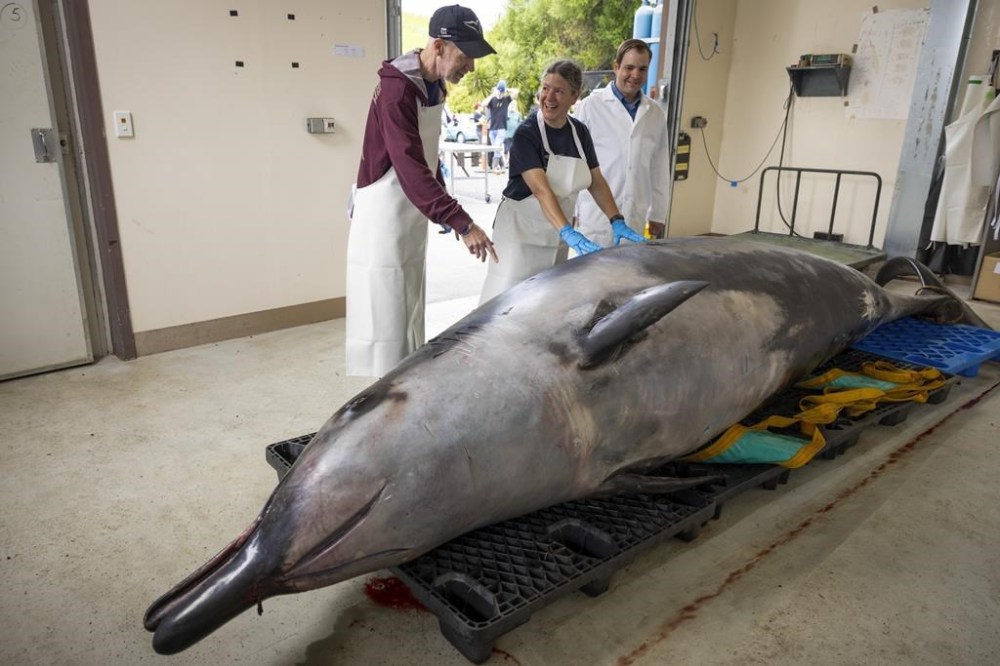
International scientist's, Alexander Werth, from left, professor Joy Reidenberg and Michael Denk study a male spade-toothed whale ahead of a dissection at Invermay Agricultural Centre, Mosgiel, near Dunedin, New Zealand, Monday, Dec. 2, 2024. (AP Photo/Derek Morrison)

None has ever been seen alive at sea.

The list of what scientists don’t know about spade-toothed whales is longer than what they do know. They don’t know where in the ocean the whales live, why they’ve never been spotted in the wild, or what their brains look like. All beaked whales have different stomach systems and researchers don’t know how the spade-toothed kind processes its food. They don’t know how this one died.

Over the next week, researchers studying the 5-meter (16-foot) -long male at an agricultural research center near the city of Dunedin hope to find out.

“There may be parasites completely new to science that just live in this whale,” said van Helden, who thrilled at the chance of learning how the species produces sound and what it eats. “Who knows what we’ll discover?”

Only six other spade-toothed whales have ever been found, but all those discovered intact were buried before DNA testing could verify their identification.

New Zealand is a whale-stranding hotspot, with more than 5,000 episodes recorded since 1840, according to the Department of Conservation. The first spade-toothed whale bones were found in 1872 on New Zealand’s Pitt Island. Another discovery was made at an offshore island in the 1950s, and the bones of a third were found on Chile’s Robinson Crusoe Island in 1986.

DNA sequencing in 2002 proved that all three specimens were of the same species — and that it was distinct from other beaked whales. But researchers studying the mammal couldn’t confirm whether the species was extinct until 2010, when two whole spade-toothed whales, both dead, washed up on a New Zealand beach. But none has been studied before.

On Monday, the seventh of its kind, surrounded by white-aproned scientists who were measuring and photographing, appeared relatively unblemished, giving no clue about its death. Researchers pointed out marks from cookiecutter sharks — normal, they said, and not the cause.

The dissection will be quiet, methodical and slower than usual, because it is being undertaken in partnership with Māori, New Zealand’s Indigenous people. To Māori, whales are a taonga -– a precious treasure -– and the creature will be treated with the reverence afforded to an ancestor.

Members of the local iwi, or tribe, will be present throughout the dissection and consulted at each turn, allowing them to share traditional knowledge and observe customs, such as saying a karakia -– a prayer -– over the creature before the study begins.
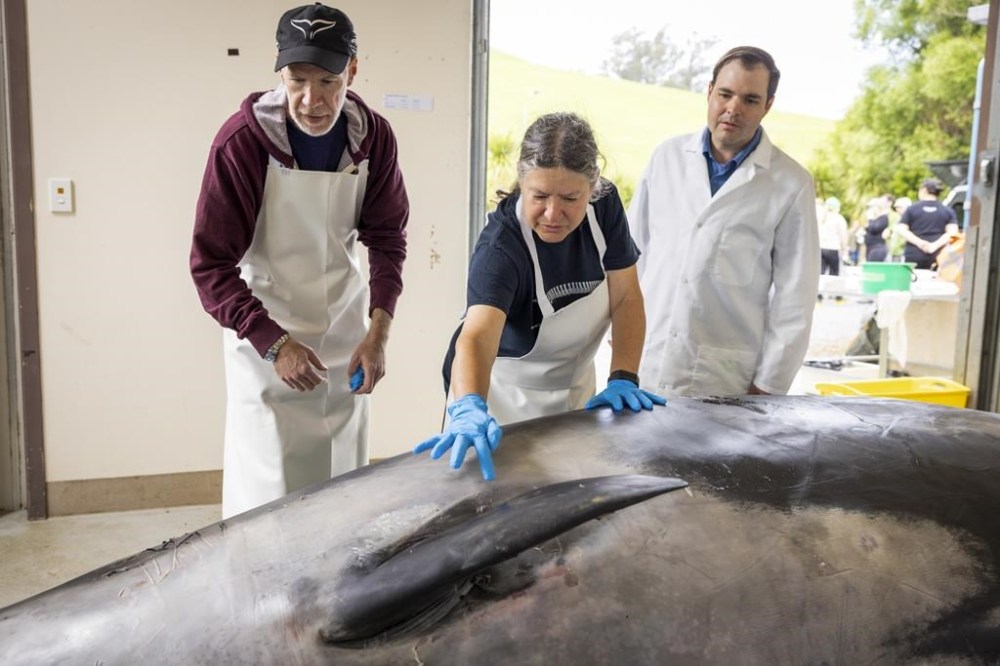
International scientists, Alexander Werth, from left, professor Joy Reidenberg and Michael Denk study a male spade-toothed whale ahead of a dissection at Invermay Agricultural Centre, Mosgiel, near Dunedin, New Zealand, Monday, Dec. 2, 2024. (AP Photo/Derek Morrison)

“According to our beliefs and our traditions, this whale is a gift of Tangaroa, deity of the ocean,” said Tumai Cassidy from the local people Te Rūnanga Ōtākou. “It’s very important for us to respect that gift and to honor the whale.”

The iwi will keep the jawbone and teeth of the whale at the end of the dissection, before its skeleton is displayed in a museum. 3D printing will be used to replicate those parts, using a CT scan taken of the whale’s head this week.

“It all builds a richer picture for that species but also tells us how it interacts with our oceans,” Cassidy said.

It’s thought that spade-toothed whales live in the vast Southern Pacific Ocean, home to some of the world’s deepest ocean trenches. Beaked whales are the ocean’s deepest divers for food, and the spade-toothed may rarely surface, adding to its mystery.

The assembled scientists on Monday included a few who had traveled from abroad to see the whale, which was put in refrigerated storage after its discovery.

“What we are interested in is not only how these animals died, but how they lived,” said Joy Reidenberg, a comparative anatomist from the Icahn School of Medicine at Mount Sinai in New York. “In discovering how they live, we are hoping to find discoveries that we can apply back to the human condition.”


Report Error Submit a Tip

More Stories

Woman accused of pulling handgun on taxi driver

1 minute read Yesterday at 10:39 AM CDT

A 45-year-old woman accused of pulling a handgun on a Winnipeg taxi driver is facing multiple firearms-related charges.

It happened Sunday afternoon, at about 2:30 p.m., near the intersection of Concordia Avenue and Louelda Street. Officers learned a woman got into a cab in the Munroe East neighbourhood and pulled out a handgun, asking the driver to take her to a specific location, the Winnipeg Police Service stated in a news release.

The taxi driver activated the taxi's emergency beacon, exited the vehicle, and contacted police.

The woman got into the driver's seat of the taxi, but the keys had been removed, and she fled on foot. A suspect was arrested shortly afterward in the 1000 block of Concordia Avenue. Police seized a .22-calibre handgun during the arrest.

Today’s horoscope

Georgia Nicols 4 minute read Preview

Today’s horoscope

Georgia Nicols 4 minute read 2:00 AM CDT

MOON ALERT: Caution. Avoid shopping (except food and gas) and important decisions from 3:15 a.m. until 8:15 p.m. After that, the moon moves from Scorpio into Sagittarius.

ARIES (March 21-April 19)

It’s tricky because the moon is in your financial house, which might encourage you to negotiate financial matters and discuss shared property, banking details, insurance issues and inheritances. However, there’s a moon alert. Postpone these discussions.

TAURUS (April 20-May 20)

Read
2:00 AM CDT

Manitoba e-scooter legislation changes set to impose speed limit, age restrictions, sidewalk ban

Matthew Frank 5 minute read Preview

Manitoba e-scooter legislation changes set to impose speed limit, age restrictions, sidewalk ban

Matthew Frank 5 minute read Updated: 11:26 AM CDT

People riding e-scooters and other personal electric vehicles in Manitoba will have to strap on a helmet, stay off sidewalks and follow new age limits once new provincial rules for the devices take effect next year.

The vehicles, which also include electric skateboards, hoverboards and unicycles, will fall under The Highway Traffic Act starting in 2027, according to the province’s website. E-bikes are excluded from the new rules, according to the province’s frequently-asked-questions page.

All riders must be at least 16 years old and wear properly fitting helmets — that goes for passengers, too, the province said.

The proposed new legislation sets a speed limit of 25 km/h and would prohibit personal electric vehicles from sidewalks unless signs specifically allow sidewalk use. Riders would be using shared paths or roads with speed limits of 50 km/hr or less. They won’t be allowed to operate the vehicles under the influence of alcohol or drugs and they must use hand signals and obey traffic signs.

Read
Updated: 11:26 AM CDT

News briefs for Tuesday, October 13, 2026

1 minute read Updated: 8:59 AM CDT

A collection of breaking news briefs filed on Tuesday, October 13, 2026

The Lobster Trap wins 2026 Dafoe Book Prize

8:59 AM

Greg Mercer’s The Lobster Trap: The Global Fight for a Seafood on the Brink has won the 2026 J.W. Dafoe Book Prize.

Piece of magic history disappears

Kelly-Anne Riess 5 minute read Preview

Piece of magic history disappears

Kelly-Anne Riess 5 minute read Updated: Yesterday at 4:15 PM CDT

A piece of Winnipeg’s magic history has vanished, and internationally renowned escape artist Dean Gunnarson is offering a $500 reward to anyone who can make it reappear.

The plaque marked the birthplace of what has become the world’s largest organization of professional and amateur magicians, the International Brotherhood of Magicians, which was founded in Winnipeg more than a century ago.

Gunnarson said fellow magician and local magic historian Bruce Thompson discovered the disappearance Tuesday while on his way to work.

Thompson returned to inspect the site and found what appeared to be evidence it had been forcibly removed.

Read
Updated: Yesterday at 4:15 PM CDT

Riding the Unity Bus to rally support for Canada in Alberta

Melissa Martin 8 minute read Preview

Riding the Unity Bus to rally support for Canada in Alberta

Melissa Martin 8 minute read Updated: Yesterday at 9:57 PM CDT

WAINWRIGHT, Alta. — The Unity Bus arrives right on time, pulling into a parking lot on the edge of this town of about 6,600 people close to the Alberta-Saskatchewan border. As the vehicle slows to a halt, resplendent in its patriotic red-and-white paint, a small group of supporters stand waiting, decked in their own maple leaf garb.

The Unity Bus’s doors open and former Alberta deputy premier Thomas Lukaszuk bounds to the ground. The supporters, volunteers with Lukaszuk’s Forever Canadian campaign, welcome him with applause; he greets them with open arms. He knows many by name, having been to Wainwright four times; some of them fondly call him “the boss.”

“Do you need some stickers?” he asks. “Do you need some swag to give away?”

It’s a chilly Thanksgiving Monday morning on the eastern edge of Alberta. A sharp wind nips at exposed skin and drab grey clouds hang low in the sky. Such weather does not encourage high spirits, but Lukaszuk and these volunteers can’t afford to let theirs falter: in just one week, on Oct. 19, Albertans will vote on a historic question on whether to remain in Canada.

Read
Updated: Yesterday at 9:57 PM CDT

