Alberta minister wants to see $100B in data centre infrastructure in next five years

Advertisement

Advertise with us

EDMONTON - Alberta Technology Minister Nate Glubish says he's hoping to see $100 billion worth of artificial intelligence data centres under construction within the next five years.

Read this article for free:


or

Already have an account? Log in here »

To continue reading, please subscribe:

Subscribe and receive a limited-edition Free Press branded hat or tote.

Digital Subscription

One year of digital access for only $205*

  • Enjoy unlimited reading on winnipegfreepress.com
  • Read the E-Edition, our digital replica newspaper
  • Access News Break, our award-winning app
  • Play interactive puzzles

*First annual payment billed as $205.00 + GST for one year. This annual subscription will automatically renew at $233.00 + GST every 52 weeks (10% off the regular annual price of $259.35). Offer available to new and qualified returning subscribers only. Cancel any time.

To continue reading, please subscribe:

Add Free Press access to your Brandon Sun subscription for only an additional

$1 for the first 4 weeks*

  • Enjoy unlimited reading on winnipegfreepress.com
  • Read the E-Edition, our digital replica newspaper
  • Access News Break, our award-winning app
  • Play interactive puzzles
Start now

*Your next Brandon Sun subscription payment will increase by $1.00 and you will be charged $17.95 plus GST for four weeks. After four weeks, your payment will increase to $24.95 plus GST every four weeks.

Hey there, time traveller!
This article was published 04/12/2024 (616 days ago), so information in it may no longer be current.

EDMONTON – Alberta Technology Minister Nate Glubish says he’s hoping to see $100 billion worth of artificial intelligence data centres under construction within the next five years.

Such centres are filled with computer servers used by companies like Meta, the owner of Facebook and Instagram, to develop and train large-scale artificial intelligence models.

These centres, depending on size, require loads of electricity to run.

Nate Glubish shakes hands with Alberta Premier Danielle Smith after Glubish was sworn into cabinet as Minister of Technology and Innovations in Edmonton, Monday, Oct. 24, 2022. Glubish says he's hoping to see $100 billion worth of artificial intelligence data centres under construction within the next five years.THE CANADIAN PRESS/Jason Franson

In an interview, Glubish said Meta, as well as other major companies like Google and Amazon, are on the hunt for space, and he wants Alberta to be an option.

“That’s where the home run comes in, in terms of increased investment, increased jobs and increased economic activity,” Glubish said.

He added that, through the government’s new data centre attraction strategy announced Wednesday, the government has created a “concierge program” to attract companies to Alberta.

“We’re already working with about a dozen companies that are looking very seriously at setting up a data centre in Alberta,” he said.

“We’re working with them to help identify the fastest way through the regulatory framework to get their projects moving forward.”

He said the ultimate goal is to create jobs and bring in much needed new tax revenue.

Glubish said since Alberta’s deregulated electricity market allows for off-grid power generation — permitting power generators to strike deals with private companies and supply them directly — the province is an ideal landing spot for many companies.

“The key there is off-grid means no risk to the grid in terms of reliability and affordability,” he said. “Make no mistake, we are not going to let anything happen that compromises affordability or reliability for Alberta’s electrical grid.”

“That’s a no-go zone for Albertans.”

This past January, during an extreme cold snap, high demand and unexpected generation outages led the Alberta Electric System Operator to issue an emergency grid warning asking Albertans to conserve power to avoid rolling blackouts.

The operator reported that two days before the January grid warning, Alberta had hit a record level of power demand at 12,384 megawatts.

But Utilities Minister Nathan Neudorf told reporters Wednesday that Alberta’s electricity grid could handle data centres.

“We have some room on our grid right now, but data centres can capture everything from 20 megawatts to 10,000 megawatts,” Neudorf said. “We are trying to identify who’s interested, what size, what are their needs and where would they like to go, so we can provide the best path for them.

“We have the ability, with our private industry, to scale up our generation very, very quickly, without it being dollars spent by the taxpayer or the government on behalf of the taxpayer.”

On Wednesday, the Royal Bank of Canada’s Climate Action Institute released a report that found if all data centre projects currently going through the regulatory approval process across the country were approved, they would account for 14 per cent of Canada’s power needs by 2030.

“Canadian regulators are reviewing data centre applications with an estimated combined capacity of 15 gigawatts — enough to power seven out of 10 homes nationwide,” the report reads, noting that Alberta-based projects represent 6.5 gigawatts (or 6,500 megawatts) of capacity.

“Alberta, with ample natural gas and lower grid pressures, prefers data centres operate off-grid, minimizing the strain on public grids,” the report states.

“But powering AI through natural gas comes with an emissions cost that provinces will need to weigh.”

The report said that if natural gas were to power six gigawatts of electricity for data centres, it would create an estimated 16 million tonnes of annual greenhouse gas emissions, although the use of carbon capture and storage could provide a partial offset.

This report by The Canadian Press was first published Dec. 4, 2024.

Report Error Submit a Tip

More Stories

Put in the work to find fulfilling relationship

Maureen Scurfield 4 minute read 2:00 AM CDT

DEAR MISS LONELYHEARTS: I made it four months without a girlfriend. Although I miss the sex, I have never felt more free! I’ve had overlapping girlfriends since the age of 13, and it’s like having a job for a guy like me. I’m always serving the woman, keeping her happy, giving her what she wants.

After my last break-up in June, I told my best friend I needed to stop serving princesses. He said “Well, you pick ’em! They can see you coming a mile away, and they’re ready.”

I start university this fall, and I swear I’m not going to end up in the same kind of messes with women in my life I always do. There’s a chance to start over, but I don’t know how to be anything different from what I am — a guy like my dad. He totally looks after my mom’s needs — but she loves it, and she looks after him in return.

I don’t know how to be a hard-headed guy who looks out for himself, like a few of my buddies who seem to get what they want with women. But I don’t see them finding any great relationships, either.

Couple feels flush after porta-potty scare

Nicole Buffie 3 minute read Preview

Couple feels flush after porta-potty scare

Nicole Buffie 3 minute read Yesterday at 5:29 PM CDT

Talk about a crappy situation.

Two Winnipeg seniors were driving on the Trans-Canada Highway Monday afternoon when they collided with an unlikely projectile: a porta-potty.

Ed and Helen Toews were driving to their cottage in Sioux Narrows from Kenora, Ont., when a portable toilet came loose from the bed of a passing truck and launched into their car.

Ed Toews, 87, was sitting in the passenger seat when a flash of green came into his line of sight.

Read
Yesterday at 5:29 PM CDT

Manitoba-made technology earns faith of investors across Canada

Gabrielle Piché 4 minute read Preview

Manitoba-made technology earns faith of investors across Canada

Gabrielle Piché 4 minute read Yesterday at 2:00 AM CDT

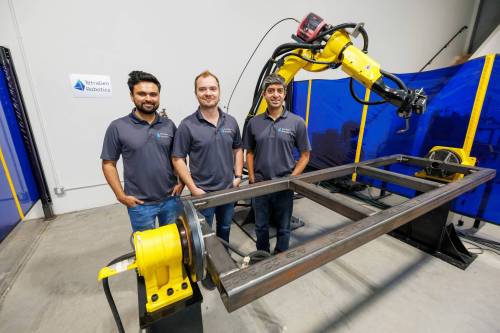
Blue light flashed as a robotic arm welded the metal in front of it.

Unlike other robots of its kind, this one uses artificial intelligence. It’s supposed to see and adjust its movements if a part it’s working on doesn’t match the standard piece.

It’s Manitoba-made technology that investors across Canada are betting on. TetraGen Robotics, the technology’s creator, announced it had raised $1.8 million in an oversubscribed seed funding round.

It announced the funding Monday afternoon. Jim Richardson, from the family behind Richardson International, is among the investors listed online.

Read
Yesterday at 2:00 AM CDT

AI bio-weapons loom

Gwynne Dyer 4 minute read 2:00 AM CDT

‘Artificial intelligence’ based on large language models is shaping up to be the most efficient destroyer of value since the South Sea Bubble. After “the Crash”, which is inevitably coming, some specific functions of AI will eventually turn out to be genuinely revenue-generating, and a lot of jobs will duly disappear. But the biggest winner (and potentially biggest loser) is medical science.

Dr. Brian Hie, a chemical engineer at Stanford University in California, has just revealed that his team has made the first viruses designed by artificial intelligence. They are ‘bacteriophages’, viruses that only infect bacteria and are widely used to treat people with infections that resist other treatments.

However, natural bacteriophages sometimes fail, so Dr. Hie used generative AI to design new ones that might do the job. The AI generated thousands of designs for new genomes that more or less fit the bill, and he chose around 300 of them to build in the lab. It’s hard work, not magic, but he ended up with 16 ‘novel’ bacteriophages that might work.

He applied them to petri dishes containing two harmful strains of E. coli, a common bacteria that lives in the human gut, and they killed the bacteria off. It’s still early days, but if it is truly becoming possible to tailor-make bacteriophages that target specific bacteria, then we may be getting a major new weapon in the struggle against antibiotic resistance.

Arcade bar to open in former downtown Keg

Gabrielle Piché 4 minute read Preview

Arcade bar to open in former downtown Keg

Gabrielle Piché 4 minute read Monday, Aug. 10, 2026

Smash burgers and Skee-Ball will replace steaks as the former downtown Keg transforms into an arcade bar.

Read
Monday, Aug. 10, 2026

Signs the Carney approach is working

Editorial 4 minute read Preview

Signs the Carney approach is working

Editorial 4 minute read 2:00 AM CDT

It was, if nothing else, a glowing review in trying times.

Matt Winkler, the editor in chief emeritus of Bloomberg News, spoke last week on Bloomberg Business News Daily about a recent Bloomberg analysis of the performance of the Canadian economy, and this country as a target for investment

“This is one of the greatest periods for overseas investment in Canada that we’ve seen in the century, and it may be unprecedented, because we have to wait for the rest of the year. … Money is pouring into Canada like we have not seen from everywhere. Stocks and bonds are the obvious beneficiaries,” Winkler said. He argued that Canada is both liked and seen as reasonable.

“The point is… Canada since Mark Carney became prime minister in 2025, has outperformed everyone in America and also the Eurozone and anywhere in the world. The 10 largest stock markets in the world, Canada appreciated the most, more than 40 per cent. … Its bond market is also doing great, partially because the inflation rate in Canada, unlike the Eurozone or America, is actually trending lower, and is outperforming both the Eurozone and the U.S.”

Read
2:00 AM CDT