US updates a science and technology pact with China to reflect growing rivalry and security threats

Advertisement

Advertise with us

WASHINGTON (AP) — The U.S. has updated a decades-old science and technology agreement with China to reflect their growing rivalry for technological dominance. The new agreement, signed Friday in Beijing after many months of negotiations, has a narrower scope and additional safeguards to minimize the risk to national security.

Read this article for free:


or

Already have an account? Log in here »

To continue reading, please subscribe:

Subscribe and receive a limited-edition Free Press branded hat or tote.

Digital Subscription

One year of digital access for only $205*

  • Enjoy unlimited reading on winnipegfreepress.com
  • Read the E-Edition, our digital replica newspaper
  • Access News Break, our award-winning app
  • Play interactive puzzles

*First annual payment billed as $205.00 + GST for one year. This annual subscription will automatically renew at $233.00 + GST every 52 weeks (10% off the regular annual price of $259.35). Offer available to new and qualified returning subscribers only. Cancel any time.

To continue reading, please subscribe:

Add Free Press access to your Brandon Sun subscription for only an additional

$1 for the first 4 weeks*

  • Enjoy unlimited reading on winnipegfreepress.com
  • Read the E-Edition, our digital replica newspaper
  • Access News Break, our award-winning app
  • Play interactive puzzles
Start now

*Your next Brandon Sun subscription payment will increase by $1.00 and you will be charged $17.95 plus GST for four weeks. After four weeks, your payment will increase to $24.95 plus GST every four weeks.

Hey there, time traveller!
This article was published 13/12/2024 (613 days ago), so information in it may no longer be current.

WASHINGTON (AP) — The U.S. has updated a decades-old science and technology agreement with China to reflect their growing rivalry for technological dominance. The new agreement, signed Friday in Beijing after many months of negotiations, has a narrower scope and additional safeguards to minimize the risk to national security.

The State Department said the agreement sustains intellectual property protections, establishes new guardrails to protect the safety and security of researchers and “advances U.S. interests through newly established and strengthened provisions on transparency and data reciprocity.”

It covers only basic research and does not facilitate the development of critical and emerging technologies, the department said. This includes technologies related to artificial intelligence and quantum computing, which are considered crucial for economic strength and military supremacy.
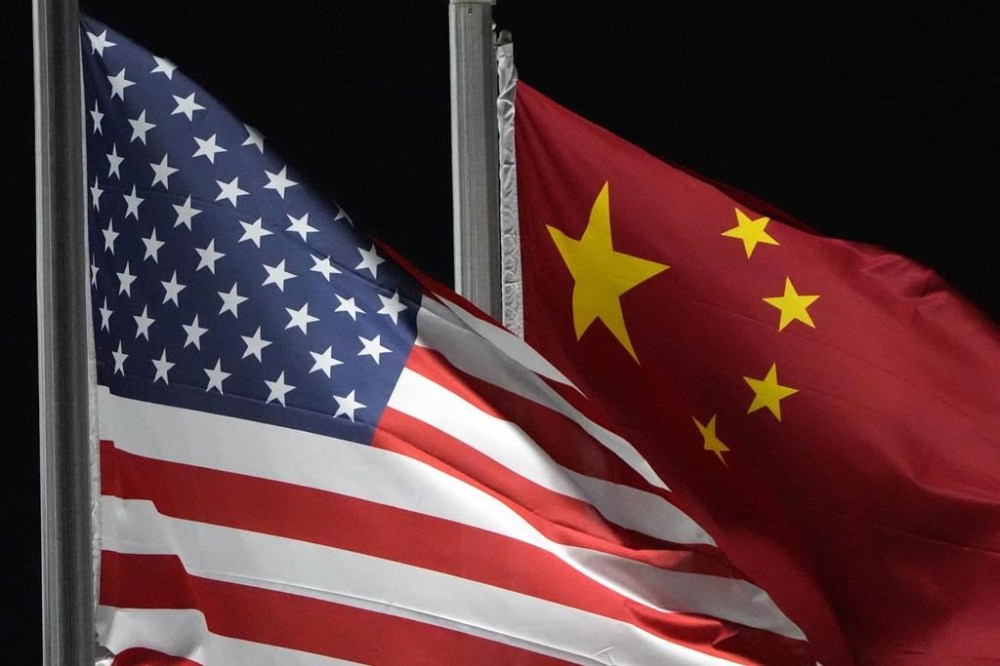
FILE - The American and Chinese flags wave at Genting Snow Park ahead of the 2022 Winter Olympics, in Zhangjiakou, China, Feb. 2, 2022. (AP Photo/Kiichiro Sato, File)

China’s science and technology ministry also announced the signing, but provided no details or assessment in its one-line statement. The Chinese foreign ministry said earlier this year that such cooperation is mutually beneficial.

The first such agreement was signed in January 1979 when the two countries established diplomatic ties to counter the influence of the Soviet Union and when China severely lagged behind the U.S. and other Western nations in science and technology.

The agreement was last extended in 2018, and given temporary extensions last year and this year to allow for negotiations. Washington had come to view the agreement as failing to reflect the shift in U.S.-China relations and China’s emergence as a heavyweight in the field. The new agreement extends cooperation for five years.

As the tech war between the two countries has escalated, the U.S. has banned exports of advanced chips to China and restricted U.S. investments in certain technologies that could boost China’s military capabilities. Cooperation in science and technology chilled in universities and research institutions after a Trump-era program was introduced to curb China’s spying. The program was ended in 2022 after multiple unsuccessful prosecutions of researchers and because of concerns that it had prompted racial profiling.

Deborah Seligsohn, an assistant professor of political science at Villanova University, said the new agreement would lead to fewer government-to-government programs, but, through its limited scope and stronger safeguards, it would allow for the cooperation to be sustained “through a more difficult relationship.”

Earlier this year, Rep. Andy Barr, a Kentucky Republican, said the decades-long cooperation had resulted in the U.S. “providing all sorts of scientific and technical knowledge to Chinese scientists in what would amount to the greatest outpouring of American scientific and technology expertise in history.”

Rep. Gregory Meeks, a Democrat from New York, argued that the U.S. and the global community also have benefited from research collaborations that have “prevented diseases, reduced pollution, and deepened our understanding of the Earth’s history.”

But Meeks said he favored congressional oversight to ensure projects under the agreement would be in line with U.S. values and interests.

Report Error Submit a Tip

More Stories

US updates a science and technology pact with China to reflect growing rivalry and security threats

Didi Tang, The Associated Press 3 minute read Preview

US updates a science and technology pact with China to reflect growing rivalry and security threats

Didi Tang, The Associated Press 3 minute read Friday, Dec. 13, 2024

WASHINGTON (AP) — The U.S. has updated a decades-old science and technology agreement with China to reflect their growing rivalry for technological dominance. The new agreement, signed Friday in Beijing after many months of negotiations, has a narrower scope and additional safeguards to minimize the risk to national security.

The State Department said the agreement sustains intellectual property protections, establishes new guardrails to protect the safety and security of researchers and "advances U.S. interests through newly established and strengthened provisions on transparency and data reciprocity.”

It covers only basic research and does not facilitate the development of critical and emerging technologies, the department said. This includes technologies related to artificial intelligence and quantum computing, which are considered crucial for economic strength and military supremacy.

China's science and technology ministry also announced the signing, but provided no details or assessment in its one-line statement. The Chinese foreign ministry said earlier this year that such cooperation is mutually beneficial.

Read
Friday, Dec. 13, 2024

Two-time cancer survivor trades blows with angry Lake Winnipeg in epic 12-hour fundraising swim

Zoe Pierce 3 minute read Preview

Two-time cancer survivor trades blows with angry Lake Winnipeg in epic 12-hour fundraising swim

Zoe Pierce 3 minute read Updated: Yesterday at 2:46 PM CDT

After 12 hours of wind, waves and a painful shoulder, Jonathon Fenton has finished what he started, making it across Lake Winnipeg.

The 62-year-old two-time cancer survivor completed the roughly 26-kilometre swim Sunday, a year after shoulder problems forced him to stop 16 kilometres into his first attempt.

The swim was the second year of Fenton’s Jonny’s Big Swim fundraiser, which supports the Alberta Cancer Foundation, CancerCare Manitoba Foundation and Health Sciences Centre Foundation.

He raised roughly $48,000 this year, bringing the two-year total to about $90,000.

Read
Updated: Yesterday at 2:46 PM CDT

How well do you know your city? Put your knowledge to the test with our 10-question quiz.

An ambassador, a petition and 213,000 signatures

Editorial 4 minute read Preview

An ambassador, a petition and 213,000 signatures

Editorial 4 minute read 2:00 AM CDT

You have to admit, they have a point.

As of 7 a.m. on Monday, 209,909 Canadians had signed it. By 9:41 a.m., that number had reached 211,846. By 10:54 a.m., 213,124. And there are months left to sign.

It is an electronic petition to have the U.S. Ambassador to Canada, Pete Hoekstra, ousted and sent back to Trump’s America.

The reasons? Well, ambassadors are meant to represent the national positions of their governments and you could argue that Hoekstra is doing exactly that: his blunt pronouncements on things such as Canadian sovereignty sound very much like the words of one Donald Trump, President of the United States.

Read
2:00 AM CDT

Puzzles Palace

1 minute read Monday, Jul. 27, 2026

To solve our puzzles, please subscribe with this special offer: |

Hayden Panettiere, who starred in ‘Heroes’ and ‘Nashville,’ dies at 36

Hannah Schoenbaum, The Associated Press 6 minute read Preview

Hayden Panettiere, who starred in ‘Heroes’ and ‘Nashville,’ dies at 36

Hannah Schoenbaum, The Associated Press 6 minute read Updated: Yesterday at 12:26 PM CDT

Hayden Panettiere, a onetime child star who soared to fame in the TV shows “Heroes” and “Nashville” while enduring struggles with alcohol addiction and depression, has died. She was 36.

Police said Panettiere was found unresponsive in an apartment in Greenville, South Carolina, shortly before 2 p.m. Sunday. Lifesaving measures were performed but she was pronounced dead at the scene.

No cause of death has been determined and Panettiere's death remains under investigation. An autopsy found no signs of trauma and police said officers saw no signs of foul play.

The television and film performer, who would have turned 37 on Friday, had been open about her private battles and wrote at length about them in the memoir, “This Is Me,” which came out in May. She described lifelong scars from her early fame, and acknowledged being addicted to alcohol and enduring postpartum depression after the birth of her daughter, Kaya, with Ukrainian boxer Wladimir Klitschko in 2014.

Read
Updated: Yesterday at 12:26 PM CDT