US updates a science and technology pact with China to reflect growing rivalry and security threats

Advertisement

Advertise with us

WASHINGTON (AP) — The U.S. has updated a decades-old science and technology agreement with China to reflect their growing rivalry for technological dominance. The new agreement, signed Friday in Beijing after many months of negotiations, has a narrower scope and additional safeguards to minimize the risk to national security.

Read this article for free:


or

Already have an account? Log in here »

To continue reading, please subscribe:

Subscribe and receive a limited-edition Free Press branded hat or tote.

Digital Subscription

One year of digital access for only $205*

  • Enjoy unlimited reading on winnipegfreepress.com
  • Read the E-Edition, our digital replica newspaper
  • Access News Break, our award-winning app
  • Play interactive puzzles

*First annual payment billed as $205.00 + GST for one year. This annual subscription will automatically renew at $233.00 + GST every 52 weeks (10% off the regular annual price of $259.35). Offer available to new and qualified returning subscribers only. Cancel any time.

To continue reading, please subscribe:

Add Free Press access to your Brandon Sun subscription for only an additional

$1 for the first 4 weeks*

  • Enjoy unlimited reading on winnipegfreepress.com
  • Read the E-Edition, our digital replica newspaper
  • Access News Break, our award-winning app
  • Play interactive puzzles
Start now

*Your next Brandon Sun subscription payment will increase by $1.00 and you will be charged $17.95 plus GST for four weeks. After four weeks, your payment will increase to $24.95 plus GST every four weeks.

Hey there, time traveller!
This article was published 13/12/2024 (613 days ago), so information in it may no longer be current.

WASHINGTON (AP) — The U.S. has updated a decades-old science and technology agreement with China to reflect their growing rivalry for technological dominance. The new agreement, signed Friday in Beijing after many months of negotiations, has a narrower scope and additional safeguards to minimize the risk to national security.

The State Department said the agreement sustains intellectual property protections, establishes new guardrails to protect the safety and security of researchers and “advances U.S. interests through newly established and strengthened provisions on transparency and data reciprocity.”

It covers only basic research and does not facilitate the development of critical and emerging technologies, the department said. This includes technologies related to artificial intelligence and quantum computing, which are considered crucial for economic strength and military supremacy.
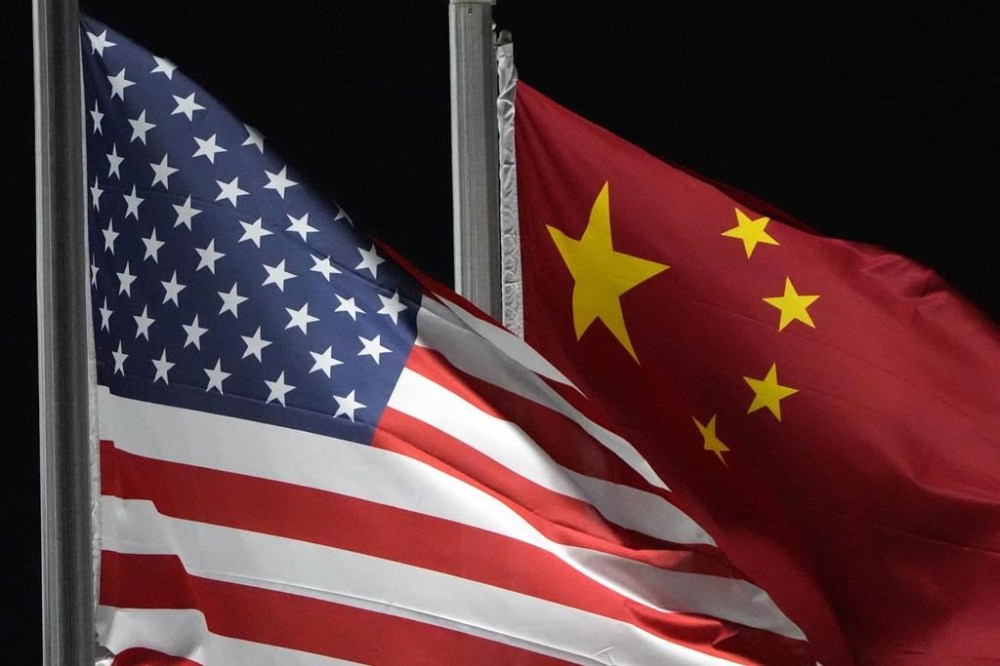
FILE - The American and Chinese flags wave at Genting Snow Park ahead of the 2022 Winter Olympics, in Zhangjiakou, China, Feb. 2, 2022. (AP Photo/Kiichiro Sato, File)

China’s science and technology ministry also announced the signing, but provided no details or assessment in its one-line statement. The Chinese foreign ministry said earlier this year that such cooperation is mutually beneficial.

The first such agreement was signed in January 1979 when the two countries established diplomatic ties to counter the influence of the Soviet Union and when China severely lagged behind the U.S. and other Western nations in science and technology.

The agreement was last extended in 2018, and given temporary extensions last year and this year to allow for negotiations. Washington had come to view the agreement as failing to reflect the shift in U.S.-China relations and China’s emergence as a heavyweight in the field. The new agreement extends cooperation for five years.

As the tech war between the two countries has escalated, the U.S. has banned exports of advanced chips to China and restricted U.S. investments in certain technologies that could boost China’s military capabilities. Cooperation in science and technology chilled in universities and research institutions after a Trump-era program was introduced to curb China’s spying. The program was ended in 2022 after multiple unsuccessful prosecutions of researchers and because of concerns that it had prompted racial profiling.

Deborah Seligsohn, an assistant professor of political science at Villanova University, said the new agreement would lead to fewer government-to-government programs, but, through its limited scope and stronger safeguards, it would allow for the cooperation to be sustained “through a more difficult relationship.”

Earlier this year, Rep. Andy Barr, a Kentucky Republican, said the decades-long cooperation had resulted in the U.S. “providing all sorts of scientific and technical knowledge to Chinese scientists in what would amount to the greatest outpouring of American scientific and technology expertise in history.”

Rep. Gregory Meeks, a Democrat from New York, argued that the U.S. and the global community also have benefited from research collaborations that have “prevented diseases, reduced pollution, and deepened our understanding of the Earth’s history.”

But Meeks said he favored congressional oversight to ensure projects under the agreement would be in line with U.S. values and interests.

Report Error Submit a Tip

More Stories

A grand jeté of climate-change denial

Gwynne Dyer 5 minute read Preview

A grand jeté of climate-change denial

Gwynne Dyer 5 minute read 2:00 AM CDT

The first hurricane to hit Hawaii in 34 years. The Mediterranean on fire from Spain to Greece. ‘Heat domes’ one after another for months on end in Europe and North America. Thousands of excess deaths. A record El Niño piled on top of an average global temperature up from +1.2 C five years ago. Predicted high for this year: +1.7 C.

Surely they’ll get it now, you think — but no, they won’t. It once seemed sensible to think that when the climate damage gets bad enough and the trend line becomes impossible to ignore, ‘they’ (meaning the climate change deniers and their fellow travellers) will finally accept that the threat is real and urgent action is necessary.

A few of them will, but most will not.

It is becoming clear that as the old position of flat disbelief in climate science becomes untenable, the preferred response among former deniers is to admit that climate change is big, dangerous and already well underway — but to insist that it is already too late and nothing can be done about it now.

Read
2:00 AM CDT

Manitoba man lied about abduction: N.D. police

Scott Billeck 2 minute read Yesterday at 3:17 PM CDT

U.S. authorities say a Manitoba man falsely claimed he had been kidnapped and taken across the Canada-U.S. border over the weekend.

Roderick Garson, 37, is being held in a county jail near Alexandria, Minn., after he was arrested and charged with falsely reporting a crime.

The arrest stems from a report police received Saturday that a man had been abducted with a weapon in Manitoba and taken across the border into the United States.

The investigation led U.S. authorities to Alexandria, about two hours northwest of Minneapolis, where police located the reported victim and suspect after the latter ran into a local store claiming he had escaped from his 31-year-old unnamed captor.

Free fix is in: repair café aims to keep items out of landfills

Tiago Resko 3 minute read Preview

Free fix is in: repair café aims to keep items out of landfills

Tiago Resko 3 minute read Updated: Yesterday at 12:09 PM CDT

Stephen Kirk wants to give people a chance to fix items they’re not ready to let go of.

The Spence Neighbourhood Association staffer took notice when repair cafés started popping up around the world, and he decided to bring the idea to Winnipeg.

The café invites people to bring broken items like bikes, clothes and small kitchen appliances to the association’s headquarters to get free repairs by a team of skilled volunteers.

“Certainly in our neighbourhood, a lot of people’s motivation is economic, they would rather fix it than have to buy a new one,” said Kirk, the environmental and open spaces coordinator for the Spence Neighbourhood Association.

Read
Updated: Yesterday at 12:09 PM CDT

Letters, Aug. 18

7 minute read 2:01 AM CDT

In support of real engineering

Jerry Storie’s op-ed Take advantage of hydroelectric potential and Laura Cameron’s op-ed Lasting legacy or pining for a pipe dream, both in the Free Press Aug. 17, provide quite different perspectives on what should be done to provide reliable power to Manitoba residents in the future.

Mr. Storie advocates construction of more hydroelectric projects rather than new natural gas generated capacity to offset looming power shortages. He argues that these hydroelectric projects will benefit Manitoba for the next century, and observes there will be significant increases in the demand for electricity in upcoming years. He is not wrong in any of these observations. However, hydroelectric developments are very capital intensive and have long lead development periods. Natural gas generation can be brought on line far more quickly with less investment. And perhaps Mr. Storie’s minimization of the environmental impacts of these developments deserves more scrutiny. Any First Nations impacted by development deserve to be consulted and participate in any benefits. Having said this, Mr. Storie is a former minister responsible for Manitoba Hydro, and thus has a fairly deep understanding of the issues at hand.

Laura Cameron advocates against construction of the LNG pipeline and terminal at Churchill, citing “the technical challenges of building a pipeline over thawing permafrost; the prohibitive cost of ice-breaking tankers that move LNG through the Arctic; and a forecasted global oversupply of LNG and uncertain long-term export markets.” These would all be persuasive arguments if Ms Cameron possessed any credentials indicating an expertise in engineering or economics. She does not. The balance of Ms Cameron’s op-ed focuses on ways for Manitoba to reduce its carbon footprint while taking a few shots at the proposed LNG pipeline to B.C. Her opposition to the pipeline to Churchill is almost a Trojan horse.

Daycare, family centre addition will turn care home into intergenerational community hub

Maggie Macintosh 4 minute read Preview

Daycare, family centre addition will turn care home into intergenerational community hub

Maggie Macintosh 4 minute read Updated: Yesterday at 3:29 PM CDT

Seven-year-olds and 70-somethings will socialize daily when a 152-spot daycare opens inside of a seniors’ residence in Winnipeg in a couple of years.

Construction on a new wing of the Saul and Claribel Simkin Centre is scheduled to begin this fall, it was announced Monday.

The project won’t be complete for at least 22 months, but it’s already being touted as a made-in-Manitoba model for intergenerational community hubs across the country.

“It’s a real good idea to mix the younger generation with the older generation,” said Allan Rutherford, a 79-year-old resident of the 200-bed personal care home in Linden Ridge.

Read
Updated: Yesterday at 3:29 PM CDT

Puzzles Palace

1 minute read Monday, Jul. 27, 2026

To solve our puzzles, please subscribe with this special offer: |