How Timothée Chalamet transformed into Bob Dylan
Advertisement
Read this article for free:
or
Already have an account? Log in here »
To continue reading, please subscribe:

Digital Subscription
One year of digital access for only $205*
- Enjoy unlimited reading on winnipegfreepress.com
- Read the E-Edition, our digital replica newspaper
- Access News Break, our award-winning app
- Play interactive puzzles
*First annual payment billed as $205.00 + GST for one year. This annual subscription will automatically renew at $233.00 + GST every 52 weeks (10% off the regular annual price of $259.35). Offer available to new and qualified returning subscribers only. Cancel any time.
To continue reading, please subscribe:
Add Free Press access to your Brandon Sun subscription for only an additional
$1 for the first 4 weeks*
- Enjoy unlimited reading on winnipegfreepress.com
- Read the E-Edition, our digital replica newspaper
- Access News Break, our award-winning app
- Play interactive puzzles
*Your next Brandon Sun subscription payment will increase by $1.00 and you will be charged $17.95 plus GST for four weeks. After four weeks, your payment will increase to $24.95 plus GST every four weeks.
Read unlimited articles for free today:
or
Already have an account? Log in here »
Hey there, time traveller!
This article was published 13/12/2024 (614 days ago), so information in it may no longer be current.
NEW YORK (AP) — How many roads must a man walk down to play Bob Dylan?
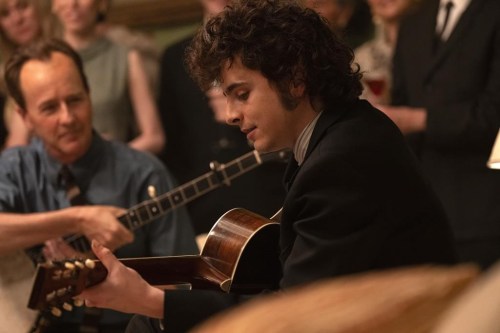
Quite a few, at least, if you’re Timothée Chalamet. Off and on for some six years, Chalamet has been obsessively working toward his performance in “A Complete Unknown.” He has visited Dylan’s childhood home, learned how to play the guitar (and the harmonica) and immersed himself in the early ‘60s New York that Dylan emerged out of — even if much of it has faded with history by now.
“Cafe Wha? was funny because they have Jimi Hendrix and Bob Dylan painted along the staircase and everything but now it’s just, like, Aerosmith covers,” Chalamet says, chuckling. “I was like: I don’t think this is what it was like when Bob was here.”
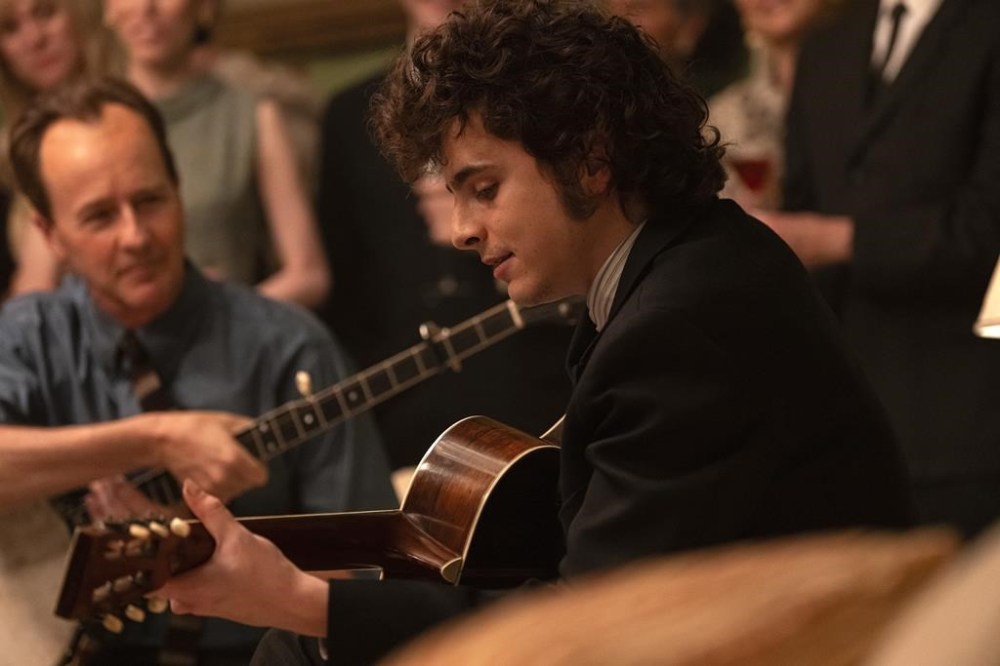
Chalamet has been building his Bob Dylan for so long that he’s been seen playing Dylan songs while in costume as Willy Wonka and on the set of “Dune.” His “Dune” co-star, Oscar Isaac (who famously played a fictional Dylan-adjacent folk musician in “Inside Llewyn Davis”), said, ”My first thought, it sounded like a really bad idea.”
Isaac certainly wasn’t the only one to doubt whether Chalamet, or anyone, could tackle someone as iconic and enigmatic as Dylan. But Chalamet’s performance — complete with singing and guitar playing — in the James Mangold-directed film, which opens in theaters Dec. 25, has drawn near-universal praise. Chalamet has been nominated for a Golden Globe; if he were to be nominated and win at the Academy Awards, the 28-year-old would be the youngest best actor winner ever.
Even Dylan, who gave Mangold notes on the film, has said: “Timmy’s a brilliant actor so I’m sure he’s going to be completely believable as me. Or a younger me. Or some other me.”
The Dylan in question in “A Complete Unknown,” loosely based on Elijah Wald’s 2015 book, “Dylan Goes Electric! Newport, Seeger, Dylan, and the Night That Split the Sixties,” is a young, just-starting-out Dylan. By the end of the film, which culminates in the 1965 Newport Folk Festival, he’s gone from folk messiah to Judas.
Chalamet recently spoke to The Associated Press about how he navigated the biggest acting challenge of his career.
AP: There might not be a much more daunting undertaking for an actor than playing Dylan. How did you decide you wanted to do it?
CHALAMET: I like how you framed the question initially, that it’s an undertaking. Bob Dylan is not only someone whose behaviorism and whose presence as a cultural figure is iconic, but, more importantly, as a thinker, as an artist, as a shaper of American culture through the last 60, 70 years, he’s The Guy in a lot of ways. I obviously felt like you can’t go near that if you’re not ready to do it. Equally, I had five years to work on this, or six, so there was no truncated process at any point. If you play any real-life figure, it’s sort of a gift. There’s the reality of how it happened. But with a musician, your education becomes twofold, or tenfold, because there’s not only the record of what he went through in his work, but the feeling he can give you as a person — which for me, with Bob’s music, was exponential. It was indescribable — like many people, maybe yourself. And I wouldn’t even try to describe it because he wouldn’t.
AP: Where did you begin?
CHALAMET: Weirdly, it was the press conferences. This came to me in an email in 2018. Bob Dylan, to me, was limited to the good friend of my father’s in New York, growing up, who had a striking black-and-white portrait of Dylan on his apartment wall. I didn’t know much of his music. You know, stuff like “Blowing in the Wind” or “Time’s They Are a-Changin’” are so enwoven in American culture that, of course, I knew those.
I just went up YouTube and before songs popped up, the San Francisco press conference popped up in ’65. I was just so fascinated to see an artist who was a definitive figure of the ’60s, but who clearly was as much a thinker as he was a forward-facing entertainer. It’s really, really rare to find the people that are deep thinkers and lyricists and artists that as much forward-facing entertainers. So when these artists pop up, like Bob Dylan, or I think in today’s culture, Frank Ocean, we all have a responsibility to champion these artists. Usually, the sensitive nature or whatever you want to call it, would encourage someone with a deep brain like that to not put themselves out there like that — that’s my theory.
AP: Were any of the documentaries helpful?
CHALAMET: It was really D.A. Pennebaker’s “Don’t Look Back.” That was a Bible to me on this. I love, love, love that film. I love music documentaries. There’s a Lil’ Wayne documentary called “The Carter” that’s all these moments. It’s just so special when you can get your camera on these music artists when they’re at a moment like Bob was in “Don’t Look Back.” Lil’ Wayne in “The Carter” is the same thing where they’re learning to turn their back in some way, but they haven’t done it yet.
AP: What’d you get from ‘Don’t Look Back’?
CHALAMET: The great thing about “Don’t Look Back” is it’s just really raw. There aren’t the talking heads. It’s what’s great about Suze Rotolo’s book. It’s really raw. It’s more raw than a lot of the other books about Bob Dylan. It’s very clear-sighted about the young relationship she had with Bob. With an artist of such reverence, it’s important as an actor not to simply revere him. Then you’ll do justice to the people that already revere him, but to everyone else in the room, they won’t get it.
AP: When did you first pick up a guitar?
CHALAMET: I picked up a guitar on “Call Me By Your Name” because I pluck out the chords of a song in that film. So I had, like, a really rudimental experience with that. I think sometime in 2018 I had my first lesson with this great guitar teacher named Larry Saltzman who at some point became less of a teacher and more a co-sanity artist through COVID. I think we were keeping each other sane. We would Zoom three, four times a week and doing songs that never made it into the movie.
AP: What songs did you gravitate toward?
CHALAMET: All of it. I really liked all of it. I like the more intimate songs like “Girl From the North Country” or “Boots of Spanish Leather” or “One Too Many Mornings” or “Tomorrow Is a Long Time.” But then I also liked “North Country Blues” and “Rocks and Gravel” or “Ballad of Hollis Brown” — things where you hear the iron ore in Bob’s voice, the North Country in Minnesota, the Hibbing. The Hibbing that when I visited you really felt like you were on the edge of America, like the edge of the world. These factories that are covered in snow and the icy roads. That stuff, as a New Yorker, I just started to fall in love with.
AP: So much of the movie is about the onset of fame for Dylan and his rejection of the expectations others have for him. Were you able to connect with that experience?
CHALAMET: Yeah, absolutely, in ways that are more unspoken than I could be definitive about. I just do. I don’t know how to use more words than that. And it was empowering to play someone that really just bucked off all pressure.
AP: I’ve heard you mention his infamous speech in 1963 accepting the Tom Paine award where he said “it is not an old peoples’ world.”
CHALAMET: That is a young man saying: Why are the older people in this room the signifiers and those who determine who the young lights forward are? Maybe the way he said it — talking about hair loss for older people being representative of their old age (laughs) — wasn’t the nicest way of putting it. But what he was saying, it has an element of truth. And at a time when media was more centralized or something, I think his attitude toward it was — I don’t know, I don’t want to speak for him.
AP: You haven’t met Dylan, but have you thought about what you’d ask him if you did?
CHALAMET: I think I’d just say thank you, really. Not thank you for the opportunity to meet, or thank you for the opportunity to play the role. Thank you for his music and his art and his work.
AP: You traveled through some of the Midwest to retrace his footsteps. How did that help?

CHALAMET: I spent time in Duluth and Hibbing and Wisconsin and Chicago. I tried to retrace those steps leading to New York where he arrived in the early ’60s. That wasn’t some academy process. That wasn’t trying to excavate the exact footprint and see if there was some DNA remaining and what that meant about where he was psychologically at the time. That was simply to be in the energy of these places and quell some insecurity I had about growing up in midtown Manhattan in the 2000s and how that would be different from growing up in iron ore country in the ’50s and ’60s.
Granted, that’s a different place than it was 60, 70 years ago — which was also moving to me, honestly. The unspoken metaphor I was feeling was: The world goes on. The times they are a’changing and things have changed. Being a brilliant poet or artist like Bob is isn’t the remedy for everyone.
I also have this personal affinity for these artists that come from the Midwest of the United State. Kid Cudi is obviously a hip-hop artist I’m hugely admiring of who came from Cleveland. It’s beyond me. Because I had a hard enough time getting my career going being from New York. When I got to Hibbing, you think of this hero’s journey of this young man.
AP: You sound altered by this experience. Did it in some way shift your DNA as an actor?
CHALAMET: I feel changed by the experience. I can’t speak about the actual film. The process of it, the yearslong endeavor into it, the dignity in playing something that actually happened. Those were new facets to my experience as an artist. Beyond that, people will make of it what they will, which is totally fair. I think that’s a great Bob worldview, too. Do with it what you want.