

Private trees are a public good
Advertisement
Read this article for free:
or
Already have an account? Log in here »
To continue reading, please subscribe:

Digital Subscription
One year of digital access for only $205*
- Enjoy unlimited reading on winnipegfreepress.com
- Read the E-Edition, our digital replica newspaper
- Access News Break, our award-winning app
- Play interactive puzzles
*First annual payment billed as $205.00 + GST for one year. This annual subscription will automatically renew at $233.00 + GST every 52 weeks (10% off the regular annual price of $259.35). Offer available to new and qualified returning subscribers only. Cancel any time.
To continue reading, please subscribe:
Add Free Press access to your Brandon Sun subscription for only an additional
$1 for the first 4 weeks*
- Enjoy unlimited reading on winnipegfreepress.com
- Read the E-Edition, our digital replica newspaper
- Access News Break, our award-winning app
- Play interactive puzzles
*Your next Brandon Sun subscription payment will increase by $1.00 and you will be charged $17.95 plus GST for four weeks. After four weeks, your payment will increase to $24.95 plus GST every four weeks.
Read unlimited articles for free today:
or
Already have an account? Log in here »
Hey there, time traveller!
This article was published 19/12/2024 (599 days ago), so information in it may no longer be current.
I want to talk to you about your trees — you know, the ones you planted in your yard or were lucky enough to inherit when you bought your home. The reason being, some of us still don’t fully appreciate just how valuable our trees are and why we should keep and care for them.
First off is your own self-interest, because it benefits you, financially, to retain your trees. Surveys of homebuyers show, for example, that residential properties with mature trees are more attractive and sell at higher prices than houses featuring nothing but grass sod and a couple of flower beds.
In addition to increased resale value, your yard trees also save you money. In fact, a U.S. Department of Energy study estimated that a properly positioned tree can save you up to 25 per cent on heating and cooling costs.
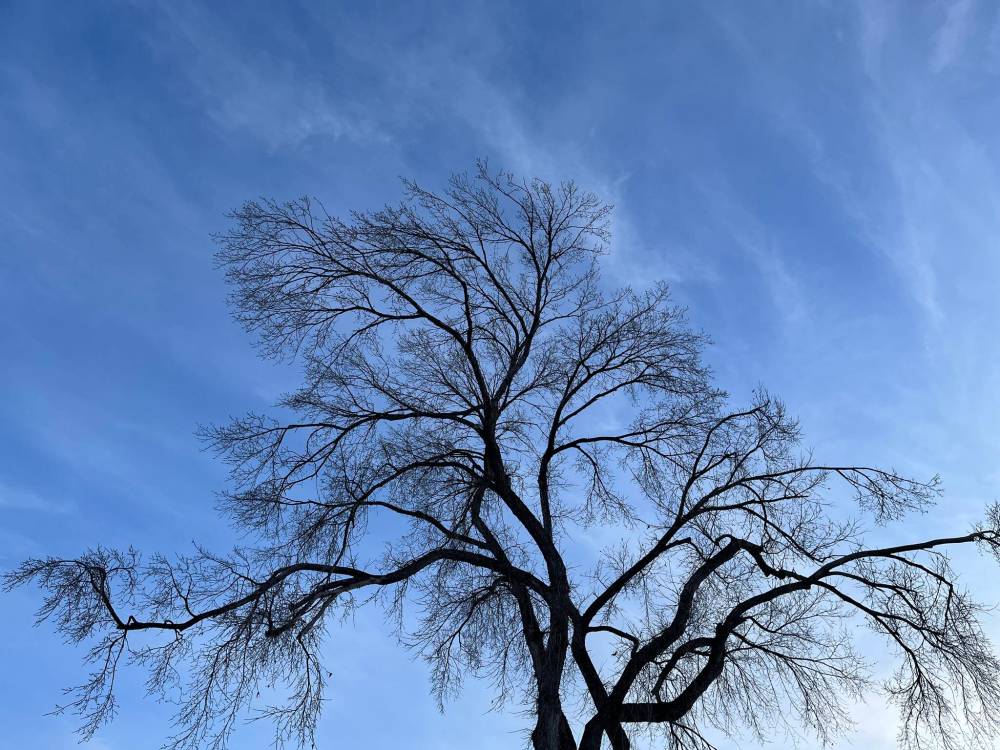
Russell Wangersky/Free Press
Trees, whether on public or private land, have far-reaching benefits for cities and their residents.
Then there are the broader community benefits associated with trees on private land.
You may not know this, but 90 per cent of Winnipeg’s canopy sits on private property, whether residential, commercial or developer owned. Which means that our so-called private trees are actually an integral part of an urban forest of over three million trees.
And those trees generate huge financial and health benefits.
In fact, without them our city would be hotter, wetter and our air pollution index would skyrocket, because trees are incredibly efficient at capturing toxic particulates from the air.
So, in essence, the tree that benefits you, also benefits the entire community.
More importantly, retaining private trees is critical as we continue to battle escalating citywide tree loss due to Dutch elm disease, ash borers, cottony psyllid, and sudden oak death.
And as I’ve itemized before, the so-called dangers associated with yard trees are minimal if the right tree is in the right spot and is kept well pruned, watered and fed.
Which is not to say that trees should never be removed from your yard. If they’ve reached their maximum life span, are diseased or pose any kind of hazard they will, of course, need to be taken down.
But homeowners who remove trees because they’re afraid of some mythical damage they might do to their foundations or because their seeds and leaves are “too messy,” need to be reminded that their trees are, in effect, public trees, because they provide services to the entire community. And as such they should be protected and preserved.
The same goes for developers, too many of whom clear-cut their properties prior to construction, instead of retaining a healthy portion of mature trees and building around them. By clear-cutting, they effectively rob our city of the quantifiable yearly benefits those trees would provide in lifespans that can stretch from 60 to 200 years and beyond, depending on the species.
That’s why we need zoning regulations and bylaws that would prevent the unnecessary destruction of mature trees on private land.
“But wait a minute,” I hear you say. “That’s my land; it’s private property and you can’t say what I can and can’t do with it. I can do whatever I want on my land!”
To which I would respond, no, that’s not actually true. If you want to demolish a house, build a garage or add a deck to your home, your plans need to be approved by the city. And if you don’t get permission and a permit, and your neighbour reports you, you could face a fine. You might even be forced to rebuild or tear down that new deck or garage.
That’s because the public good sometimes trumps individual property rights. And the services provided by mature trees on private land are, without doubt, a public good. That’s why the city, not you, is responsible for culling all diseased elm trees, whether on private or publicly owned land.
And yes, I can already hear you grumbling about city bureaucracy and the trials and tribulations of pulling permits. But guess what? You won’t necessarily have to pull the permit yourself. If your tree is taken down for legitimate reasons, an arborist will get the permit you need.

That’s what happened when I pruned and inoculated my publicly owned boulevard tree. The arborist dealt with the city, not me.
Finally, you could view protecting your private trees as part of your legacy. Because it’s thanks to past city leaders and tree-loving neighbours that I was lucky enough to grow up in a west end neighbourhood with magnificent elms lining the boulevard and everything from fruit trees to weeping willows in neighbouring yards.
That’s a legacy I’d like to see protected for future generations.
I hope you agree.
Erna Buffie is a writer and filmmaker. See more at https://www.ernabuffie.com/