Casting some light on Manitoba’s little-seen big cats
Advertisement
Read this article for free:
or
Already have an account? Log in here »
To continue reading, please subscribe:

Digital Subscription
One year of digital access for only $205*
- Enjoy unlimited reading on winnipegfreepress.com
- Read the E-Edition, our digital replica newspaper
- Access News Break, our award-winning app
- Play interactive puzzles
*First annual payment billed as $205.00 + GST for one year. This annual subscription will automatically renew at $233.00 + GST every 52 weeks (10% off the regular annual price of $259.35). Offer available to new and qualified returning subscribers only. Cancel any time.
To continue reading, please subscribe:
Add Free Press access to your Brandon Sun subscription for only an additional
$1 for the first 4 weeks*
- Enjoy unlimited reading on winnipegfreepress.com
- Read the E-Edition, our digital replica newspaper
- Access News Break, our award-winning app
- Play interactive puzzles
*Your next Brandon Sun subscription payment will increase by $1.00 and you will be charged $17.95 plus GST for four weeks. After four weeks, your payment will increase to $24.95 plus GST every four weeks.
Read unlimited articles for free today:
or
Already have an account? Log in here »
Hey there, time traveller!
This article was published 30/12/2024 (627 days ago), so information in it may no longer be current.
You could be forgiven for not knowing that cougars make their home in Manitoba, since the big cats are so elusive, preferring to live in solitude and travelling at night.
We don’t know how many cougars there are in the province, says Randall Mooi, curator of zoology at the Manitoba Museum, but there were almost a thousand reported sightings from 2000 to 2020; only three to four per cent of those were confirmed.
Those who have caught a glimpse of the largest of the small cats can consider themselves fortunate.
MIKE DEAL / FREE PRESS
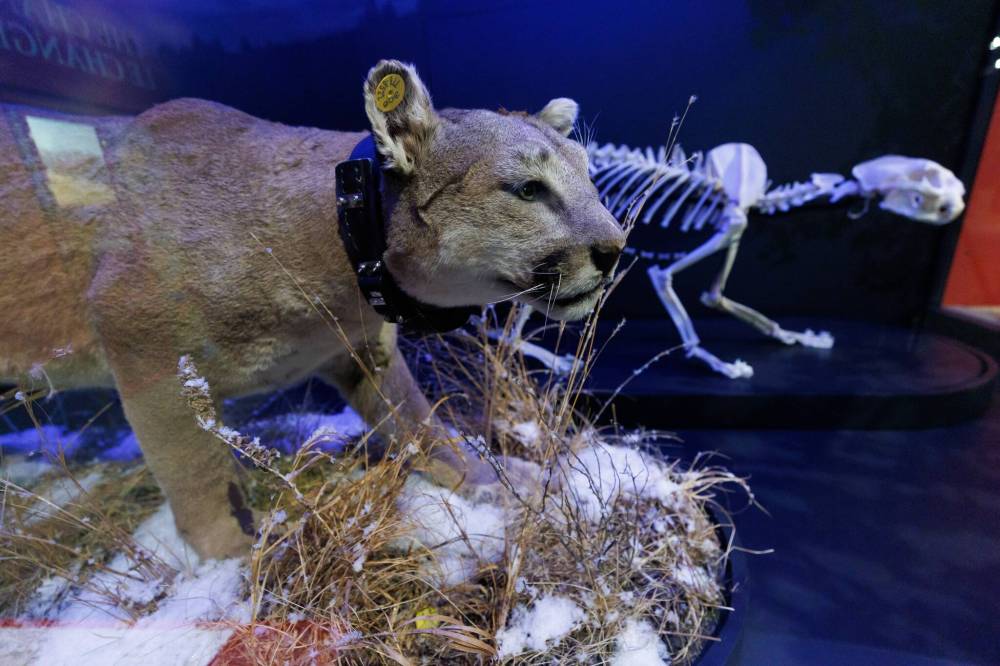
The Manitoba Museum’s new permanent exhibit on Manitoba’s cougars takes an in-depth look at one of the most enigmatic creatures that roams our province.
“I’ve certainly never seen one (in the wild),” Mooi says. “I’d love to see one.”
However, visitors to the Manitoba Museum’s new permanent exhibition will get a much better picture of these decidedly antisocial creatures, which have likely roamed the province for millennia.
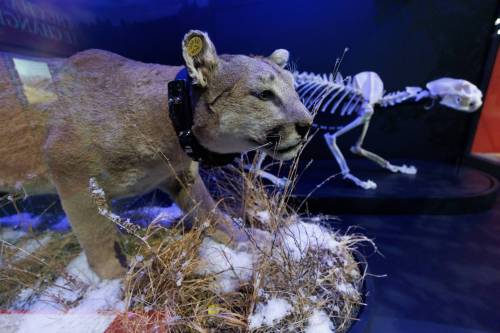
The Cougar — Manitoba’s Big Cat tells the story of a cougar born in Saskatchewan’s Cypress Hills in 2010. When he was just over a year old, as part of a study at the University of Alberta, he was given an ear tag labelled SK-10 and fitted with a satellite-tracking collar.
The exhibition — now a permanent feature of the museum’s Parklands Gallery — details SK-10’s decade-long journey through the Prairies, which covered hundreds of kilometres until he was caught in a legal coyote trap in 2020. As part of a partnership between the museum, Manitoba Wildlife officials and the Assiniboine Park Zoo, cougars that are accidentally killed are preserved for future study.
Like SK-10, most of our province’s cougars are probably born in Saskatchewan or South Dakota, according to Mooi; there is very little photographic or physical evidence that the big cats are breeding here.
Cougars are polygamous — male cougars mate with multiple females and do not live in packs. SK-10’s mother “kicked him out” when he was just under two years old so she could prepare to have her next set of cubs, Mooi explains.
After leaving their mother, young cougars must wander to find their own territory, since there would not be enough food to support them if they all settled in one place, he says. Once it establishes its territory, a cougar will likely stay there for about five years.
Because of SK-10’s tracker, U of A scientists know he travelled farther than any other cougar in the study. Over the course of 100 days, he covered 750 kilometres, roaming through Montana before reaching Moose Mountain, Sask.
His tracking collar later malfunctioned, but he was caught on trail cameras in Riding Mountain National Park between 2015 and 2016, having travelled another 300 km, reaching his final stop near Duck Mountain in 2020, where he was snared.

Cougars are considered a top predator and are large enough to take down an elk. They have physical features that have adapted for their hunting style; their legs are quite long, which allow them to cover five metres in a single bound.
In addition to being adept tree climbers, cougars also have the ability to sprint up to 50 km/h. After stalking their prey, they will get within 50 metres, run and pounce, then use their large canines to bring it down by biting into the neck.
These features of the cougar can be seen in the Big Cat exhibition, which features SK-10’s fully mounted skeleton, providing a rare look at the inner-workings of this powerful predator.
The exhibition also includes illustrated interpretative panels and interactive elements such as paw prints, scat and examples of the cougar’s various vocalizations, from purrs to screams.
arts@freepress.mb.ca