Scientists drill nearly 2 miles down to pull 1.2 million-year-old ice core from Antarctic

Advertisement

Advertise with us

An international team of scientists announced Thursday they’ve successfully drilled one of the oldest ice cores yet, penetrating nearly 2 miles (2.8 kilometers) to Antarctic bedrock to reach ice they say is at least 1.2 million years old.

Read this article for free:


or

Already have an account? Log in here »

To continue reading, please subscribe:

Subscribe and receive a limited-edition Free Press branded hat or tote.

Digital Subscription

One year of digital access for only $205*

  • Enjoy unlimited reading on winnipegfreepress.com
  • Read the E-Edition, our digital replica newspaper
  • Access News Break, our award-winning app
  • Play interactive puzzles

*First annual payment billed as $205.00 + GST for one year. This annual subscription will automatically renew at $233.00 + GST every 52 weeks (10% off the regular annual price of $259.35). Offer available to new and qualified returning subscribers only. Cancel any time.

To continue reading, please subscribe:

Add Free Press access to your Brandon Sun subscription for only an additional

$1 for the first 4 weeks*

  • Enjoy unlimited reading on winnipegfreepress.com
  • Read the E-Edition, our digital replica newspaper
  • Access News Break, our award-winning app
  • Play interactive puzzles
Start now

*Your next Brandon Sun subscription payment will increase by $1.00 and you will be charged $17.95 plus GST for four weeks. After four weeks, your payment will increase to $24.95 plus GST every four weeks.

Hey there, time traveller!
This article was published 09/01/2025 (619 days ago), so information in it may no longer be current.

An international team of scientists announced Thursday they’ve successfully drilled one of the oldest ice cores yet, penetrating nearly 2 miles (2.8 kilometers) to Antarctic bedrock to reach ice they say is at least 1.2 million years old.

Analysis of the ancient ice is expected to show how Earth’s atmosphere and climate have evolved. That should provide insight into how Ice Age cycles have changed, and may help in understanding how atmospheric carbon changed climate, they said.

“Thanks to the ice core we will understand what has changed in terms of greenhouse gases, chemicals and dusts in the atmosphere,” said Carlo Barbante, an Italian glaciologist and coordinator of Beyond EPICA, the project to obtain the core. Barbante also directs the Polar Science Institute at Italy’s National Research Council.

The same team previously drilled a core about 800,000 years old. The latest drilling went 2.8 kilometers (about 1.7 miles) deep, with a team of 16 scientists and support personnel drilling each summer over four years in average temperatures of about minus-35 Celsius (minus-25.6 Fahrenheit).

Italian researcher Federico Scoto was among the glaciologists and technicians who completed the drilling at the beginning of January at a location called Little Dome C, near Concordia Research Station.

“It was a great a moment for us when we reached the bedrock,” Scoto said. Isotope analysis gave the ice’s age as at least 1.2 million years old, he said.

Both Barbante and Scoto said that thanks to the analysis of the ice core of the previous Epica campaign they have assessed that concentrations of greenhouse gases, such as carbon dioxide and methane, even during the warmest periods of the last 800,000 years, have never exceeded the levels seen since the Industrial Revolution began.

“Today we are seeing carbon dioxide levels that are 50% above the highest levels we’ve had over the last 800,000 years,” Barbante said.

The European Union funded Beyond EPICA (European Project for Ice Coring in Antarctica) with support from nations across the continent. Italy is coordinating the project.

The announcement was exciting to Richard Alley, a climate scientist at Penn State who was not involved with the project and who was recently awarded the National Medal of Science for his career studying ice sheets.

Alley said advancements in studying ice cores are important because they help scientists better understand the climate conditions of the past and inform their understanding of humans’ contributions to climate change in the present. He added that reaching the bedrock holds added promise because scientists may learn more about Earth’s history not directly related to the ice record itself.
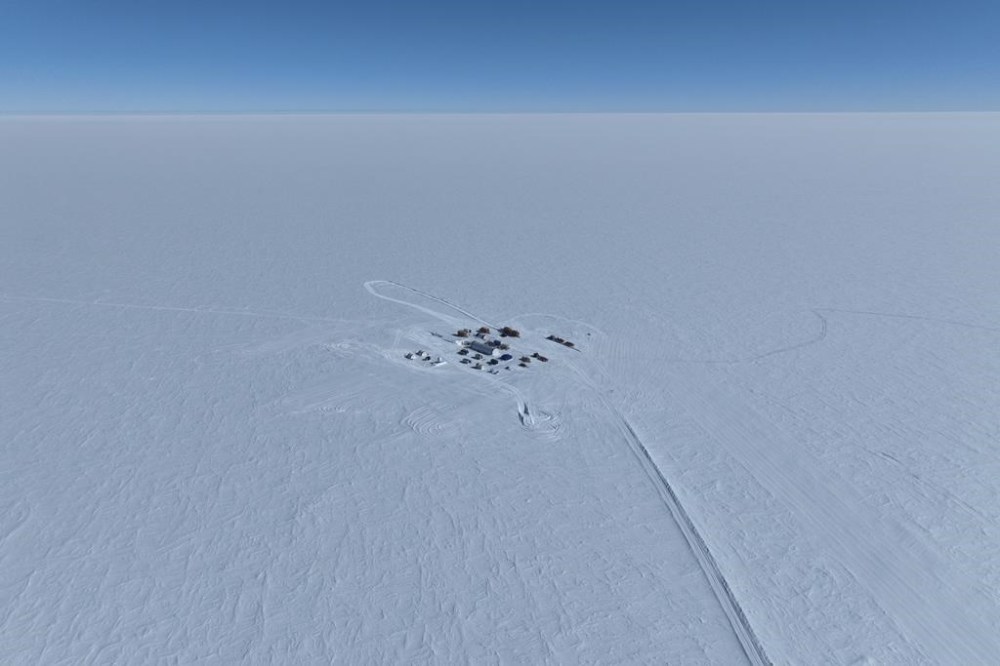
Little Dome C field base and drilling station sits in eastern Antarctica on Tuesday, Jan. 7, 2025. (PNRA/IPEV Beyond Epica via AP)

“This is truly, truly, amazingly fantastic,” Alley said. “They will learn wonderful things.”

___

Associated Press writer Melina Walling contributed from Chicago. Santalucia reported from Rome.

___

The Associated Press’ climate and environmental coverage receives financial support from multiple private foundations. AP is solely responsible for all content. Find AP’s standards for working with philanthropies, a list of supporters and funded coverage areas at AP.org.

Report Error Submit a Tip

More Stories

Family account spiced with magic realism, geopolitical intrigue and a ghost story

Reviewed by Zilla Jones 4 minute read Preview

Family account spiced with magic realism, geopolitical intrigue and a ghost story

Reviewed by Zilla Jones 4 minute read Yesterday at 2:01 AM CDT

Tom Lin’s second novel Babylon, South Dakota moves beyond a historical account of an immigrant family’s struggle, delightfully blending and bending genres.

Lin is a Chinese-born novelist whose family emigrated to the U.S. when he was four years old. His debut novel, The Thousand Crimes of Ming Tsu, won the 2022 Andrew Carnegie Medal for Excellence in Fiction, making him the youngest ever recipient of that award. He earned a PhD in English from the University of California Davis and is currently an assistant professor of English and creative writing at the University of Iowa.

Babylon, South Dakota takes place in an unspecified time period that can be understood to be during the Mao era — likely the 1950s or ’60s. A young Chinese couple, the Hsuis, immigrate to the rural community that gives the book its title. They take the names Saul and Mei and settle on a 160-acre homestead left to them by a distant relative.

Saul’s dream is to breed and sell chrysanthemums from seeds he brought from China, while Mei wants to raise livestock. They speak no English, know nothing of life in the United States, are unprepared for the harshness of winter and the isolation of the farm and bring nothing with them except some gold, which Mei hides around the house for emergencies. Their only link to the outside world is a discarded and marginally functioning TV set, which Saul rescues and rigs up.

Read
Yesterday at 2:01 AM CDT

Near-future U.S. the setting for surreal dual-world storyline

Reviewed by Morley Walker 4 minute read Preview

Near-future U.S. the setting for surreal dual-world storyline

Reviewed by Morley Walker 4 minute read Yesterday at 2:01 AM CDT

It’s not every day you encounter a seriously intended literary novel that attempts to dramatize a mind-bending physics theory like quantum entanglement.

But then the B.C.-born-and-raised Emily St. John Mandel is not your everyday Canadian literary writer.

In her late 40s, she has lived in the U.S. for her entire writing career. She is best known for her 2014 dystopian novel Station Eleven, about a Shakespearean acting troupe navigating a pandemic-ravaged America.

Her new outing, her seventh, Exit Party, shares DNA with detective and sci-fi genres more than with conventional literary fiction.

Read
Yesterday at 2:01 AM CDT

Steinbach Credit Union member warns others after scammer steals $10K

Scott Billeck 5 minute read Preview

Steinbach Credit Union member warns others after scammer steals $10K

Scott Billeck 5 minute read Friday, Sep. 18, 2026

A Winnipeg single mother whose bank account was drained of nearly $10,000 says Steinbach Credit Union needs to warn its members about what she believes is a broader security problem.

The woman, who is not being named to protect her identity, said a scammer gained access to her account earlier this week after calling SCU’s contact centre, claiming to be her and successfully completing the credit union’s authentication process.

She said she knows of at least six others who have experienced similar incidents in which callers impersonate SCU account holders and pass the authentication checks.

The woman discovered something was wrong when her minor son asked why money had been transferred out of an account they jointly hold.

Read
Friday, Sep. 18, 2026

Former Bombers linebacker Gauthier enjoying career as electrician

Taylor Allen 6 minute read Preview

Former Bombers linebacker Gauthier enjoying career as electrician

Taylor Allen 6 minute read Friday, Sep. 18, 2026

Most professional football players don’t ride off into the sunset on their own terms.

Shayne Gauthier was well aware of that, but it didn’t make it sting any less when the Winnipeg Blue Bombers informed the veteran linebacker that they weren’t bringing him back for 2026.

“I was really hoping to play one more (season) because it would have been my 10th season, so, I’d say it didn’t really end the way I wanted,” Gauthier recently told the Free Press.

“It left a little sour taste in my mouth, but that’s part of pro sports. If everybody got the ending that they wanted, then it wouldn’t really work.”

Read
Friday, Sep. 18, 2026

A Winnipeg lawyer has been disbarred after admitting to six counts of professional misconduct and two counts of providing incompetent service involving eight clients.

The career-ending decision marks the sixth time Gisele Champagne has been disciplined by the Law Society of Manitoba since she was called to the bar in 1992.

“Disbarment is the appropriate remedy when a lawyer has demonstrated a repeated pattern of conduct that violates professional standards,” a law society panel said in a written decision released Wednesday.

“A lawyer who has been unable to learn from past discipline proceedings to fulfill his or her obligation to provide ethical and high-quality legal services must at some point lose the privilege of practising law.”

Give-and-take relationship of Roman leaders takes centre stage in Harris’s historical fiction

Reviewed by Kathryne Cardwell 4 minute read Preview

Give-and-take relationship of Roman leaders takes centre stage in Harris’s historical fiction

Reviewed by Kathryne Cardwell 4 minute read Yesterday at 2:01 AM CDT

British novelist Robert Harris’s latest work is a reflection on tyranny, corruption and betrayal among all-powerful political leaders.

You might be forgiven for thinking it’s a contemporary thriller — it’s actually historical fiction set in ancient Rome.

A former BBC journalist, Harris debuted as a novelist in 1992 with Fatherland, an alternative history where Nazi Germany won the Second World War.

Since then, the prolific author has become best-known for his works of historical fiction, especially his ancient Rome trilogy released from 2006-2015 and the novel Conclave, which was published in 2016 and was made into the film of the same name in 2024.

Read
Yesterday at 2:01 AM CDT