

Parliament speaker, advocate for return of sculptures from Britain, tapped to be Greece’s president
Advertisement
Read this article for free:
or
Already have an account? Log in here »
To continue reading, please subscribe:

Digital Subscription
One year of digital access for only $205*
- Enjoy unlimited reading on winnipegfreepress.com
- Read the E-Edition, our digital replica newspaper
- Access News Break, our award-winning app
- Play interactive puzzles
*First annual payment billed as $205.00 + GST for one year. This annual subscription will automatically renew at $233.00 + GST every 52 weeks (10% off the regular annual price of $259.35). Offer available to new and qualified returning subscribers only. Cancel any time.
To continue reading, please subscribe:
Add Free Press access to your Brandon Sun subscription for only an additional
$1 for the first 4 weeks*
- Enjoy unlimited reading on winnipegfreepress.com
- Read the E-Edition, our digital replica newspaper
- Access News Break, our award-winning app
- Play interactive puzzles
*Your next Brandon Sun subscription payment will increase by $1.00 and you will be charged $17.95 plus GST for four weeks. After four weeks, your payment will increase to $24.95 plus GST every four weeks.
Read unlimited articles for free today:
or
Already have an account? Log in here »
Hey there, time traveller!
This article was published 15/01/2025 (599 days ago), so information in it may no longer be current.
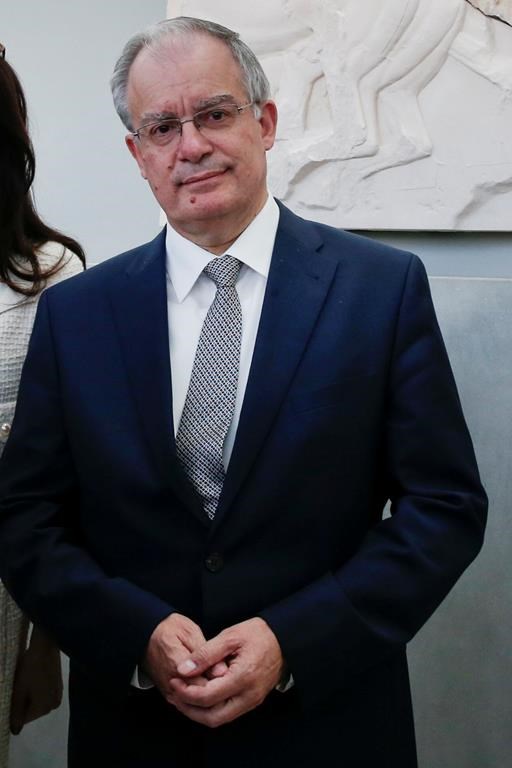
ATHENS, Greece (AP) — Greece’s conservative government on Wednesday nominated Parliament Speaker Constantine Tassoulas, a leading advocate for the return of disputed Parthenon sculptures from the British Museum, to become the country’s next president.
Tassoulas, a 65-year-old lawyer and member of the governing center-right New Democracy party, served as culture minister a decade ago and helped reinvigorate Greece’s campaign to reclaim the 2,500-year-old Parthenon Marbles.
During his tenure he hosted lawyer Amal Clooney in Athens, who lent her support to the country’s bid for the sculptures’ return. Clooney, the wife of actor George Clooney, helped raise international awareness of the campaign.
The sculptures were removed from the Acropolis in Athens by British diplomat Lord Elgin in the early 1800s and have since been kept in the British Museum. The Greek government contends that their removal was illegal and seeks to reunite them with other Parthenon artifacts displayed in a museum in the Greek capital.
Greek officials believe the return of the sculptures is more likely now due to the U.K. Labour government’s perceived openness to loan agreements. Ongoing discussions on a potential arrangement would likely include an offer to facilitate rotating exhibitions of ancient Greek artifacts at the British Museum.
The Greek presidency is largely ceremonial, with the president elected to a five-year term by the country’s 300 lawmakers through a process that may require up to five rounds of voting. Victory in the first or second round requires 200 votes, decreasing to 180 in the third round and a simple parliamentary majority of 151 in the fourth.
The New Democracy party currently holds 156 seats, with the center-left PASOK controlling 31 and the left-wing SYRIZA holding 26. Opposition parties criticized the nomination of a political conservative, viewing it as a missed opportunity for consensus building.
The first round of voting is scheduled for Jan. 25.
Tassoulas described the nomination as a “supreme honor and responsibility,” adding: “We have entered increasingly turbulent and uncertain times in our region and globally. Preserving national unity and ensuring the harmonious functioning of state institutions have become even more crucial for our country’s stability and prosperity.”
Greece’s current president, Katerina Sakellaropoulou, who is the first woman to serve as head of the Greek state, was not nominated for a second term.