Here’s what the Paris climate agreement does and doesn’t do
Advertisement
Read this article for free:
or
Already have an account? Log in here »
To continue reading, please subscribe:

Digital Subscription
One year of digital access for only $205*
- Enjoy unlimited reading on winnipegfreepress.com
- Read the E-Edition, our digital replica newspaper
- Access News Break, our award-winning app
- Play interactive puzzles
*First annual payment billed as $205.00 + GST for one year. This annual subscription will automatically renew at $233.00 + GST every 52 weeks (10% off the regular annual price of $259.35). Offer available to new and qualified returning subscribers only. Cancel any time.
To continue reading, please subscribe:
Add Free Press access to your Brandon Sun subscription for only an additional
$1 for the first 4 weeks*
- Enjoy unlimited reading on winnipegfreepress.com
- Read the E-Edition, our digital replica newspaper
- Access News Break, our award-winning app
- Play interactive puzzles
*Your next Brandon Sun subscription payment will increase by $1.00 and you will be charged $17.95 plus GST for four weeks. After four weeks, your payment will increase to $24.95 plus GST every four weeks.
Read unlimited articles for free today:
or
Already have an account? Log in here »
Hey there, time traveller!
This article was published 21/01/2025 (580 days ago), so information in it may no longer be current.
WASHINGTON (AP) — The 2015 Paris climate agreement is not the boogeyman that punishes the United States that critics such as President Donald Trump claim. But it hasn’t quite kept the world from overheating either.
The Paris agreement is a mostly voluntary climate pact originally written in ways that would both try to reduce warming and withstand the changing political winds in the United States.
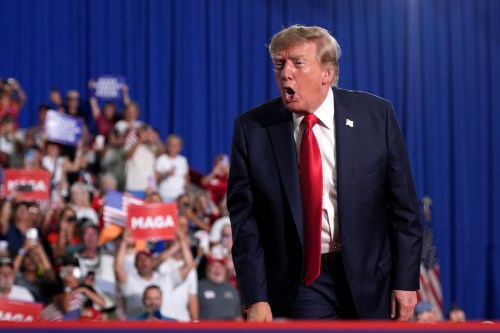
In his first hours in office, Trump started the year-long process to withdraw from the pact. It’s the second time he’s done it — then-President Joe Biden had the U.S. rejoin on his second day in office.

Once the withdrawal takes effect next year the United States joins Iran, Libya and Yemen as the only United Nations countries that are not part of the agreement.
The U.S. withdrawal, while expected, triggered heavy reactions from around the world. That’s because the United States is historically responsible for the largest share of heat-trapping gases in the atmosphere, has been a leader in international climate negotiations and is the world’s largest producer of the fossil fuels that cause the problem in the first place.
When the agreement was signed Dec. 12, 2014, then-President Barack Obama called it “the best chance to save the one planet we have.”
What is the Paris Agreement?
The main goal is to keep long-term global temperatures from warming 1.5 degrees Celsius (2.7 degrees Fahrenheit) above pre-industrial times and if not that well below 2 degrees Celsius (3.6 degrees) by slashing planet-warming emissions from coal, oil and gas.
“The Paris Agreement is a framework, not a stand alone solution,” said Mohamed Adow, founder of PowerShift Africa and a veteran climate negotiations observer. “Tackling climate change is not a pass-or-fail scenario. The Paris Agreement was never a solution itself, just a structure for countries to take action. And in large part that is what countries are doing.”
It is a pact that is part of the United Nations Framework Convention on Climate Change, which started in 1992 with the Rio Earth Summit. Technically, the Paris agreement itself is not a treaty so its adoption by America did not require U.S. Senate approval.
Is it mandatory?
It works as a binding but voluntary program. Every five years countries are required to submit a goal or plan for what it will do about heat-trapping emissions of carbon dioxide, methane and other gases. And those goals — called National Determined Contributions or NDCs — are supposed to be more ambitious every five years, said Cambridge University climate negotiations historian Joanna Depledge.
The latest five-year pledges are due next month. Biden submitted a plan for the United States last month to reduce emissions as much as two-thirds by 2035 compared to 2005 levels. Countries can make their emissions targets less ambitious.
“The countries themselves” decide what it’s in those goals with no punishment for countries missing goals, Depledge said.
Every two years, countries have to report how much greenhouse gases they emit.
The pact also says that rich countries, such as the United States, need to help poor countries decarbonize their economies, adapt to the impacts of climate change, and most recently be responsible in some ways for damage done by climate change.
Last year international negotiations set a goal of rich nations contributing $300 billion a year to help poor nations with climate change. The United States disputes that the $300 billion goal is legally binding, Depledge said.
How much does it cost the U.S.?
No industrialized country is assigned a portion of the $300 billion.
Historically, the United States has been criticized for providing less than its share of the global financial climate aid, given the United States’ history as a major climate polluter and it being the world’s largest economic power.
“Formally, there is no agreement on how much the U.S. should provide. However, our work on Fair Shares – based on U.S. historical emissions and ability to pay – finds that the U.S. contribution should be $44.6 billion per year,” Mercy Corps climate lead Debbie Hillier said in an email.
Last year, Biden announced that the U.S. climate aid to poor nations was up to $11 billion a year.
How did it come to be?
The 1998 Kyoto Protocol — which Al Gore and the Clinton Administration helped forge — called for mandatory emission cuts and was rejected by non-binding votes in the U.S. Senate. Then George W. Bush withdrew America from the deal.

That eventually led to an agreement being fashioned in Paris in a way that didn’t need U.S. Senate approval and was not mandatory. A bilateral agreement between the United States and China in 2014 paved the way for the agreement in Paris.
“One of the main reasons that countries are not legally required to actually meet the emissions reduction pledges they put forward under the Paris Agreement is because the Obama administration indicated that with the increased political polarization around climate change over the two decades following the Rio Earth Summit, obtaining 67 votes in support of the agreement in the U.S. Senate would have been challenging,” said veteran climate analyst Alden Meyer of the European think-tank E3G.
Has it worked?
Last year Earth temporarily passed the primary Paris 1.5 degree threshold, said several of the global monitoring groups. And while the 1.5 degree goal is about a 20-year average, the overwhelming majority of scientists say the world is likely to eventually breach the 1.5 mark for good. The long-term warming is now 1.3 degrees (2.3 degrees Fahrenheit) above pre-industrial times.
In 2015, Climate Action Tracker, a group of scientists, said the world was on path to 3.6 degrees Celsius (6.5 degrees Fahrenheit) of warming since pre-industrial times. Now the same group has the world on path for 2.7 degrees Celsius (4.9 degrees Fahrenheit).
Experts call it a partial success, saying negotiators in Paris never figured that the agreement alone would be sufficient.
Mercy Corps’ Hillier said that while reduced warming projections are “far from sufficient, it is shows that the collective commitments under the Paris Agreement have made a difference.”
What does U.S. withdrawal mean?
Once withdrawn, the U.S. can attend negotiations, but not be part of decision making.
There’s little direct impact on domestic U.S. climate policy, but “the decision may undermine U.S. credibility in climate diplomacy, likely reducing its influence in global environmental policy,” said Scott Segal, a Washington lawyer who represents energy interests, including fossil fuel companies.
Several experts say the United States will lose out on a trillion dollar plus renewable energy boom, leaving other countries like China to rule the green economy.
“The world is more likely to warm slightly more,″ said Climate Analytics and scientist CEO Bill Hare. “The more the world warms the faster we will experience more extreme weather events such as flooding, extreme hurricanes, fire, weather, drought, and heat. The U.S. will not be exempt from such events.”
___
Science writer Seth Borenstein covered the 2015 Paris Agreement live. Follow him on X at @borenbears
___
Read more of AP’s climate coverage at http://www.apnews.com/climate-and-environment
___
The Associated Press’ climate and environmental coverage receives financial support from multiple private foundations. AP is solely responsible for all content. Find AP’s standards for working with philanthropies, a list of supporters and funded coverage areas at AP.org.