

Supreme Court could revive lawsuit against Texas officer who shot motorist stopped for unpaid tolls
Advertisement
Read this article for free:
or
Already have an account? Log in here »
To continue reading, please subscribe:
Monthly Digital Subscription
$1 per week for 24 weeks*
- Enjoy unlimited reading on winnipegfreepress.com
- Read the E-Edition, our digital replica newspaper
- Access News Break, our award-winning app
- Play interactive puzzles
*Billed as $4.00 plus GST every four weeks. After 24 weeks, price increases to the regular rate of $19.95 plus GST every four weeks. Offer available to new and qualified returning subscribers only. Cancel any time.
Monthly Digital Subscription
$4.99/week*
- Enjoy unlimited reading on winnipegfreepress.com
- Read the E-Edition, our digital replica newspaper
- Access News Break, our award-winning app
- Play interactive puzzles
*Billed as $19.95 plus GST every four weeks. Cancel any time.
To continue reading, please subscribe:
Add Free Press access to your Brandon Sun subscription for only an additional
$1 for the first 4 weeks*
*Your next subscription payment will increase by $1.00 and you will be charged $16.99 plus GST for four weeks. After four weeks, your payment will increase to $23.99 plus GST every four weeks.
Read unlimited articles for free today:
or
Already have an account? Log in here »
Hey there, time traveller!
This article was published 22/01/2025 (430 days ago), so information in it may no longer be current.
WASHINGTON (AP) — The Supreme Court on Wednesday seemed inclined to revive a civil rights lawsuit against the Texas police officer who shot a man to death during a traffic stop in Houston over unpaid tolls.
The justices appeared to be in broad agreement that the New Orleans-based 5th U.S. Circuit Court of Appeals should take another look at the case of Ashtian Barnes, who died in his rental car in April 2016 on the shoulder of the Sam Houston Tollway.
Barnes was shot by the officer, Roberto Felix Jr., who jumped on the sill of the driver’s door of Barnes’ car as it began to pull away from the stop. Felix fired twice in two seconds because he “reasonably feared for his life,” his lawyers wrote in their Supreme Court brief.
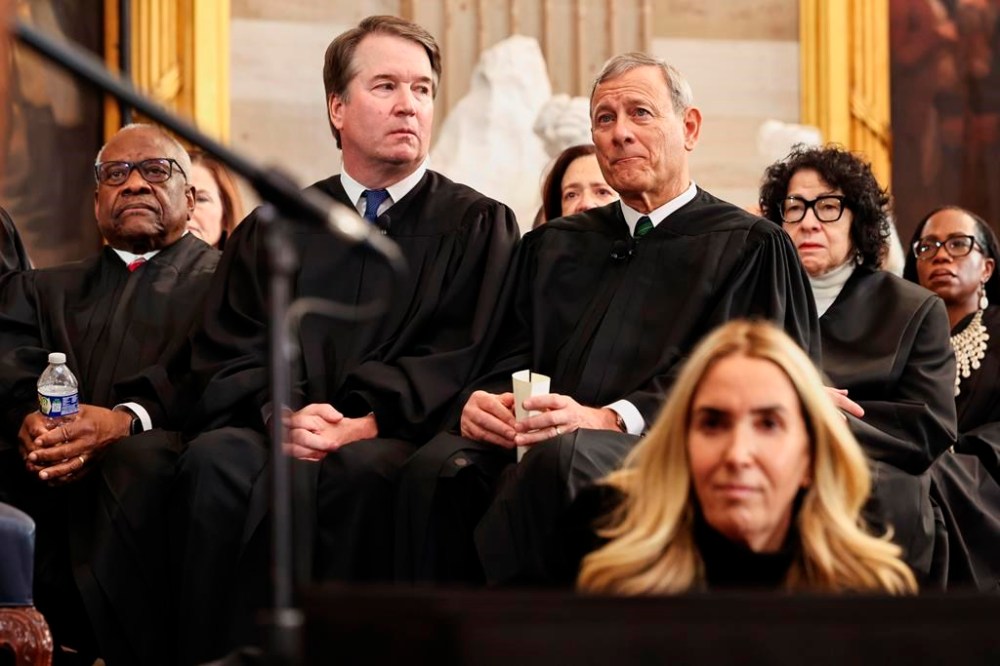
Lower courts had dismissed the excessive force lawsuit filed against Felix by Barnes’ mother, Janice Hughes. The issue before the justices is whether those lower courts used the right standard, evaluating Felix’s actions only at the “moment of the threat” that caused him to shoot Barnes.
Lawyers for Hughes and the Justice Department said courts should use a wider lens, the “totality of the circumstances,” to evaluate the suit against Felix.
Taking all the circumstances into account, courts would find that Felix acted unreasonably by jumping onto the side of Barnes’ car, Nathaniel Zelinsky, Hughes’ lawyer, told the court.
The justices appeared headed for a narrow ruling that might simply say “the two-second rule is not the law,” Justice Neil Gorsuch said.
The Supreme Court’s decision could help clarify the standard judges apply nationwide, but it might not ultimately help Hughes. Even if Felix ultimately is found to have violated Barnes’ rights, the officer probably would be shielded from financial liability by a separate high court standard known as qualified immunity.
Justice Brett Kavanaugh posed several questions in which he appeared worried that a win for Hughes could make life more dangerous for police officers during traffic stops, when they might have to make decisions in a matter of seconds.
“The officer does not get the time we spent here today making the decision,” Kavanaugh said.
Barnes had been driving to pick up his girlfriend’s daughter from day care when he was pulled over by Felix, who received a radio message that the license plate on Barnes’ car had unpaid tolls associated with it. Barnes’ girlfriend had rented the car and Barnes was unaware of the outstanding tolls, according to court records.
In siding with the officer, 5th Circuit Judge Patrick Higginbotham voiced regret that a “routine traffic stop has again ended in the death of an unarmed Black man.”
A decision is expected by early summer.
___
This story has been corrected to reflect that the last name of Janice Hughes’ lawyer is Zelinsky, not Zelensky