

ICC prosecutor requests warrants for Afghan Taliban leaders over persecution of women
Advertisement
Read this article for free:
or
Already have an account? Log in here »
To continue reading, please subscribe:

Digital Subscription
One year of digital access for only $205*
- Enjoy unlimited reading on winnipegfreepress.com
- Read the E-Edition, our digital replica newspaper
- Access News Break, our award-winning app
- Play interactive puzzles
*First annual payment billed as $205.00 + GST for one year. This annual subscription will automatically renew at $233.00 + GST every 52 weeks (10% off the regular annual price of $259.35). Offer available to new and qualified returning subscribers only. Cancel any time.
To continue reading, please subscribe:
Add Free Press access to your Brandon Sun subscription for only an additional
$1 for the first 4 weeks*
- Enjoy unlimited reading on winnipegfreepress.com
- Read the E-Edition, our digital replica newspaper
- Access News Break, our award-winning app
- Play interactive puzzles
*Your next Brandon Sun subscription payment will increase by $1.00 and you will be charged $17.95 plus GST for four weeks. After four weeks, your payment will increase to $24.95 plus GST every four weeks.
Read unlimited articles for free today:
or
Already have an account? Log in here »
Hey there, time traveller!
This article was published 23/01/2025 (605 days ago), so information in it may no longer be current.
THE HAGUE, Netherlands (AP) — The International Criminal Court’s chief prosecutor announced on Thursday he had requested arrest warrants for two top Afghan Taliban officials for the repression of women.
Karim Khan said in a statement he asked judges to approve warrants for the group’s supreme leader, Hibatullah Akhunzada, and the head of Afghanistan’s Supreme Court, Abdul Hakim Haqqani, accusing the men of crimes against humanity for gender-based persecution.
“These applications recognize that Afghan women and girls as well as the LGBTQI+ community are facing an unprecedented, unconscionable and ongoing persecution by the Taliban,” Khan said.
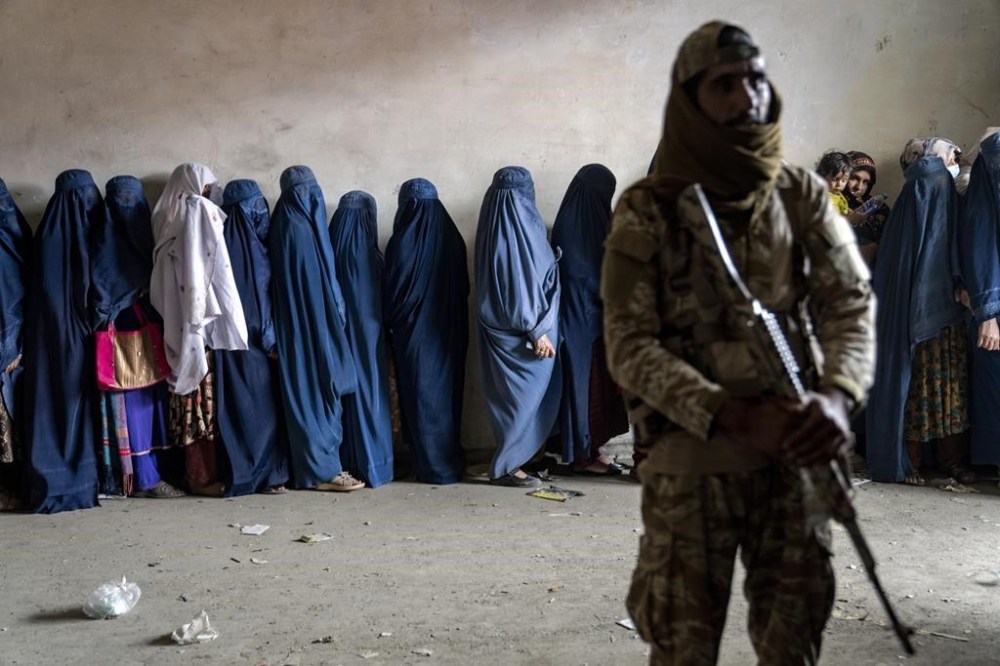
Since they took back control of the country in 2021, the Taliban have barred women from jobs, most public spaces and education beyond sixth grade. Last year, Akhundzada banned buildings from having windows looking into places where a woman might sit or stand.
Human rights groups applauded the ICC move against the Taliban leadership.
“Their systematic violations of women and girls’ rights, including education bans, and the suppression of those speaking up for women’s rights, have accelerated with complete impunity. With no justice in sight in Afghanistan, the warrant requests offer an essential pathway to a measure of accountability,” Liz Evenson, international justice director at Human Rights Watch, said in a statement.
It is the first time in the court’s history that attacks on the LGBTQ+ community have been considered a crime against humanity.
Judges at the The Hague-based court approved a request in 2022 from the prosecutor to reopen the investigation into Afghanistan. The probe was shelved after Kabul said it could handle the investigation.
Khan said he wanted to reopen the inquiry because under the Taliban, there was “no longer the prospect of genuine and effective domestic investigations” in Afghanistan.
However, human rights groups criticized Khan’s decision to focus on crimes committed by the Taliban and the Afghan affiliate of the Islamic State group. He said he would “deprioritize” other aspects of the investigation, such as crimes committed by Americans.
Khan’s predecessor, Fatou Bensouda, got approval in 2020 to start looking at offenses allegedly committed by Afghan government forces, the Taliban, American troops and U.S. foreign intelligence operatives dating back to 2002.
The decision to look into Americans led to the previous Trump administration slapping sanctions on Bensouda, whose term ended in 2021.
There is no deadline for judges to rule on a request for a warrant, but a decision typically takes around four months. It took a pre-trial chamber three weeks to issue an arrest warrant for Russian President Vladimir Putin in 2023 but six months in the case of Israeli Prime Minister Benjamin Netanyahu last year.