General purpose AI could lead to array of new risks, experts say in report ahead of AI summit

Advertisement

Advertise with us

LONDON (AP) — Advanced artificial intelligence systems have the potential to create extreme new risks, such as fueling widespread job losses, enabling terrorism or running amok, experts said in a first-of-its-kind international report Wednesday cataloging the range of dangers posed by the technology.

Read this article for free:

or

Already have an account? Log in here »

To continue reading, please subscribe:

Subscribe and receive a limited-edition Free Press branded hat or tote.

Digital Subscription

One year of digital access for only $205*

  • Enjoy unlimited reading on winnipegfreepress.com
  • Read the E-Edition, our digital replica newspaper
  • Access News Break, our award-winning app
  • Play interactive puzzles

*First annual payment billed as $205.00 + GST for one year. This annual subscription will automatically renew at $233.00 + GST every 52 weeks (10% off the regular annual price of $259.35). Offer available to new and qualified returning subscribers only. Cancel any time.

To continue reading, please subscribe:

Add Free Press access to your Brandon Sun subscription for only an additional

$1 for the first 4 weeks*

  • Enjoy unlimited reading on winnipegfreepress.com
  • Read the E-Edition, our digital replica newspaper
  • Access News Break, our award-winning app
  • Play interactive puzzles
Start now

*Your next Brandon Sun subscription payment will increase by $1.00 and you will be charged $17.95 plus GST for four weeks. After four weeks, your payment will increase to $24.95 plus GST every four weeks.

Hey there, time traveller!
This article was published 29/01/2025 (531 days ago), so information in it may no longer be current.

LONDON (AP) — Advanced artificial intelligence systems have the potential to create extreme new risks, such as fueling widespread job losses, enabling terrorism or running amok, experts said in a first-of-its-kind international report Wednesday cataloging the range of dangers posed by the technology.

The International Scientific Report on the Safety of Advanced AI is being released ahead of a major AI summit in Paris next month. The paper is backed by 30 countries including the U.S. and China, marking rare cooperation between the two countries as they battle over AI supremacy, highlighted by Chinese startup DeepSeek stunning the world this week with its budget chatbot in spite of U.S. export controls on advanced chips to the country.

The report by a group of independent experts is a “synthesis” of existing research intended to help guide officials working on drawing up guardrails for the rapidly advancing technology, Yoshua Bengio, a prominent AI scientist who led the study, told the Associated Press in an interview.

A woman is reflected in a window with a slogan about AI ahead of the World Economy Forum in Davos, Switzerland, Sunday, Jan. 19, 2025. (AP Photo/Markus Schreiber)

“The stakes are high,” the report says, noting that while a few years ago the best AI systems could barely spit out a coherent paragraph, now they can write computer programs, generate realistic images and hold extended conversations.

While some AI harms are already widely known, such as deepfakes, scams and biased results, the report said that “as general-purpose AI becomes more capable, evidence of additional risks is gradually emerging” and risk management techniques are only in their early stages.

It comes amid warnings this week about artificial intelligence from the Vatican and the group behind the Doomsday Clock.

The report focuses on general purpose AI, typified by chatbots such as OpenAI’s ChatGPT used to carry out many different kinds of tasks. The risks fall into three categories: malicious use, malfunctions and widespread “systemic” risks.

Bengio, who with two other AI pioneers won computer science’s top prize in 2019, said the 100 experts who came together on the report don’t all agree on what to expect from AI in the future. Among the biggest disagreements within the AI research community is the timing of when the fast-developing technology will surpass human capabilities across a variety of tasks and what that will mean.

“They disagree also about the scenarios,” Bengio said. “Of course, nobody has a crystal ball. Some scenarios are very beneficial. Some are terrifying. I think it’s really important for policymakers and the public to take stock of that uncertainty.”

Researchers delved into the details surrounding possible dangers. AI makes it easier, for example, to learn how to create biological or chemical weapons because AI models can provide step by step plans. But it’s “unclear how well they capture the practical challenges” of weaponizing and delivering the agents, it said.

General purpose AI is also likely to transform a range of jobs and “displace workers,” the report says, noting that some researchers believe it could create more jobs than it takes away, while others think it will drive down wages or employment rates, though there’s plenty of uncertainty over how it will play out.

AI systems could also run out of control, either because they actively undermine human oversight or humans pay less attention, the report said.

However, a raft of factors make it hard to manage the risks, including AI developers knowing little about how their models work, the authors said.
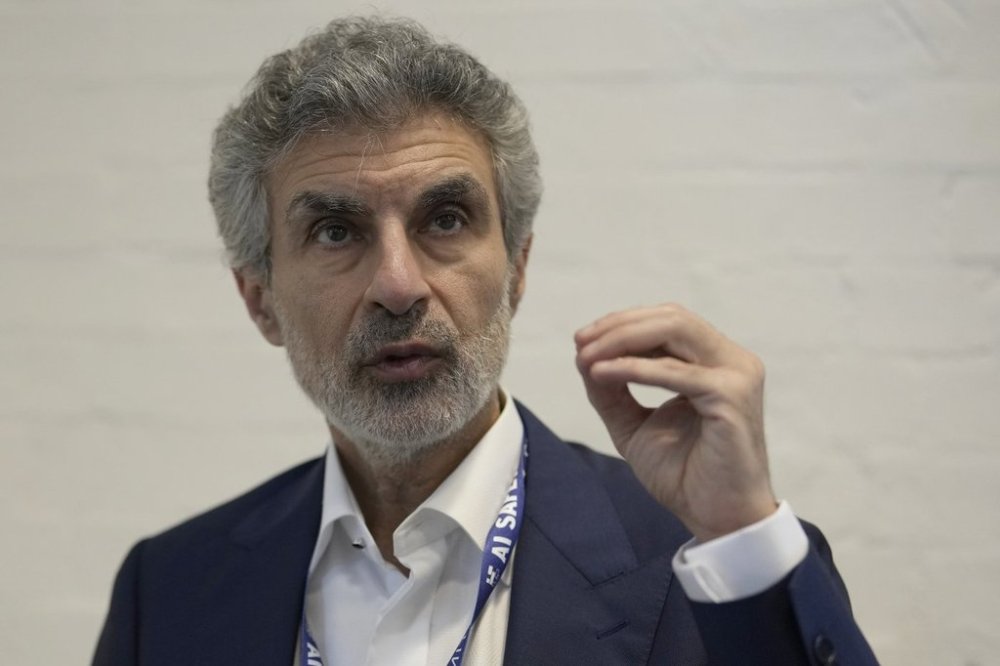
FILE - Yoshua Bengio, Scientific Director Mila Quebec AI Institute, speaks to the Associated Press during the AI Safety Summit in Bletchley Park, Milton Keynes, England, Wednesday, Nov. 1, 2023. (AP Photo/Alastair Grant, File)

The paper was commissioned at an inaugural global summit on AI safety hosted by Britain in November 2023, where nations agreed to work together to contain potentially “catastrophic risks.” At a follow-up meeting hosted by South Korea last year, AI companies pledged to develop AI safety while world leaders backed setting up a network of public AI safety institutes.

The report, also backed by the United Nations and the European Union, is meant to weather changes in governments, such as the recent presidential transition in the U.S., leaving it up to each country to choose how it responds to AI risks. President Donald Trump rescinded former President Joe Biden’s AI safety policies on his first day in office, and has since directed his new administration to craft its own approach. But Trump hasn’t made any move to disband the AI Safety Institute that Biden formed last year, part of a growing international network of such centers.

World leaders, tech bosses and civil society are expected to convene again at the Paris AI Action Summit on Feb 10-11. French officials have said countries will sign a “common declaration” on AI development, and agree to a pledge on sustainable development of the technology.

Bengio said the report’s aim was not to “propose a particular way to evaluate systems or anything.” The authors stayed away from prioritizing particular risks or making specific policy recommendations. Instead they laid out what the scientific literature on AI says “in a way that’s digestible by policymakers.”

“We need to better understand the systems we’re building and the risks that come with them so that we can we can take these better decisions in the future,” he said.

__

AP Technology Writer Matt O’Brien in Providence, Rhode Island contributed to this report.

Report Error Submit a Tip

More Stories

Mom spearheads fight for rehab services

Zoe Pierce 4 minute read Preview

Mom spearheads fight for rehab services

Zoe Pierce 4 minute read Yesterday at 2:01 AM CDT

Four years ago, a car crash permanently changed Will Castor’s life.

The 28-year-old suffered a traumatic brain injury that required a long recovery as he worked to relearn skills many people take for granted, such as eating, speaking and getting out of bed.

A key part of that journey was First Steps Wellness Centre, a Winnipeg rehabilitation facility, where Will worked with therapists to regain independence and connect with others facing similar challenges.

But on June 5, financial constraints forced First Steps to close, leaving families without the specialized therapy they had come to rely on.

Read
Yesterday at 2:01 AM CDT

More mayoral candidates would mean more ideas

Editorial 4 minute read Preview

More mayoral candidates would mean more ideas

Editorial 4 minute read 2:00 AM CDT

The absence of a competitive race for Winnipeg mayor is shaping up as one of the biggest disappointments of this year’s civic election.

Incumbent Scott Gillingham remains the clear favourite to win a second term. That, by itself, is hardly unusual. Winnipeg has a long history of re-electing mayors.

Incumbency carries enormous advantages in municipal politics, from name recognition to an established fundraising network. Unless a serious challenger emerges, history suggests Gillingham is well positioned to remain in office.

But elections are about more than determining a winner. They are an opportunity to debate ideas, challenge assumptions and force difficult conversations about a city’s future. That is where the apparent lack of a high-profile challenger becomes a problem.

Read
2:00 AM CDT

Former Manitoba MP Inky Mark charged with firearms offences; more than 400 weapons seized from home

Tyler Searle 6 minute read Preview

Former Manitoba MP Inky Mark charged with firearms offences; more than 400 weapons seized from home

Tyler Searle 6 minute read Updated: Yesterday at 6:11 PM CDT

A former member of Parliament from Manitoba has been charged after a stockpile of ammunition and firearms — including an antique cannon — and $300,000 in cash were seized from a Dauphin home last week.

Manitoba RCMP charged Inky Mark, 78, with a dozen firearms-related charges, including firearms trafficking, possession of property obtained by crime, unsafe storage and careless use of a firearm.

In total, RCMP seized 439 firearms from Mark’s property, Mounties said at a news conference Monday morning.

It is expected to take investigators weeks to sort through the arsenal and determine how many of the weapons were legally possessed, but police have already identified three guns that are believed to have been illegally trafficked, and one that had a tampered serial number, RCMP Cpl. Barry Kirby said.

Read
Updated: Yesterday at 6:11 PM CDT

Letters,

7 minute read 2:01 AM CDT

A mature prime minister

Re: Carney plays well on the road (Editorial, July 14)

The editorial discusses Mark Carney’s strengths from being head of the Bank of Canada and Bank of England.

There is merit in this analysis, but it overlooks Carney’s major contribution to date. This is the simple fact he has replaced Justin Trudeau. Trudeau’s primary personal characteristic is petulance. He slapped a moral label on every issue. If you agreed with him you were amongst the virtuous, if you disagreed with him you were morally culpable and/or stupid. He polarized Canadians in a blink of an eye.

Provincial independence means loss of portable health benefits

Charles S. Shaver 5 minute read Preview

Provincial independence means loss of portable health benefits

Charles S. Shaver 5 minute read 2:00 AM CDT

During the many decades that I practised internal medicine, at times I would warn patients about the potential adverse effects of medications or procedures. No one accused me of scare-mongering. Most thanked me for spending the time so that they could make an informed decision. Similarly, Albertans and Quebecers need a full discussion of all the risks of amputating themselves from Canada.

On Oct. 19, Albertans will vote on whether to have a referendum on independence. Also, if the Parti Québécois wins the early October election, Paul St-Pierre Plamondon has promised to hold a third referendum on Quebec independence, likely toward the end of his mandate. An Ipsos poll found that 15 to 18 per cent of Albertans were committed to separation. Meanwhile, CTV and Global polls found that 26 to 29 per cent of Quebecers favoured separation, a historic low. About 62 to 71 per cent rejected having a third referendum.

Alberta Premier Danielle Smith estimated that start-up costs would be about $400 billion. The Calgary Chamber of Commerce warned that Alberta would forego $10 to 15 billion in investment in the first year.

Few have mentioned the effects on access to health care within an independent province or elsewhere in Canada. A vote for independence would cause many physicians, nurses, and health professionals to flee, for they are quite mobile. CBC reported on June 27 that from October 2025 to June 2026, the College of Physicians and Surgeons in New Brunswick granted 47 licences and received 156 applications from Quebec physicians. Also, between late October and mid-November 2025, nearly 300 Quebec physicians applied to work in Ontario; over half were family physicians.

Read
2:00 AM CDT

If it works in Ontario, why not in Manitoba?

James Wilt 5 minute read Preview

If it works in Ontario, why not in Manitoba?

James Wilt 5 minute read Yesterday at 2:00 AM CDT

Grid-scale battery storage has fundamentally changed the global energy landscape — and Manitoba needs to get on board.

Battery systems store large amounts of excess electricity for when it’s most needed. While they can be charged from any generation source, they are especially beneficial for integrating wind and solar power, which vary with weather and time of day. Batteries allow electrical grids to meet the need for firm, dispatchable and affordable capacity using renewable energy, rather than relying on coal, nuclear and fossil gas. They also provide numerous other benefits, including reducing overloading of transmission infrastructure and helping to regulate the grid’s frequency and voltage.

Average costs for grid-scale batteries plummeted by more than half between 2023 and 2025 and installations have skyrocketed in China, the U.S., Australia and Europe. Texas now has 16,500 megawatts (MW) of battery storage, while California has 15,200 MW. Closer to home, Ontario recently awarded 640 MW of contracts to three battery storage projects in a competitive auction, with batteries beating out fossil gas-fired power plants on cost every time. One of these projects will be built near Dryden, only four hours east of Winnipeg.

Each battery system will provide eight hours of capacity but will cost considerably less than Ontario’s previous battery procurements, which provide only four hours of capacity. With this latest auction, Ontario has now secured 3,600 MW of battery storage capacity, including the operational Oneida (250 MW), Hagersville (300 MW) and Napanee (250 MW) projects. Almost all have significant Indigenous participation, with the latest procurements boasting 50 per cent First Nations ownership.

Read
Yesterday at 2:00 AM CDT