Tariff tremors ripple across the family farm Producers on both sides of the border share common ground as trade threats loom
Read this article for free:
or
Already have an account? Log in here »
To continue reading, please subscribe:

Digital Subscription
One year of digital access for only $205*
- Enjoy unlimited reading on winnipegfreepress.com
- Read the E-Edition, our digital replica newspaper
- Access News Break, our award-winning app
- Play interactive puzzles
*First annual payment billed as $205.00 + GST for one year. This annual subscription will automatically renew at $233.00 + GST every 52 weeks (10% off the regular annual price of $259.35). Offer available to new and qualified returning subscribers only. Cancel any time.
To continue reading, please subscribe:
Add Free Press access to your Brandon Sun subscription for only an additional
$1 for the first 4 weeks*
- Enjoy unlimited reading on winnipegfreepress.com
- Read the E-Edition, our digital replica newspaper
- Access News Break, our award-winning app
- Play interactive puzzles
*Your next Brandon Sun subscription payment will increase by $1.00 and you will be charged $17.95 plus GST for four weeks. After four weeks, your payment will increase to $24.95 plus GST every four weeks.
Read unlimited articles for free today:
or
Already have an account? Log in here »
Hey there, time traveller!
This article was published 31/01/2025 (622 days ago), so information in it may no longer be current.
The crops have been harvested, the soil tilled. The fields are blanketed in snow. Normally, this is a farmer’s quiet season. But this year, on either side of the Canada-U.S. border, there’s a chill of unpredictability hanging in the winter air.
“My stomach starts to turn just a little bit,” Minnesota farmer Harmon Wilts said in a late January interview. “As a farmer, we can control the things we can control … but when it comes to something like tariffs — that is totally out of our control and very frustrating.”
Since November, U.S. President Donald Trump has threatened to impose broad 25 per cent tariffs on Canadian goods beginning Saturday. He’s repeatedly claimed the country has no need for Canada’s exports — cars, lumber, oil and food products in particular — because America makes “the same products on the other side of the border.”
Canadian leaders have promised retaliatory measures ranging from export taxes on major commodities like energy to dollar-for-dollar tariffs meant to squeeze vulnerable sectors of the American economy. Prime Minister Justin Trudeau maintains “nothing is off the table.”
Experts predict the ripple effects of a trade war could be crushing for both economies. Canadian and American farmers, who have long relied on a steady exchange of crops, equipment, fertilizer and other agricultural goods, are bracing for impact.
CLIMATE FIELDVIEW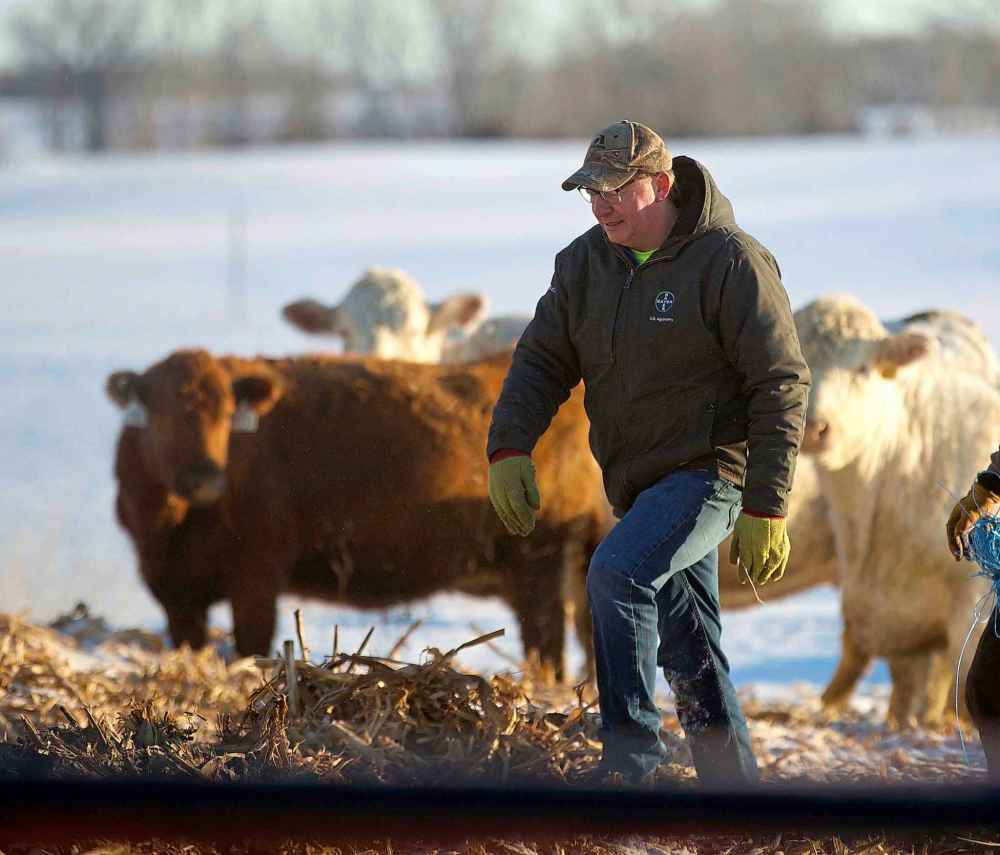
Wilts, his wife Gina and their three daughters tend almost 1,500 acres of corn, soybeans, sugar beets and alfalfa on the family farm near Kerkhoven, about two hours west of Minneapolis. Canada is an important trading partner, both as a customer and as a supplier of crucial inputs like potassium fertilizer.
In the short window before any tariff decisions are formally announced, Wilts is negotiating with suppliers and strategizing with lobby groups to build some resilience for his farm in the tumultuous years ahead.
“Canada is really important for us and I think we’re important for them on several things too,” he says.
It’s a similar story in Elm Creek, Man., some six hours north, where Colin Penner and his brother grow a mix of canola, wheat, soybeans and oats on their family’s 3,500-acre farm.
“It does feel more chaotic and uncertain than most years, but it takes a bit of nerve sometimes to be a farmer,” Penner says.
“Right now what we’re trying to do is … have a plan. What can we lock in? What can we do to make sure that we’re safe? And where can we gamble a little bit and hope for the best?”
While the impacts of a Canada-U.S. trade war are likely to hit all economic sectors, Wilts believes farmers are on the front lines.
“Business owners, farmers and folks like that are right in it right now — and have been — because it totally directly affects them,” Wilts says.
Margins have been tight in farming for many years. Family farms like the Wilts’ and Penner’s are slowly losing ground to larger corporate operations. Unpredictable costs and commodity prices continue to make farming difficult, and younger generations have been reluctant to stay on the farm.
“On the farm business side of things, this is some of the tightest budgeting I’ve ever seen,” says Penner, 39, who is in the process of taking over the farm from his parents.
“We’ve seen tremendous years where farmers are making hundreds of dollars an acre, and this year it’s looking like we might be losing $10 to $20 an acre. It does make it a little more complicated to farm.”
Colin Penner, a grain farmer southwest of Winnipeg, has had to think about the impact of possible tariffs and work on the diversity of his crops. (Mike Deal / Free Press)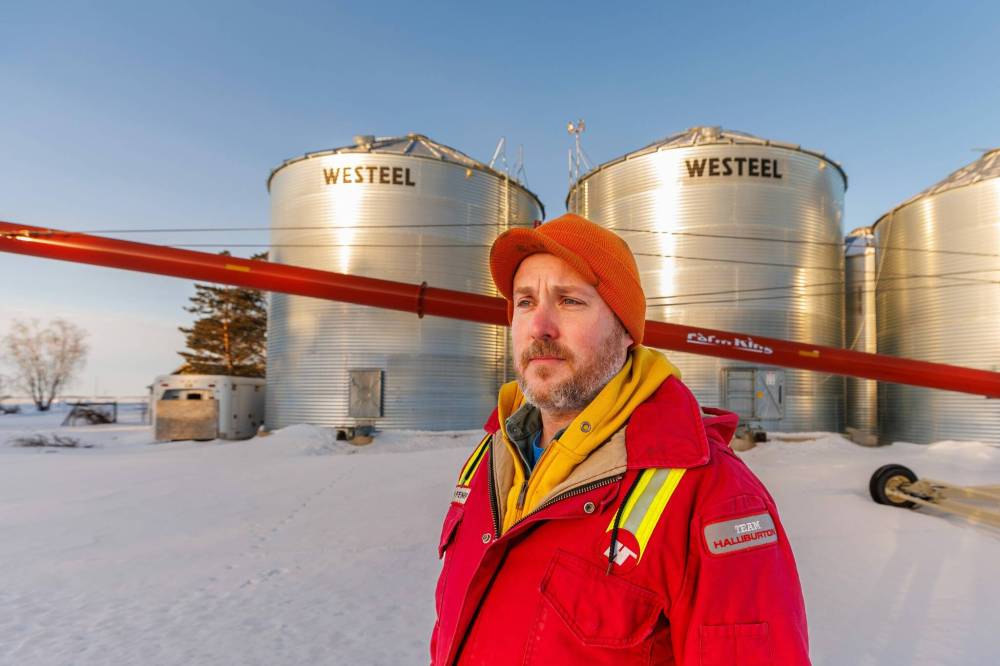
Tariffs would add another layer of complexity given Canada and the United States are among each other’s largest agricultural trade partners.
More than US$70 billion worth of agricultural goods crossed the border in 2023, with the U.S. buying more half of Canada’s exports and supplying more than half its imports.
Manitoba’s agricultural industry, one of the province’s most important sectors, sent more than $4.5 billion in agriculture and food exports stateside in 2023 — almost half of all its agri-food exports. In recent years, agricultural sales to the U.S. have grown faster than other export sectors.
“Canada-U.S. relations on any farm is huge,” Penner says.
His farm sells oats and soybeans to brokers who then sell to American customers. In recent months, he’s checked in more than once to make sure they can honour their contracts, asking: “‘Can you still find a home for some of these grains?’”
Canola is even more uncertain. Penner sells to a local crusher, which in turn exports to the U.S. Canola products are Manitoba’s largest American export, and experts predict it will bear the brunt of tariffs. Penner says the commodity is also vulnerable to political instabilities at home — a federal election is looming and a new government could indirectly impact how much is produced and used in Canada — and canola producers have been left to watch and wait before the impacts are fully understood.
“That’s why we grow a quarter of the farm to wheat, canola, oats and soybeans, to manage that risk,” Penner says. “(We’re) not throwing all our eggs in one basket.”
Colin Penner works with his son Everett in the shop. Colin has had to think about the impact of possible tariffs and look at measures to build resilience in his business. (Mike Deal / Free Press)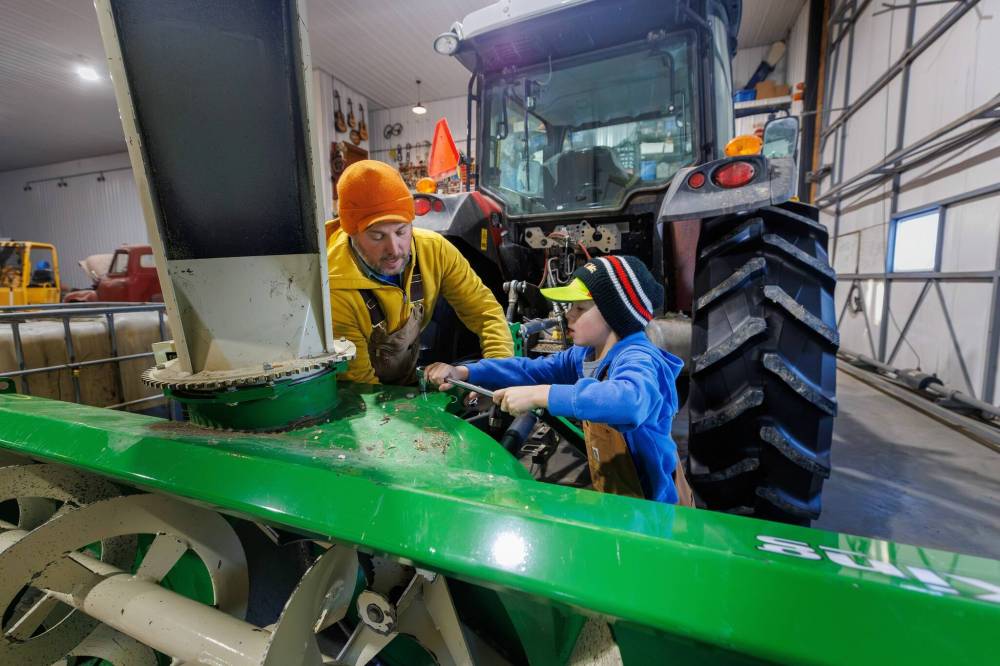
Meanwhile, in the U.S., it’s precisely the crops Wilts grows — corn and soybeans — that stand to be most affected by a trade war. They’re the country’s biggest farm export, together accounting for a quarter of all agricultural exports. For more than two dozen states, including Minnesota, Canada is a farmer’s largest market.
“I want to have our best trading partners to the north have a good relationship and it’s hard to do that when you have tariffs,” Wilts says.
For corn and soybean farmers, talk of tariffs is a sour dose of deja vu. Midway through his first term, Trump imposed tariffs on a raft of goods from China, Canada, Mexico and other nations. The retaliation — particularly from China, which imposed its own 25 per cent tariff on American soybeans — cost farmers billions.
“Our soybeans went from about $10 a bushel to about $7 a bushel — and that does not work in this economy,” Wilts says. “That will put a lot of farmers out of business within a year or two.”
Wilts is involved in the political side of farming — part of advocacy groups like the Minnesota Farmers Union, the National Farm Bureau and the National Corn Growers association — and supports lobbying efforts to convince American lawmakers that tariffs aren’t good for agricultural business. He’s planning a trip to Washington, D.C. in the spring with the American Coalition for Ethanol, where he serves as a board member, to advocate for measures that keep farms profitable.
“We’re about at a break even right now with prices — at best,” Wilts says. “I think the biggest thing has been to show legislators exactly what will happen if this happens. We can’t afford to lose any more farmers than we are now. We need to find a way to bring the next generation in.”
Related Articles
Trump says Canada facing 25 per cent tariff but oil might get a 10 per cent levy










It’s not just the exchange of food that American farmers are worried about. As threats of a cross-border trade war gain traction, Canadian politicians have publicly mulled the possibility of an export tax on commodities Americans may struggle to find elsewhere. Energy products and critical minerals like uranium and potash top those lists.
Potash, in particular, is among Canada’s most significant exports.
A catch-all term for minerals rich in potassium, potash is one of three key ingredients in fertilizer, making it vital to food production. Canada lists potash as a critical mineral; American lawmakers have lobbied to see it designated in the States, too.
About a third of the global potash supply comes from 11 mines in southern Saskatchewan, where the remnants of an ancient inland ocean form the largest potassium deposit in the world. Canada exports nearly 20 million tonnes of the rose-coloured rock each year, mostly to American farmers.
“Potash is very important to our operation,” Wilts says. “A very good chunk of it does come from our trading partners in Canada.”
Fertilizer is already in the ground for the 2025 growing season, but next year and beyond are full of unknowns. If tariffs or export taxes drive up the cost of fertilizer, Wilts will either need to cut back on potassium inputs, which could be bad for yield, or strike a deal with suppliers to lock in a price before tariffs are announced. In late January, he says, those conversations are already underway.
“I’ve got about 25 different people that help me with things: my seed supplier, my fertilizer supplier. I want to have a good relationship with them,” he says.
Manitoba’s lone potash producer shares the sentiment.
Daymon Guillas, president of the Potash and Agri Development Corporation of Manitoba (Mikaela MacKenzie / Free Press files)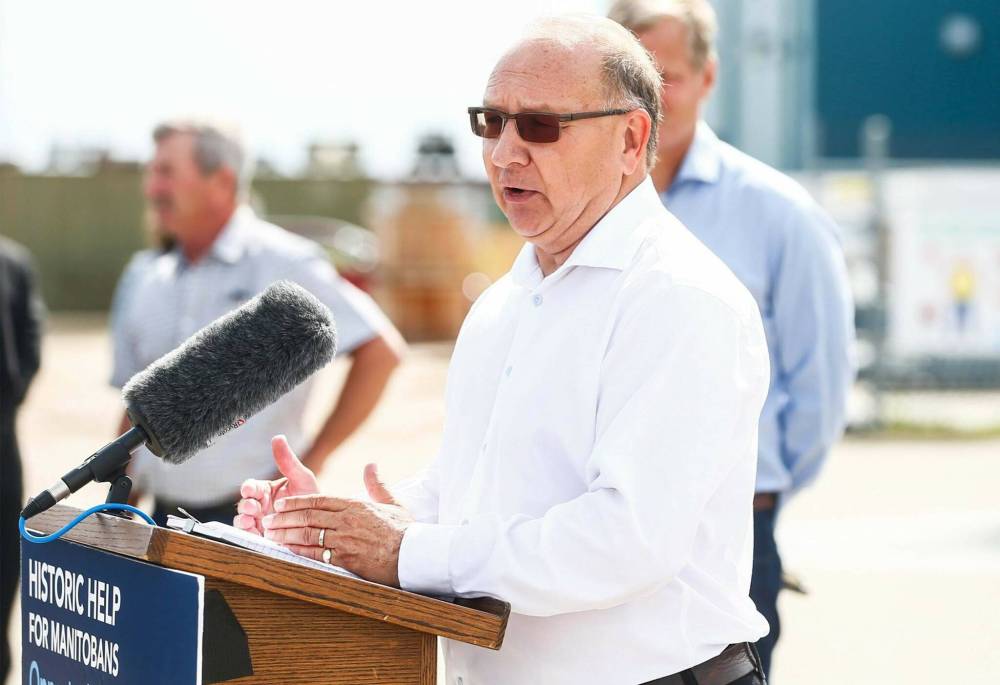
The Prairie Evaporite Formation — that ancient, potassium-rich ocean bed — stretches about 25 kilometres into western Manitoba, where Daymon Guillas has spent the better part of two decades trying to get his home province into the potash game.
As of 2023, the Potash and Agri Development Corporation of Manitoba successfully made its way onto the market. It expects to extract a modest 250,000 tonnes annually once it scales up its Harrowby-area mine, just west of Russell near the Saskatchewan border.
Though the mine is still in its infancy, Guillas says he isn’t worried about the impact of tariffs on business. The company has secured customers across North America, including many in the United States. Because potash is critical to America’s food security, relationships between Canadian miners and American farmers will outlast any political administration, Guillas says, and he’s not interested in jeopardizing those ties. The company is prepared to take an economic hit if needed to keep supplying its U.S. customers.
“Our business model is always long-term, sustainable relationships: you share the pain in bad times and you share the gains in good times,” he says. “We’re going to protect our long-term relationships with our U.S. neighbours forever.”
In Manitoba, the price of fuel, farm equipment and phosphate — another fertilizer ingredient — could be impacted by tariffs too. Penner secured a long-term supply of fertilizer and fuel while there was still “certainty in the market.”
It’s part of his efforts to future-proof the farm, though he acknowledges there’s only so much he can prepare for in advance.
“It’s kind of like playing cards. You should never hope you’re going to get the next card, you should look at the cards you’ve got and say: ‘This is what I’ve got now, I’ve got to make the best decision with what I know right now,’” Penner says.
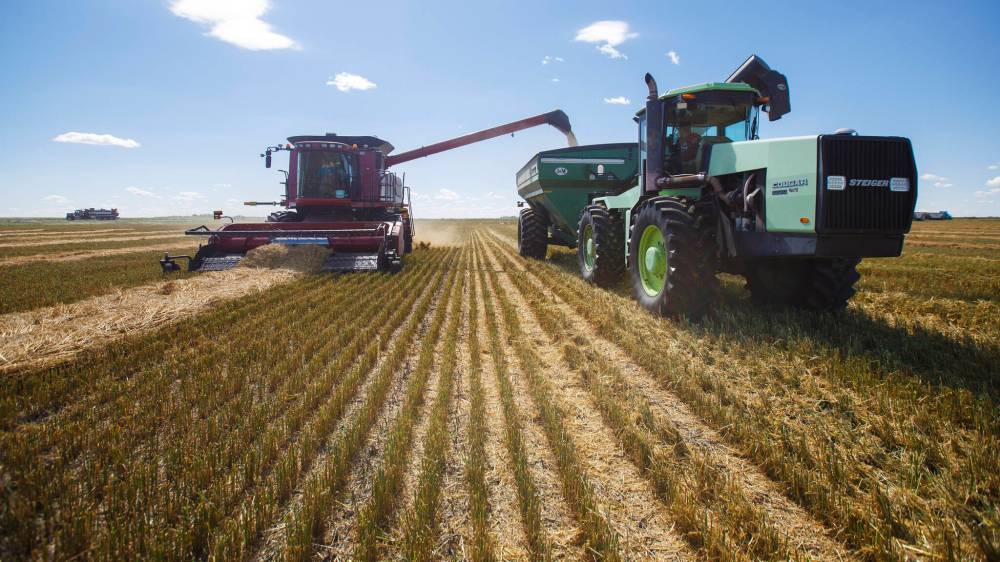
Colin Penner and his mother, Gloria, drive combines to get their canola field harvested in 2020. (Mike Deal / Free Press files)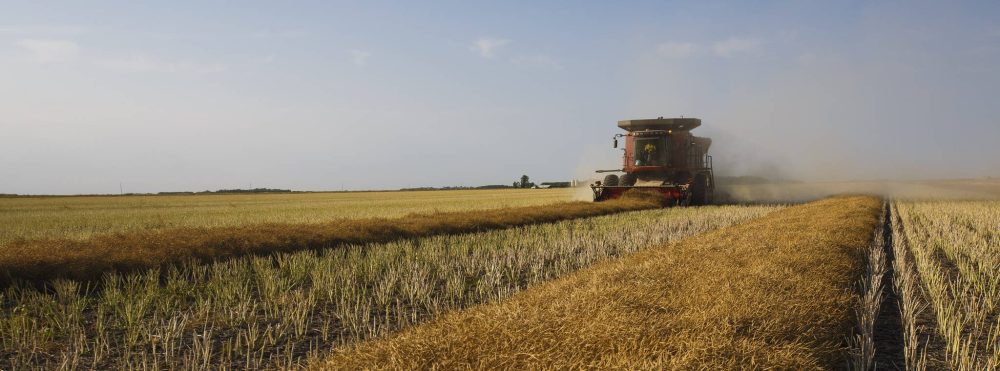
In the winter, Penner teaches a farm management class at the University of Manitoba, where he recently dedicated a week to discussing current geopolitical issues like tariffs and the upcoming federal election.
“Your head can spin around trying to navigate these things,” he says. But his students are optimistic — a trait he believes helps farmers keep their heads above water.
“There’s times when it absolutely is dark out there,” Penner says. “If we can look at things positively then hopefully we can grow into that and have positive things happen to us.”
Wilts is optimistic, too. Strong cross-border relationships, he believes, can help not only in the present moment, but in the long-term future of both countries’ agricultural sectors.
“I think the ideal outcome is a better relationship than we even have now with our very important trading partners in Canada,” he says.
“A win-lose doesn’t work. So the hope would be that we could come together and find a way to have a win-win situation going forward.”
julia-simone.rutgers@freepress.mb.ca
Julia-Simone Rutgers is a reporter covering environmental issues in Manitoba. Her position is part of a partnership between The Narwhal and the Winnipeg Free Press.

Julia-Simone Rutgers is an investigative reporter who joined the Free Press in 2020. Read more about Julia-Simone.
Every piece of reporting Julia-Simone produces is reviewed by an editing team before it is posted online or published in print — part of the Free Press‘s tradition, since 1872, of producing reliable independent journalism. Read more about Free Press’s history and mandate, and learn how our newsroom operates.
Our newsroom depends on a growing audience of readers to power our journalism. If you are not a paid reader, please consider becoming a subscriber.
Our newsroom depends on its audience of readers to power our journalism. Thank you for your support.