‘A wake-up call’: Report urges agri-food export diversification amid tariff threat

Advertisement

Advertise with us

TORONTO - The Canadian agriculture industry needs to expand its international exports to hold its own against U.S. tariffs and global competitors, according to a new report from RBC.

Read this article for free:


or

Already have an account? Log in here »

To continue reading, please subscribe:

Subscribe and receive a limited-edition Free Press branded hat or tote.

Digital Subscription

One year of digital access for only $205*

  • Enjoy unlimited reading on winnipegfreepress.com
  • Read the E-Edition, our digital replica newspaper
  • Access News Break, our award-winning app
  • Play interactive puzzles

*First annual payment billed as $205.00 + GST for one year. This annual subscription will automatically renew at $233.00 + GST every 52 weeks (10% off the regular annual price of $259.35). Offer available to new and qualified returning subscribers only. Cancel any time.

To continue reading, please subscribe:

Add Free Press access to your Brandon Sun subscription for only an additional

$1 for the first 4 weeks*

  • Enjoy unlimited reading on winnipegfreepress.com
  • Read the E-Edition, our digital replica newspaper
  • Access News Break, our award-winning app
  • Play interactive puzzles
Start now

*Your next Brandon Sun subscription payment will increase by $1.00 and you will be charged $17.95 plus GST for four weeks. After four weeks, your payment will increase to $24.95 plus GST every four weeks.

Hey there, time traveller!
This article was published 25/02/2025 (584 days ago), so information in it may no longer be current.

TORONTO – The Canadian agriculture industry needs to expand its international exports to hold its own against U.S. tariffs and global competitors, according to a new report from RBC.

Amid the looming tariff threat, the report says Canada’s agriculture and agri-food sector is vulnerable as more than 60 per cent of its exports go to the U.S.

It argues Canada has become too reliant on the U.S. for those exports, and over the years has become a dominant supplier for American grocery stores.
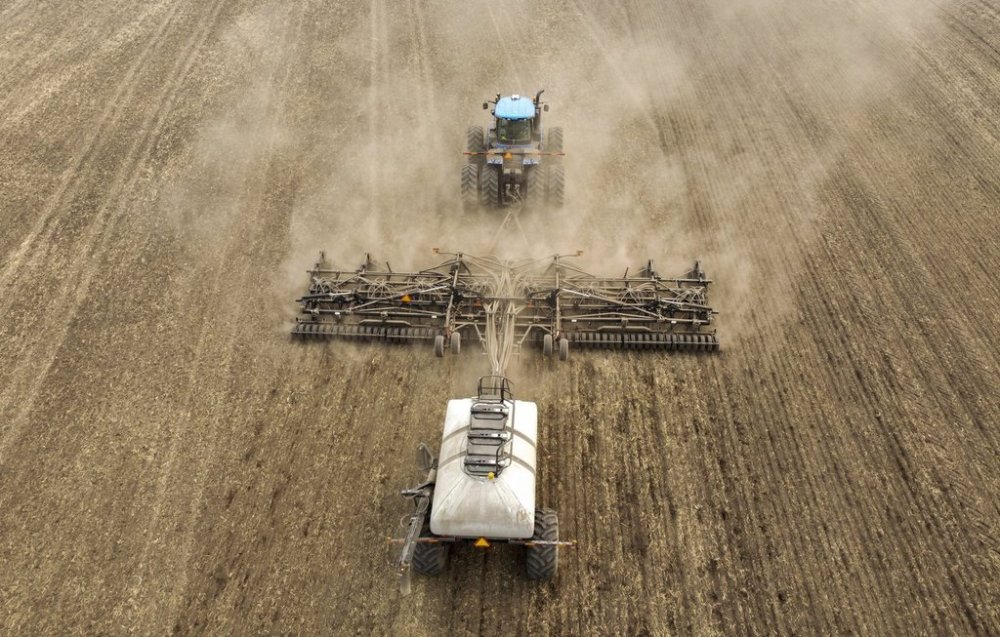
David Reid drives a seeding rig as he plants a canola crop on the family's farm near Cremona, Alta., Tuesday, May 16, 2023. THE CANADIAN PRESS/Jeff McIntosh

For instance, about 96 per cent of Canada’s canola oil went to the U.S. in 2024, while Canada also supplies the vast majority of potash for American farmers.

As a result of the growing relationship, Canada’s agri-food manufacturing sector quietly became the country’s largest source of manufacturing, the report said. Both countries have benefitted from their strong trading relationship.

But these advantages are now in jeopardy.

Tariffs on agriculture and agri-food products will make Canada a less desirable trading partner to the U.S. relative to other low-cost producers such as China and the Netherlands, the report said.

“Food and beverage manufacturing may also struggle to maintain investment levels, as one of its biggest selling features has been its preferential access to the world’s largest market.”

On the global stage, Canada is falling behind, with rivals like Brazil and Australia gaining market share in key markets, the report said. That means there are opportunities for diversification.

The report argues that Canada should start by taking advantage of its existing free-trade agreements, which provide access to more than two-thirds of the global economy. The next step is taking advantage of new growth markets, including in Southeast and South Asia.

India is another clear opportunity, the report said, in particular for plant-based proteins, where Canada can excel with its production of peas, lentils and soybeans.

But with the right measures, the report says Canada can increase its global share of agri-food exports, adding $44 billion in export value for the sector by 2035.

“To regain market share, Canada needs to focus on innovation, investment, export-oriented infrastructure, digital infrastructure, and overseas agri-food promotion,” the report said.

The report recommends that Canada invest in innovation in the agri-food sector, as well as fix internet and cellphone access in rural areas so farmers are able to adopt the latest generation of technology.

It also recommends investing in Canada’s export infrastructure to improve turnaround times at ports, as well as marketing Canadian products more effectively on the world stage.

The report envisions Canada making big strides in growing key industries such as the greenhouse sector, aquaculture and beef.

“Moving from short-term reactionary tactics to strategic growth, Canada can use the U.S. tariff threats as a wake-up call to leverage agriculture and agri-food as a driving force for trade diversification while building Canadian self-sufficiency.”

This report by The Canadian Press was first published Feb. 25, 2025.

Report Error Submit a Tip

More Stories

Collisions send people to hospital; one fatality

2 minute read Yesterday at 10:42 AM CDT

Five people are in hospital following a two-vehicle collision on Monday at the corner of Pembina Highway and Plaza Drive in which three pedestrians were struck.

On Sept. 28, just after 4:30 p.m., a Ford Fusion was travelling northbound on Pembina Highway through the Plaza Drive intersection with a green light when it was struck by a westbound Honda Fit that failed to stop for a red light at Plaza Drive. The Honda Fit mounted the sidewalk, striking three young children who were with an adult.

The three children were transported to hospital in stable condition with minor injuries. The driver of the Honda, a woman in her 70s, and the passenger, a man in his 80s, were transported to hospital in unstable condition. They were both upgraded to stable condition. The driver was issued a ticket under the Highway Traffic Act.

The Winnipeg Police Service’s Traffic Division is investigating.

Face up to fact you blew it with ex-wife

Maureen Scurfield 4 minute read 2:01 AM CDT

DEAR MISS LONELYHEARTS: My ex-wife just moved back to town and looks like a changed woman. She spent years married to me, and our kids just graduated in a city where we once lived together. That was without help from me, other than minor financial stuff.

She has found a great new job back in Winnipeg and she’ll do very well. I admire her more than any other woman I ever met, but she’s not interested in me at all.

I once had a solid, responsible job and then got into drinking, and I cheated on her. That’s why she left town. Now I’ve been sober and sorry for many years.

I asked her last weekend if I could take her out to dinner and she said no and changed the subject.

Health minister warns $1.2 billion in annual federal funding set to expire in March

Scott Billeck 4 minute read Preview

Health minister warns $1.2 billion in annual federal funding set to expire in March

Scott Billeck 4 minute read 6:58 PM CDT

Manitoba’s health minister is warning of possible cuts to health care with $1.2 billion in annual funding from Ottawa set to expire next year.

“We’re very concerned that what would be the largest cut to health care in a generation is right in front of us,” Health Minister Uzoma Asagwara said Thursday at the Manitoba legislature. “It means that services that Manitobans depend on will be in jeopardy and be at risk.

“Any reductions, any cuts from Canada, will have direct impacts on the health outcomes of Manitobans.”

Asagwara, who serves as the provincial and territorial health minister lead, chaired a virtual meeting Tuesday with provincial and territorial health ministers to discuss federal funding for health care, mental health care and substance use services, which is scheduled to expire March 31, 2027.

Read
6:58 PM CDT

Hero fought to remember children lost at residential school

Niigaan Sinclair 5 minute read Preview

Hero fought to remember children lost at residential school

Niigaan Sinclair 5 minute read Tuesday, Sep. 29, 2026

The story of the gravesites of students who attended the Brandon Indian Residential School underneath the Turtle Crossing Campground is truly a Manitoba tragedy.

Read
Tuesday, Sep. 29, 2026

In a smart-device world, some families keep phone jacked into the wall

Sheldon Birnie 8 minute read Preview

In a smart-device world, some families keep phone jacked into the wall

Sheldon Birnie 8 minute read Tuesday, Sep. 29, 2026

When the phone rings in Kristin Shiach and Jordan Sobkowicz’s Riverview home, their three daughters race to see who can be the first to answer.

“It depends who is closest,” says 13-year-old Emily. “If I’m sitting in my room, I can get to it quickest.”

“That’s because it’s always in your room,” Anna, 10, replies. “You never put it back!”

“Usually, when the phone rings,” explains Sobkowicz, “someone yells really loudly —”

Read
Tuesday, Sep. 29, 2026

Sisters relieved hospital takes accountability after mother’s death

Scott Billeck 6 minute read Preview

Sisters relieved hospital takes accountability after mother’s death

Scott Billeck 6 minute read 6:39 PM CDT

Eight months after losing their mother, two Winnipeg sisters say an internal hospital review has finally given them something they had been seeking since her death: accountability.

Chelsea Mann and Samantha Burns said St. Boniface Hospital officials acknowledged mistakes were made in the care of their mother, Judy Burns, during a recent meeting to discuss the findings of a critical incident review into her death.

The acknowledgement marked a significant departure from an earlier meeting with hospital officials, when they felt their concerns were largely dismissed.

Burns, 68, died on Jan. 21, three days after being admitted, after experiencing rectal bleeding.

Read
6:39 PM CDT