Some whales sing low enough to be ‘acoustically invisible’ to predators: research

Advertisement

Advertise with us

New research suggests male baleen whales looking for love sing a different tune when attracting a mate, and it all depends on if they are more likely to fight or flee from a predator.

Read this article for free:


or

Already have an account? Log in here »

To continue reading, please subscribe:

Subscribe and receive a limited-edition Free Press branded hat or tote.

Digital Subscription

One year of digital access for only $205*

  • Enjoy unlimited reading on winnipegfreepress.com
  • Read the E-Edition, our digital replica newspaper
  • Access News Break, our award-winning app
  • Play interactive puzzles

*First annual payment billed as $205.00 + GST for one year. This annual subscription will automatically renew at $233.00 + GST every 52 weeks (10% off the regular annual price of $259.35). Offer available to new and qualified returning subscribers only. Cancel any time.

To continue reading, please subscribe:

Add Free Press access to your Brandon Sun subscription for only an additional

$1 for the first 4 weeks*

  • Enjoy unlimited reading on winnipegfreepress.com
  • Read the E-Edition, our digital replica newspaper
  • Access News Break, our award-winning app
  • Play interactive puzzles
Start now

*Your next Brandon Sun subscription payment will increase by $1.00 and you will be charged $17.95 plus GST for four weeks. After four weeks, your payment will increase to $24.95 plus GST every four weeks.

Hey there, time traveller!
This article was published 13/02/2025 (608 days ago), so information in it may no longer be current.

New research suggests male baleen whales looking for love sing a different tune when attracting a mate, and it all depends on if they are more likely to fight or flee from a predator.

Killer whales are the only natural predator of baleen whales — those that eat using a system in their mouths to sieve their plankton diet from the water.

Experts have divided baleen whales into two categories based on how they are likely to respond to killer whales.
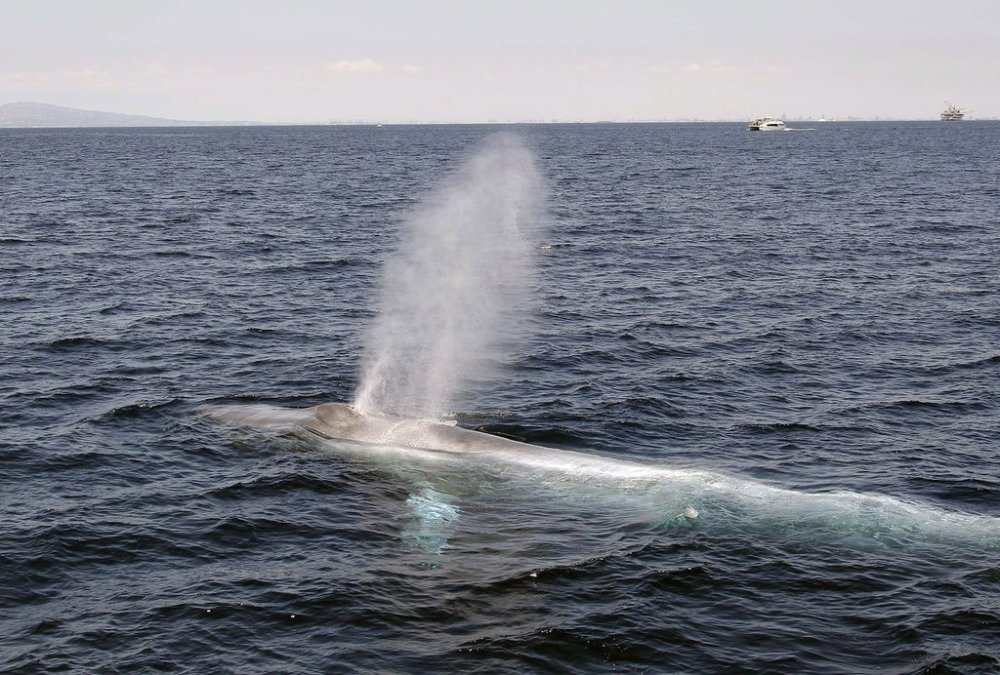
A Blue whale surfaces in front of a ship during a whale watching trip on the Pacific Ocean from Long Beach, Calif., on July 20, 2014. THE CANADIAN PRESS/AP-Nick Ut

The whales that travel in groups and are more likely to fight a killer whale, include right, bowhead, grey and humpback, while those that travel solo and are more prone to flight include blue, fin, sei, Bryde’s and minke whales.

Trevor Branch, a professor of aquatic and fishery sciences at the University of Washington, reviewed more than 250 research papers last summer on whales and found that most of the baleen whales more prone to flee from predators will sing at a bass level low enough to avoid being heard by killer whales.

“I think the astonishing thing for me is that you can have animals that produce some of the loudest sounds in nature, and yet their predators can’t hear them,” he said.

“A whale you can hear for hundreds of kilometres away, and yet a killer whale could be right next to it and couldn’t hear it. They could hear, probably, the sound of the blow, or the sound of them splashing, but as soon as you get beyond the range of that it’s like they’re completely acoustically invisible. Like ghosts in the water.”

Branch said most killer whales have poor hearing below 1500 Hz and can’t hear at all below 100 Hz.

He found only 24 per cent of flight species call above 1500 Hz, and generally very quietly, so they can’t be heard further than one kilometre away. Blue whales, for example, don’t call above 100 Hz.

In air, 100 Hz is around the low range of a baritone singer though Branch said sounds underwater are measured and heard differently.

Branch said it makes sense that females that are part of a flight species would be attracted to a male with a call that does not attract predators.

“Blue whales everywhere in the world, every population, over any time period you look at, their calls have been getting deeper and deeper over time and this is a completely unexplained mystery,” he said.

“So, maybe the females are basically forcing the males, through sexual selection, to sing a bit lower every year because the females find it more attractive to go toward a male that can sing deeply. And maybe one part of that is the deeper you sing, the less likely you attract killer whales.”

About 89 per cent of the whales that will fight against killer whales call above 1500 Hz. 

Whales in the “fight club” travel in groups and the males sing highly varied, beautiful, intricate songs that change every few years, Branch said.

“If you’re in a big aggregation with lots of males competing, then maybe singing low and monotonously is not going to get you a mate. You want to be singing in a way that shows off your abilities to sing. And maybe that’s a good indication of your fitness,” he said.

Branch said his findings are just the latest in a long line of facts about baleen whale life linked to how they respond to killer whales.

“Killer whale predation drives all kinds of aspects of whale ecology, where they move, where they stay, how they mate, why they sing, how they sing, where they go to breed, how long they suckle their calves until they wean them,” he said.

“All these aspects of life of baleen whales seem to be driven, at least in part, by killer whale predation, or at least the fear of killer whale predation.”

This report by The Canadian Press was first published Feb. 13, 2025

Report Error Submit a Tip

More Stories

Puzzles Palace

1 minute read Monday, Jul. 27, 2026

To solve our puzzles, please subscribe with this special offer: |

Former Oilers teammates square off for first time

Ken Wiebe 7 minute read Preview

Former Oilers teammates square off for first time

Ken Wiebe 7 minute read Monday, Oct. 12, 2026

Calvin Pickard has been many things to Stuart Skinner.

An ally, sounding board, confidante and most importantly, a close friend.

They were a goalie tandem for parts of three seasons with the Edmonton Oilers, making two trips to the Stanley Cup final, combining for 29 playoff wins, but falling just short of achieving the ultimate goal on both of those occasions.

They were opponents just once last season when the Oilers and Pittsburgh Penguins met for the first time since the trade that shipped Skinner to Pennsylvania, but it was Tristan Jarry – the guy he was traded for – standing at the opposite side of the rink.

Read
Monday, Oct. 12, 2026

Lobster Trap wins Dafoe book prize

Ben Sigurdson 1 minute read Preview

Lobster Trap wins Dafoe book prize

Ben Sigurdson 1 minute read 2:00 AM CDT

Greg Mercer’s The Lobster Trap: The Global Fight for a Seafood on the Brink has won the 2026 J.W. Dafoe Book Prize.

The $12,000 award, named after John Wesley Dafoe, the former editor of the Manitoba Free Press and Winnipeg Free Press, is presented annually to the best book on topics including “Canada, the West, and Canadians, as well as the Canadian nation in international affairs.”

Published by McClelland & Stewart in August 2025, The Lobster Trap examines the multi-billion dollar lobster industry and the impacts of climate change, trade wars and overfishing. The Lobster Trap is Mercer’s first book.

The award will be presented later this fall.

Read
2:00 AM CDT

Ontario to move northwest regions to permanent daylight time

Liam Casey, The Canadian Press 3 minute read Preview

Ontario to move northwest regions to permanent daylight time

Liam Casey, The Canadian Press 3 minute read Updated: Yesterday at 11:29 AM CDT

TORONTO - Ontario is set to move parts of the province's northwest region to permanent daylight time in order to align with Manitoba, Indigenous Affairs Minister Greg Rickford told The Canadian Press.

Rickford said there is overwhelming consensus among municipalities, First Nations and businesses to make the time change permanent.

The province intends to make a regulatory change in the Time Act on Nov. 1 to allow regions west of the 90th meridian to align with Manitoba, he said.

Manitoba Premier Wab Kinew announced last month the province would stop twice-annual clock changes and stay on daylight time year-round in the central time zone, leaving it one hour ahead of the other Prairie provinces rather than aligned with them.

Read
Updated: Yesterday at 11:29 AM CDT

Every few years, a sword over the baby

Hersh Seth 5 minute read Preview

Every few years, a sword over the baby

Hersh Seth 5 minute read 2:00 AM CDT

On Oct. 19, people in Alberta will answer 10 referendum questions. Nine are about things such as immigration, voter ID, judges and the Senate. The other asks if Alberta should remain in Canada or begin the legal steps toward a binding vote on leaving.

I want to share a perspective, as a patriotic Canadian, which I feel is lacking from the discourse.

Many of us who read those nine complaints can understand where Alberta is coming from. Ottawa kept control of the Prairies’ Crown lands and resources until 1930, allowing the East to grow at the West’s expense. The national energy program of the 1970s is still a sore spot west of Kenora, nearly 50 years later. Ontario and Quebec have almost 60 per cent of the seats in the House of Commons, so you can win everywhere from the Lakehead to the Pacific and still not change anything. Decisions are made about us, not with us. That frustration is real and being a Manitoban shouldn’t mean having to be Ottawa’s lawyer in this case. We are the original West, born in 1870 from Métis resistance to the same kind of treatment Alberta is protesting now.

So yes, we can understand how truly frustrated they are with the state of things in this country. But what bothers us even more is seeing someone threaten our children’s future every few years and call it leadership in their province.

Read
2:00 AM CDT

Tenants battling landlords find help in short supply from province

Scott Billeck 14 minute read Preview

Tenants battling landlords find help in short supply from province

Scott Billeck 14 minute read Yesterday at 6:00 AM CDT

For nearly three years, Quincy Houdayer and Avery Helm repeatedly pressed their landlord to address plumbing failures, water damage and other maintenance problems at their West Broadway apartment, with records showing some issues persisted until the couple turned to the Residential Tenancies Branch.

Emails and text messages between the tenants, Clearwater Management and the RTB reviewed by the Free Press document recurring leaks and flooding, periods without heat or hot water, concerns about mould and basement conditions and repeated followups from the couple seeking repairs.

“Most of the experiences we’ve had with them can be boiled down to, like, they either are very dismissive about it, they act like it’s not their problem… or they will just fully, blatantly ignore you,” Helm said, adding that the only way to get Clearwater to respond was to threaten going to the RTB, a provincial government agency.

RTB data obtained by the Free Press also shows 13 orders involving the three-building complex at 193-197 Furby St. in 2026 alone. All but one favoured the tenant, while the remaining order ruled in favour of both the tenant and landlord on different items.

Read
Yesterday at 6:00 AM CDT