Researchers link a gene to the emergence of spoken language

Advertisement

Advertise with us

Why did humans start speaking? Scientists suggest genetics played a big role – and they say the evolution of this singular ability was key to our survival.

Read this article for free:


or

Already have an account? Log in here »

To continue reading, please subscribe:

Subscribe and receive a limited-edition Free Press branded hat or tote.

Digital Subscription

One year of digital access for only $205*

  • Enjoy unlimited reading on winnipegfreepress.com
  • Read the E-Edition, our digital replica newspaper
  • Access News Break, our award-winning app
  • Play interactive puzzles

*First annual payment billed as $205.00 + GST for one year. This annual subscription will automatically renew at $233.00 + GST every 52 weeks (10% off the regular annual price of $259.35). Offer available to new and qualified returning subscribers only. Cancel any time.

To continue reading, please subscribe:

Add Free Press access to your Brandon Sun subscription for only an additional

$1 for the first 4 weeks*

  • Enjoy unlimited reading on winnipegfreepress.com
  • Read the E-Edition, our digital replica newspaper
  • Access News Break, our award-winning app
  • Play interactive puzzles
Start now

*Your next Brandon Sun subscription payment will increase by $1.00 and you will be charged $17.95 plus GST for four weeks. After four weeks, your payment will increase to $24.95 plus GST every four weeks.

Hey there, time traveller!
This article was published 18/02/2025 (581 days ago), so information in it may no longer be current.

Why did humans start speaking? Scientists suggest genetics played a big role – and they say the evolution of this singular ability was key to our survival.

A new study links a particular gene to the ancient origins of spoken language, proposing that a protein variant found only in humans may have helped us communicate in a novel way. Speech allowed us to share information, coordinate activities and pass down knowledge, giving us an edge over extinct cousins like Neanderthals and Denisovans.

The new study is “a good first step to start looking at the specific genes” that may affect speech and language development, said Liza Finestack at the University of Minnesota, who was not involved with the research.
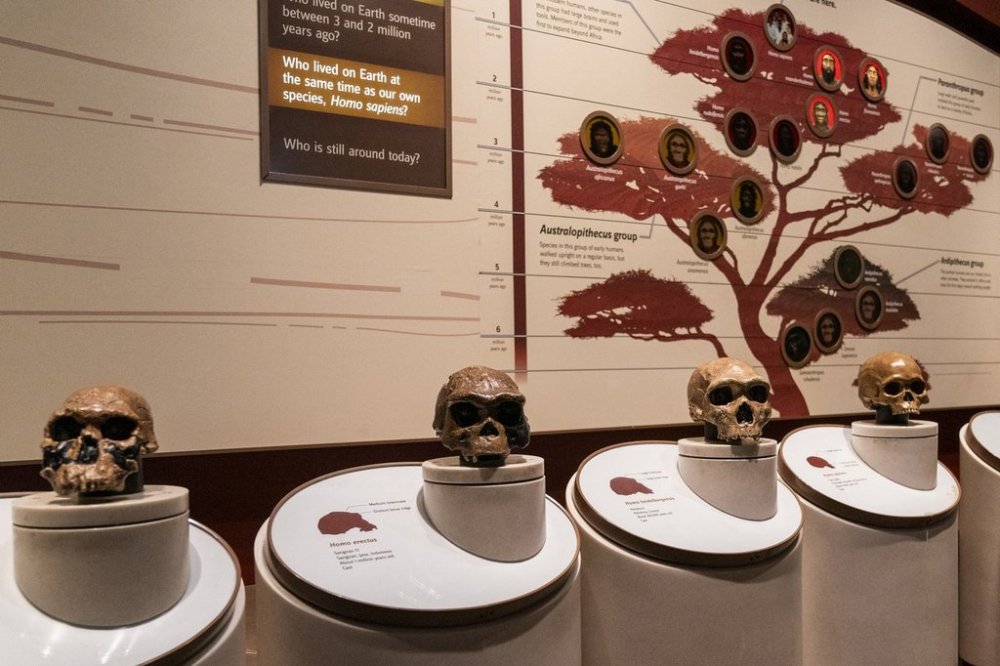
FILE - Casts of skulls are seen inside an exhibit of early human species inside the Smithsonian Hall of Human Origins, Thursday, July 20, 2023, at the Smithsonian Museum of Natural History, in Washington. (AP Photo/Jacquelyn Martin, File)

What scientists learn may someday even help people with speech problems.

The genetic variant researchers were looking at was one of a variety of genes “that contributed to the emergence of Homo sapiens as the dominant species, which we are today” said Dr. Robert Darnell, an author of the study published Tuesday in the journal Nature Communications.

Darnell has been studying the protein – called NOVA1 and known to be crucial to brain development – since the early 1990s. For the latest research, scientists in his lab at New York’s Rockefeller University used CRISPR gene editing to replace the NOVA1 protein found in mice with the exclusively human type to test the real-life effects of the genetic variant. To their surprise, it changed the way the animals vocalized when they called out to each other.

Baby mice with the human variant squeaked differently than normal littermates when their mom came around. Adult male mice with the variant chirped differently than their normal counterparts when they saw a female in heat.

Both are settings where mice are motivated to speak, Darnell said, “and they spoke differently” with the human variant, illustrating its role in speech.

This isn’t the first time a gene has been linked to speech. In 2001, British scientists said they had discovered the first gene tied to a language and speech disorder.

Called FOXP2, it was referred to as the human language gene. But though FOXP2 is involved in human language, it turned out that the variant in modern humans wasn’t unique to us. Later research found it was shared with Neanderthals. The NOVA1 variant in modern humans, on the other hand, is found exclusively in our species, Darnell said.

The presence of a gene variant isn’t the only reason people can speak. The ability also depends on things like anatomical features in the human throat and areas of the brain that work together to allow people to speak and understand language.

Darnell hopes the recent work not only helps people better understand their origins but also eventually leads to new ways to treat speech-related problems.

University of Minnesota’s Finestack said it’s more likely the genetic findings might someday allow scientists to detect, very early in life, who might need speech and language interventions.

“That’s certainly a possibility,” she said.

——

The Associated Press Health and Science Department receives support from the Howard Hughes Medical Institute’s Science and Educational Media Group and the Robert Wood Johnson Foundation. The AP is solely responsible for all content.
Report Error Submit a Tip

More Stories

Who will win? Most voters haven’t decided yet

Editorial 4 minute read Preview

Who will win? Most voters haven’t decided yet

Editorial 4 minute read 2:00 AM CDT

Just over a month before Winnipeg voters choose their next mayor, the most striking number in the latest polling isn’t Scott Gillingham’s lead.

It’s the 51 per cent of voters who still haven’t decided who they’re going to vote for.

That is an enormous chunk of the electorate to have sitting on the sidelines this late in a municipal campaign. And while it may make the current standings look more uncertain than they otherwise would, it shouldn’t come as a complete surprise.

Winnipeg municipal elections have not been models of voter engagement in recent years. Turnout has been falling — from 50 per cent in 2014 to 42 per cent in 2018 and just 37.5 per cent in 2022.

Read
2:00 AM CDT

Audited public accounts show Manitoba's deficit last year half of predicted $1.67 billion

Carol Sanders 6 minute read Preview

Audited public accounts show Manitoba's deficit last year half of predicted $1.67 billion

Carol Sanders 6 minute read Updated: Yesterday at 7:27 PM CDT

Manitoba’s audited public accounts for the last fiscal year show the province is “moving in the right direction,” NDP Finance Minister Adrien Sala said Monday.

The provincial deficit for fiscal 2025-26 was $832 million, nearly half the $1.67-billion deficit forecast in December, and in line with the $794-million estimate in Budget 2026.

“I’m particularly proud of this final result, (given the potential) implications of tariffs on our economy, the worst wildfire season in 30 years — which resulted in significant emergency expenditures — and, of course, a significant drought,” Sala said at a news conference.

The province reported revenues of $25.1 billion and expenses of $25.9 billion, resulting in the $832-million deficit. Manitoba’s net debt is $36.5 billion and costs the province $2.3 billion a year in debt-servicing charges.

Read
Updated: Yesterday at 7:27 PM CDT

Woman who fled abuse decries lack of consequences for landlord who breached lease-breaking confidentiality

Carol Sanders 5 minute read Preview

Woman who fled abuse decries lack of consequences for landlord who breached lease-breaking confidentiality

Carol Sanders 5 minute read Yesterday at 6:00 AM CDT

The provincial government is being asked to penalize landlords who breach the confidentiality of tenants breaking a lease to flee domestic violence after a survivor discovered there’s no consequences now.

“It put me in a very difficult situation,” said the woman, who was stunned to see that her landlord copied her abuser in email correspondence, including the domestic violence certificate she obtained to end a tenancy agreement early and leave an abusive relationship.

“My heart dropped to my stomach — I was in disbelief,” she said, recalling the confidentiality breach that occurred in 2025.

“I’m very lucky to be in a situation where it’s no longer a threat to my immediate safety.”

Read
Yesterday at 6:00 AM CDT

Letters, Sept. 22

6 minute read 2:00 AM CDT

You are not alone

Recent reports involving a Winnipeg firefighter with a history of criminal harassment and protection order violations, and a Winnipeg police officer charged in a physical and sexual intimate partner violence assault investigation, should prompt a broader conversation about accountability when allegations of gender-based violence involve individuals in positions of public trust.

I wrote a letter to the editor to the Free Press that was published Aug. 4 about the WFPS case, and I believe those comments are relevant to this moment as well.

Rather than reiterate those points, I would like to address those impacted by gender-based violence.

Post-secondary leaders to discuss cross-campus collaborations

Maggie Macintosh 4 minute read Preview

Post-secondary leaders to discuss cross-campus collaborations

Maggie Macintosh 4 minute read 2:00 AM CDT

The artificial intelligence boom is inducing panic about the makeup of Manitoba’s future workforce and influencing new post-secondary application trends.

What remains a constant, says the economist who oversees the University of Manitoba, is the often-overlooked value of a liberal arts degree.

“I’ve always believed in it being a foundation for lifelong learning,” said Michael Benarroch, president and vice-chancellor of the largest post-secondary institute in the province.

“Even more so, in a world of AI, where AI is going to do certain tasks, I think humanities education and social sciences education is going to become even more important.”

Read
2:00 AM CDT

Power outages expected as giant tanks moved

1 minute read Yesterday at 5:18 PM CDT

Manitoba Hydro customers in some communities may be temporarily without power while eight giant storage tanks are transported across Manitoba by truck between Tuesday and Thursday.

Outages may affect areas primarily along highways 23 and 59, Hydro said.

Crews will either lift or temporarily disconnect power lines at about 220 locations along the roughly 430-kilometre route from the Manitoba-Saskatchewan boundary and the Tolstoi border crossing into Minnesota. Each outage is expected to last about 1 ½ hours.

Hydro said the empty storage tanks, manufactured in Alberta, are being moved so they can be shipped overseas. Each tank is about the height of a two-storey building.