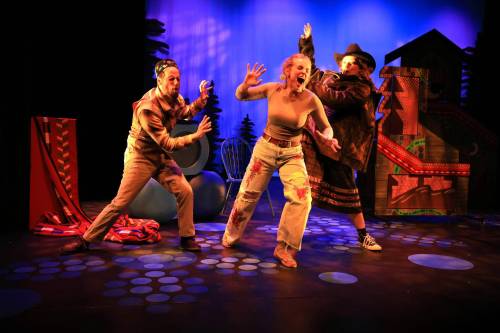
Cinderella story gets a musical Métis twist at MTYP
Fairy tale could use more laughs to liven up earnest message
Advertisement
Read this article for free:
or
Already have an account? Log in here »
To continue reading, please subscribe:

Digital Subscription
One year of digital access for only $205*
- Enjoy unlimited reading on winnipegfreepress.com
- Read the E-Edition, our digital replica newspaper
- Access News Break, our award-winning app
- Play interactive puzzles
*First annual payment billed as $205.00 + GST for one year. This annual subscription will automatically renew at $233.00 + GST every 52 weeks (10% off the regular annual price of $259.35). Offer available to new and qualified returning subscribers only. Cancel any time.
To continue reading, please subscribe:
Add Free Press access to your Brandon Sun subscription for only an additional
$1 for the first 4 weeks*
- Enjoy unlimited reading on winnipegfreepress.com
- Read the E-Edition, our digital replica newspaper
- Access News Break, our award-winning app
- Play interactive puzzles
*Your next Brandon Sun subscription payment will increase by $1.00 and you will be charged $17.95 plus GST for four weeks. After four weeks, your payment will increase to $24.95 plus GST every four weeks.
Read unlimited articles for free today:
or
Already have an account? Log in here »
Hey there, time traveller!
This article was published 23/02/2025 (592 days ago), so information in it may no longer be current.
Since time began, kids of all ages have lapped up stories passed from one generation to the next. These tales often become, in the words of Erin Macklem’s Blue Beads and Blueberries, “how our ancestors speak to us.”
Manitoba Theatre for Young People’s latest production, penned by the Victoria, B.C.-based playwright/lyricist as a “love letter” to her Métis/Michif family, honours that age-old tradition, while adding its own Indigenous twist to the Victorian-era fairy tale Cap-o-Rushes.
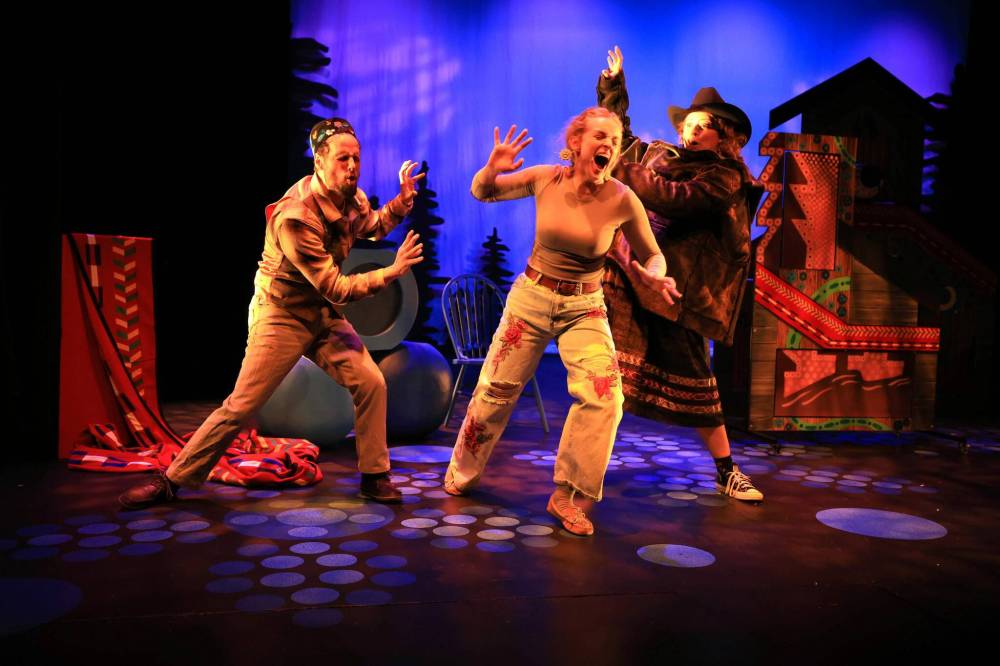
A strong cast of triple threats — Alanna McPherson (making an admirable MTYP debut as Alexina; Minnie/Rosalie); the charismatic Emily Meadows (Exerine/Célina); and the always compelling Simon Miron (Dad/Jean-Baptiste/Gerard) — seamlessly morph among their multiple characters in this story-within-a-story, in which a father tests his two squabbling daughters by asking how much they love him.
Theatre review
Blue Beads and Blueberries
Manitoba Theatre for Young People
Next shows March 2, 1 p.m. and 4 p.m.
3-1/2 stars out of five
When Célina innocently professes she loves him “as much as pemmican loves blueberries” — and that’s a good thing — her disappointed dad banishes her to the forest, while his more free-spirited daughter Alexina imagines herself becoming a fantastical “Rougarou,” a Métis werewolf-esque character that scares children into behaving.
The newly expanded 60-minute musical directed by Katie German (which was debuted by Victoria’s Story Theatre Company in 2018 at half that length) features a charming, also expanded playlist of child-friendly songs, with Macklem’s lyrics set to music by composer/music director/sound designer Avery Brown.
It took a while for this “rubaboo” story stew infused with plenty of cornball “knock-knock” jokes (some work, others fall flat) to really get going during Saturday’s second matinee performance.
There are holes in the narrative that could have been filled in, such as why the two siblings are initially so at odds with each other, other than the odd, off-the-cuff reference to Alexina’s “modernistic sensibilities,” as opposed to the more dutiful, traditional Célina.
The two sisters’ relationship — and by extension, their connection to their father — often flips like a flapjack while lacking motivation, weakening the overall narrative structure.
Yet director German takes the material presented to her and weaves the multi-generational characters like threads in a colourful “ceinture fléchée” sash into an engaging story, with its DNA firmly rooted in fairy tale, including overtones of Cinderella.
Recorded fiddle licks and musical “stings” also keep things humming as Joyce Licup’s effective set pieces, including nifty, ginormous “blueberries,” are strategically positioned to create the family’s home, forest and even a theatre, with all costumes designed by Amy McPherson.
Lovissa Wiens’s lighting design highlights the action throughout, although it is too dim at certain points.
Any show with Red River jigging has got this writer’s attention, and more dance breaks, choreographed by Seraph-Eden Boroditsky (Macklem’s newly discovered cousin) and jigging instructor Sofia Gil, would have been welcome.
A later, high-stepping broom dance (which includes Miron, now appearing as Gerard, the fashion-loving fur-trader, leaping like a leprechaun) is worth the price of admission alone, adding further texture and life.
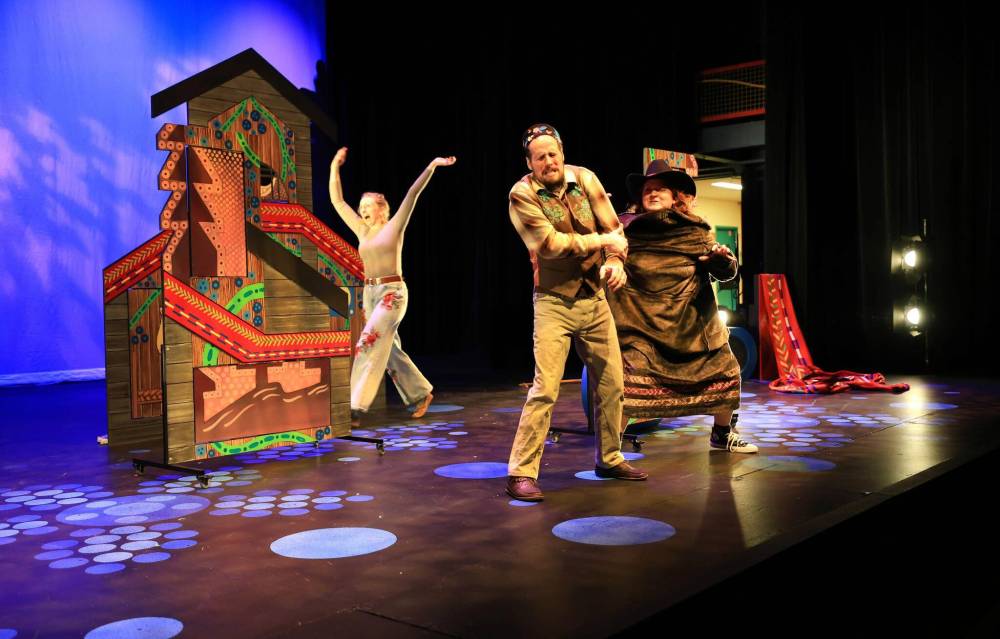
Having a live fiddler appear onstage — there are many terrific artists in this community from which to choose, including Manitoba’s Sierra Noble, who provided the recorded tracks — would have been like sweet jam on bannock.
One of the silliest scenes comes when the actors belt out Alouette while furiously plucking “feathers” out of rubber chickens; Miron’s wild-eyed yanking of plumes, with a red handkerchief symbolizing blood, offers sidesplitting slapstick humour.
Their subsequent “Prairie Chicken Lightning Round” theatre scene, in which the birds wear tiny wigs representing the human characters, is another (and one fears when fine real-life actors are upstaged by flapping poultry).
More of these joyful, zany moments would have provided the levity necessary to balance an often overly earnest plotline.
After Alexina ultimately rediscovers her familial roots through the power of sharing ancestral stories, Dad realizes both daughters love him equally and in their own way.
After imparting his wisdom to his daughter — “Be the blueberry; be the sweetness and flavour to the stories you need to tell” — she realizes her own empowerment as a feisty, creative voice.
The play ends on a high note with a final reprise of one of the show’s best songs, There’s a Sash for That (another being Célina’s earlier Take a Deep Breath Now), which underscores Blue Beads’s overriding theme: “Kwaayesh kaa ishpayin” (“It’s going to be all right”).
holly.harris@shaw.ca
Holly Harris writes about music for the Free Press Arts & Life department.
Our newsroom depends on a growing audience of readers to power our journalism. If you are not a paid reader, please consider becoming a subscriber.
Our newsroom depends on its audience of readers to power our journalism. Thank you for your support.
Holly Harris writes about music for the Free Press Arts & Life department.
Our newsroom depends on a growing audience of readers to power our journalism. If you are not a paid reader, please consider becoming a subscriber.
Our newsroom depends on its audience of readers to power our journalism. Thank you for your support.
Related Articles
MTYP's Blue Beads and Blueberries inspired by playwright’s unearthed Métis heritage

Advertisement Advertise With Us
Advertisement Advertise With Us