

South Korean births increased last year for the first time in nearly a decade
Advertisement
Read this article for free:
or
Already have an account? Log in here »
To continue reading, please subscribe:

Digital Subscription
One year of digital access for only $205*
- Enjoy unlimited reading on winnipegfreepress.com
- Read the E-Edition, our digital replica newspaper
- Access News Break, our award-winning app
- Play interactive puzzles
*First annual payment billed as $205.00 + GST for one year. This annual subscription will automatically renew at $233.00 + GST every 52 weeks (10% off the regular annual price of $259.35). Offer available to new and qualified returning subscribers only. Cancel any time.
To continue reading, please subscribe:
Add Free Press access to your Brandon Sun subscription for only an additional
$1 for the first 4 weeks*
- Enjoy unlimited reading on winnipegfreepress.com
- Read the E-Edition, our digital replica newspaper
- Access News Break, our award-winning app
- Play interactive puzzles
*Your next Brandon Sun subscription payment will increase by $1.00 and you will be charged $17.95 plus GST for four weeks. After four weeks, your payment will increase to $24.95 plus GST every four weeks.
Read unlimited articles for free today:
or
Already have an account? Log in here »
Hey there, time traveller!
This article was published 27/02/2025 (594 days ago), so information in it may no longer be current.
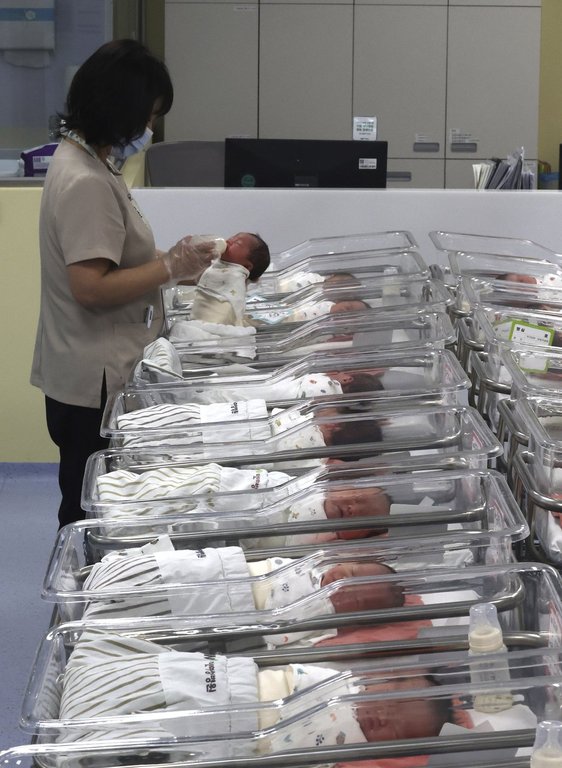
SEOUL, South Korea (AP) — The number of babies born in South Korea rebounded for the first time in nine years in 2024, welcome news for a country grappling with one of the the world’s most serious demographic crises.
South Korea’s statistics agency said Wednesday that 238,300 babies were born last year, an increase of 8,300 from a year earlier. It said the country’s fertility rate — the average number of babies born to each woman in their reproductive years — was 0.75 in 2024, up from 0.72 in 2023.
It’s the first time that the yearly number of births has increased since 2015.
“It’s fair to say this is a considerably meaningful rebound,” Choi Yoon Kyung, an expert at the Korea Institute of Child Care and Education, said Thursday. “We still have to see figures in the next few years to find whether it was a temporary rebound or it was driven by structural changes.”
Park Hyun Jung, a senior official at the Statistics Korea, said that her agency assessed the increase in births was partly attributable to an increase in marriages among couples who delayed weddings during the COVID-19 pandemic period.
Park said that another factor behind the rebound was a growing number of people entering their early 30s. She also cited a government survey showing a small increase in the number of young people hoping to have children after marriage.
Official data show South Korea’s fertility rate has been the lowest in the developed world in recent years. In 2022, it was the only country whose fertility rate was below 1 among members of the Paris-based Organization for Economic Cooperation and Development.
The low fertility rate poses a major potential threat to South Korea’s economy, Asia’s fourth largest, as it will cause labor shortages and greater welfare spendings. South Korea’s central and regional governments have been increasingly offering a variety of financial incentives and other support programs to those who give birth to children.
But experts say that it will be extremely difficult to address the country’s demographic challenges as young people don’t want to have babies, owing to a mix of factors that make it difficult to raise them in the brutally competitive, fast-changing country. They cite expensive housing, low levels of social mobility, the huge cost of raising and educating children and a culture that requires women to handle far more of childcare.
Park said that the fertility rate will likely stay on an upward trend at least for another year. But observers say it remains to be seen whether the rate will go back down as post-pandemic marriages even out. The country’s demographic structure will also eventually see a drop in people in their early 30s.
Some experts argue that the government should focus on supporting young couples who want to have babies, rather than providing broad programs meant to address diverse social problems.
“There are still people with solid wills to have a family and babies. When we help them realize their hopes, our fertility rate won’t suffer a steep, 45-degree drop,” Choi said.