In dark times, we look to unlikely sources of hope

Advertisement
Read this article for free:
or
Already have an account? Log in here »
To continue reading, please subscribe:

Digital Subscription
One year of digital access for only $205*
- Enjoy unlimited reading on winnipegfreepress.com
- Read the E-Edition, our digital replica newspaper
- Access News Break, our award-winning app
- Play interactive puzzles
*First annual payment billed as $205.00 + GST for one year. This annual subscription will automatically renew at $233.00 + GST every 52 weeks (10% off the regular annual price of $259.35). Offer available to new and qualified returning subscribers only. Cancel any time.
To continue reading, please subscribe:
Add Free Press access to your Brandon Sun subscription for only an additional
$1 for the first 4 weeks*
- Enjoy unlimited reading on winnipegfreepress.com
- Read the E-Edition, our digital replica newspaper
- Access News Break, our award-winning app
- Play interactive puzzles
*Your next Brandon Sun subscription payment will increase by $1.00 and you will be charged $17.95 plus GST for four weeks. After four weeks, your payment will increase to $24.95 plus GST every four weeks.
Read unlimited articles for free today:
or
Already have an account? Log in here »
Hey there, time traveller!
This article was published 01/03/2025 (568 days ago), so information in it may no longer be current.
It cuts a powerful, artful image.
The anglerfish — a creature that normally lives in the inky depths of the sea — swimming placidly in a glittering azure expanse, rainbows of light from the surface occasionally flickering across its face.
It’s a monster’s face. Not for nothing, this type of anglerfish is also called a black seadevil. Its teeth hang like icicles in a gaping, cavernous mouth, its lidless eyes are fixed in a dead-eyed stare.
Randy Berrett / Museum of Modern Art
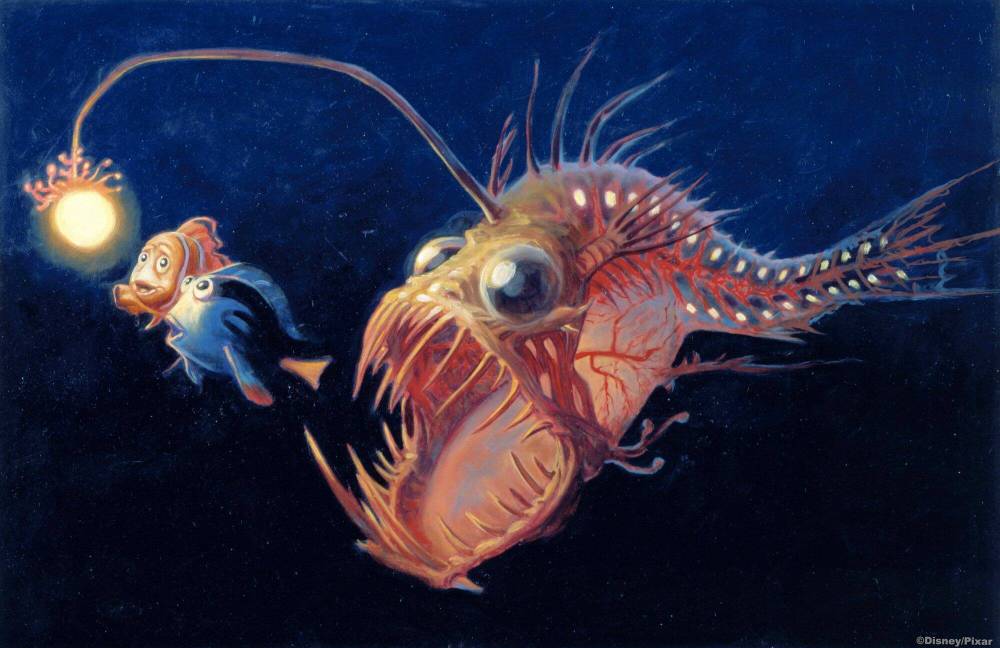
An anglerfish plays a key role in a distressing scene in Finding Nemo.
This one is female; we know this because she has a bioluminescent lure — a filament that holds a small sac of glowing bacteria.
She was a real fish, spotted by scientists close to the surface off the coast of Tenerife, the largest of Spain’s Canary Islands, in late January. She died shortly after the rare sighting.
Of course, she’s caused a stir, as the iconic and infrequently spotted tend to do. The New York Times called her a “deep-sea fish of nightmares,” which is very harsh and also how I’d like to be eulogized.
People all over social media have been moved by her, making art, composing poems and sobbing on TikTok.
It’s not the fish, exactly, that people are taken with. It’s the narrative people have ascribed to it. Look at this misunderstood little fish who overcame the odds because she “just wanted to see the light before she died.”
Now, I am not a fish scientist (clearly), but I can say with confidence that she absolutely, 100 per cent did not want to see the light before she died. She had her own lightbulb.
I’m all for seeing poetry and imagery in the world — I am, after all, an arts writer — but the anglerfish is a creature of high-pressure darkness, a place so deep it’s called the “midnight zone.” Why on earth would her final wish be to see the sun?
While we’re anthropomorphizing, though: I’ve never seen a public image so thoroughly rehabilitated than that of the anglerfish, thanks to this diva’s unwitting PR campaign.
Anglerfish are so freaky looking that one features prominently in the most scarring scene of Pixar’s Finding Nemo. Now people are tattooing this one onto their bodies as a symbol of hope.
I get it. I think people are so craving hope and light at the moment that we’re looking for it everywhere. We’re trying to escape the crushing darkness of right now — the uncertainty, the doom, the fear.
We’re searching for the sun, so it follows that everything must be. Humans and their hubris.
There probably is a tale worth our tears here, but it’s not the one social media is collectively writing.
We humans can’t fathom living out our days in crushing blackness because, to us, that’s torture.
(Well, for most of us; I’m sure there are people for whom living unbothered at the bottom of the sea sounds nice, actually.)
But for the anglerfish, that’s her reality. Her darkness is our light.

An anglerfish being so close to the surface isn’t a beautiful hero’s journey of a fish seeing the light for the first time in her final days.
It’s actually kind of a horror story. This poor little gal — oh no, look, I’m doing it too — was probably, per actual scientists, sick or injured or disoriented or caught in a current.
I don’t know what it means that species are appearing where they shouldn’t be, but I’m guessing it’s nothing good.
Instead of projecting Disney fantasies onto it, we’d do well to wonder why a fish meant to live in the depths of the sea died so very far away from home.
jen.zoratti@winnipegfreepress.com
Jen Zoratti is a columnist and feature writer working in the Arts & Life department, as well as the author of the weekly newsletter NEXT. A National Newspaper Award finalist for arts and entertainment writing, Jen is a graduate of the Creative Communications program at RRC Polytech and was a music writer before joining the Free Press in 2013. Read more about Jen.
Every piece of reporting Jen produces is reviewed by an editing team before it is posted online or published in print – part of the Free Press‘s tradition, since 1872, of producing reliable independent journalism. Read more about Free Press’s history and mandate, and learn how our newsroom operates.
Our newsroom depends on a growing audience of readers to power our journalism. If you are not a paid reader, please consider becoming a subscriber.
Our newsroom depends on its audience of readers to power our journalism. Thank you for your support.
Jen Zoratti is a columnist and feature writer working in the Arts & Life department, as well as the author of the weekly newsletter NEXT. A National Newspaper Award finalist for arts and entertainment writing, Jen is a graduate of the Creative Communications program at RRC Polytech and was a music writer before joining the Free Press in 2013. Read more about Jen.
Every piece of reporting Jen produces is reviewed by an editing team before it is posted online or published in print – part of the Free Press‘s tradition, since 1872, of producing reliable independent journalism. Read more about Free Press’s history and mandate, and learn how our newsroom operates.
Our newsroom depends on a growing audience of readers to power our journalism. If you are not a paid reader, please consider becoming a subscriber.
Our newsroom depends on its audience of readers to power our journalism. Thank you for your support.
Advertisement Advertise With Us
Advertisement Advertise With Us