Scientists genetically engineer mice with thick hair like the extinct woolly mammoth

Advertisement

Advertise with us

WASHINGTON (AP) — Extinction is still forever, but scientists at the biotech company Colossal Biosciences are trying what they say is the next best thing to restoring ancient beasts — genetically engineering living animals with qualities to resemble extinct species like the woolly mammoth.

Read this article for free:


or

Already have an account? Log in here »

To continue reading, please subscribe:

Subscribe and receive a limited-edition Free Press branded hat or tote.

Digital Subscription

One year of digital access for only $205*

  • Enjoy unlimited reading on winnipegfreepress.com
  • Read the E-Edition, our digital replica newspaper
  • Access News Break, our award-winning app
  • Play interactive puzzles

*First annual payment billed as $205.00 + GST for one year. This annual subscription will automatically renew at $233.00 + GST every 52 weeks (10% off the regular annual price of $259.35). Offer available to new and qualified returning subscribers only. Cancel any time.

To continue reading, please subscribe:

Add Free Press access to your Brandon Sun subscription for only an additional

$1 for the first 4 weeks*

  • Enjoy unlimited reading on winnipegfreepress.com
  • Read the E-Edition, our digital replica newspaper
  • Access News Break, our award-winning app
  • Play interactive puzzles
Start now

*Your next Brandon Sun subscription payment will increase by $1.00 and you will be charged $17.95 plus GST for four weeks. After four weeks, your payment will increase to $24.95 plus GST every four weeks.

Hey there, time traveller!
This article was published 04/03/2025 (572 days ago), so information in it may no longer be current.

WASHINGTON (AP) — Extinction is still forever, but scientists at the biotech company Colossal Biosciences are trying what they say is the next best thing to restoring ancient beasts — genetically engineering living animals with qualities to resemble extinct species like the woolly mammoth.

Woolly mammoths roamed the frozen tundras of Europe, Asia and North America until they went extinct around 4,000 years ago.

Colossal made a splash in 2021 when it unveiled an ambitious plan to revive the woolly mammoth and later the dodo bird. Since then, the company has focused on identifying key traits of extinct animals by studying ancient DNA, with a goal to genetically “engineer them into living animals,” said CEO Ben Lamm.
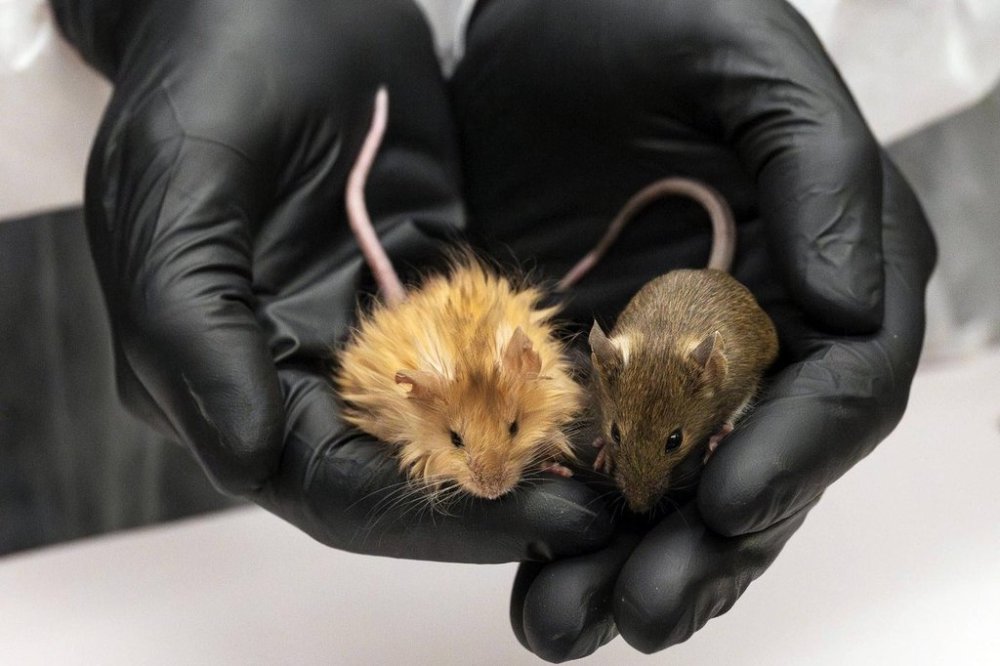
In this Feb 2025 photo provided by Colossal Biosciences are genetically edited mice with long, thick, woolly hair at a lab in Dallas, Texas. (Colossal Biosciences via AP)

Outside scientists have mixed views about whether this strategy will be helpful for conservation.

“You’re not actually resurrecting anything — you’re not bringing back the ancient past,” said Christopher Preston, a wildlife and environment expert at the University of Montana, who was not involved in the research.

On Tuesday, Colossal announced that its scientists have simultaneously edited seven genes in mice embryos to create mice with long, thick, woolly hair. They nicknamed the extra-furry rodents as the “Colossal woolly mouse.”

Results were posted online, but they have not yet been published in a journal or vetted by independent scientists.

The feat “is technologically pretty cool,” said Vincent Lynch, a biologist at the University of Buffalo, who was not involved in the research.

Scientists have been genetically engineering mice since the 1970s, but new technologies like CRISPR “make it a lot more efficient and easier,” said Lynch.

The Colossal scientists reviewed DNA databases of mouse genes to identify genes related to hair texture and fat metabolism. Each of these genetic variations are “present already in some living mice,” said Colossal’s chief scientist Beth Shapiro, but “we put them all together in a single mouse.”

They picked the two traits because these mutations are likely related to cold tolerance — a quality that woolly mammoths must have had to survive on the prehistoric Arctic steppe.

Colossal said it focused on mice first to confirm if the process works before potentially moving on to edit the embryos of Asian elephants, the closest living relatives to woolly mammoths.

However, because Asian elephants are an endangered species, there will be “a lot of processes and red tape” before any plan can move forward, said Colossal’s Lamm, whose company has raised over $400 million in funding.

Independent experts are skeptical about the idea of “de-extinction.”

“You might be able to alter the hair pattern of an Asian elephant or adapt it to the cold, but it’s not bringing back a woolly mammoth. It’s changing an Asian elephant,” said University of Montana’s Preston.

Still, the refinement of precision gene-editing in animals could have other uses for conservation or animal agriculture, said Bhanu Telugu, who studies animal biotechnology at the University of Missouri and was not involved in the new research.

Telugu said he was impressed by Colossal’s technology advances that enabled scientists to pinpoint which genes to target.

The same approach might one day help fight diseases in people, said Lamm. So far, the company has spun off two health care companies.

“It’s part of how we monetize our business,” said Lamm.

___

The Associated Press Health and Science Department receives support from the Howard Hughes Medical Institute’s Science and Educational Media Group and the Robert Wood Johnson Foundation. The AP is solely responsible for all content.

Report Error Submit a Tip

More Stories

Scientists genetically engineer mice with thick hair like the extinct woolly mammoth

Christina Larson, The Associated Press 4 minute read Preview

Scientists genetically engineer mice with thick hair like the extinct woolly mammoth

Christina Larson, The Associated Press 4 minute read Tuesday, Mar. 4, 2025

WASHINGTON (AP) — Extinction is still forever, but scientists at the biotech company Colossal Biosciences are trying what they say is the next best thing to restoring ancient beasts — genetically engineering living animals with qualities to resemble extinct species like the woolly mammoth.

Woolly mammoths roamed the frozen tundras of Europe, Asia and North America until they went extinct around 4,000 years ago.

Colossal made a splash in 2021 when it unveiled an ambitious plan to revive the woolly mammoth and later the dodo bird. Since then, the company has focused on identifying key traits of extinct animals by studying ancient DNA, with a goal to genetically “engineer them into living animals,” said CEO Ben Lamm.

Outside scientists have mixed views about whether this strategy will be helpful for conservation.

Read
Tuesday, Mar. 4, 2025

Tenants slam Alta.-based landlord, protest rent increases

Scott Billeck 6 minute read Preview

Tenants slam Alta.-based landlord, protest rent increases

Scott Billeck 6 minute read Updated: Yesterday at 8:06 PM CDT

Charlie Medd wasn’t ready for another adventure last October, when she moved out of the Wolseley Avenue apartment she had called home for 15 years.

Medd said life at Lincoln Apartments began to change after Wingspan Properties, an Alberta-based landlord, bought the building, made minor cosmetic changes and increased rent. She felt the changes were intended to push renters — many of them on fixed incomes — out the door.

“At some point, I got scared. I’d been there 15 years,” Medd said about the threat of rent increases. “I’d just painted my whole apartment. But when I heard that there’s going to be that many people homeless, I thought, ‘I’m too old for another adventure.’

“It felt like you were getting a nudge out the door. Like, ‘Yeah, we’re going to be doing this, and your rent is going to go up every year.’”

Read
Updated: Yesterday at 8:06 PM CDT

The never-ending, continuing war in Ethiopia

Gwynne Dyer 5 minute read 2:01 AM CDT

Another October coming up, and still the Nobel Peace Prize Committee refuses to give Donald Trump his prize. They even gave one to Barak Obama, who was Black and a Democrat and had only been in office for 20 minutes. Meanwhile, they ignore a man truly worthy of the prize, a man who ended eight wars last year alone. (He said so himself.)

Unfortunately the prize committee has a long record of backing the wrong person.

They gave it to Aung Sang Suu Kyi of Myanmar, who defended the Rohingya genocide: “I don’t think there is ethnic cleansing going on,” she said.

They gave it to former U.S. secretary of state Henry Kissinger, who ordered the secret carpet-bombing of Cambodia: “The illegal we do immediately; the unconstitutional takes a little longer.”

Is a better Winnipeg on the horizon?

Tom Brodbeck, Rebecca Chambers, Niigaan Sinclair and Brent Bellamy 20 minute read Preview

Is a better Winnipeg on the horizon?

Tom Brodbeck, Rebecca Chambers, Niigaan Sinclair and Brent Bellamy 20 minute read Yesterday at 4:00 PM CDT

Four Free Press columnists weigh in on the challenges ahead and how the city can become better.

Read
Yesterday at 4:00 PM CDT

‘In Normandy, we remember’

Aaron Epp 4 minute read Preview

‘In Normandy, we remember’

Aaron Epp 4 minute read 6:23 PM CDT

Travelling nearly 7,000 km from his home in France to Winnipeg gave Gabriel Zaranski a new perspective on warfare.

“It’s very different to speak about war in school (than) to speak with real people who (have fought) in a war,” he said. “We can feel the emotion when they speak … The testimony has more impact when it’s real soldiers.”

Zaranski is one of 14 Grade 12 students from Bayeux, a town in France’s Normandy region, in Winnipeg this week for a learning tour.

The students, who attend Lycée Arcisse de Caumont high school, met on Saturday with veterans from the Queen’s Own Cameron Highlanders of Canada, a local military regiment, to discuss their studies and the regiment’s role in the Second World War.

Read
6:23 PM CDT

Blue Bombers whiff on their opportunities to put game away

Taylor Allen 7 minute read Preview

Blue Bombers whiff on their opportunities to put game away

Taylor Allen 7 minute read Updated: Yesterday at 11:45 PM CDT

In theory, Bryce Perkins has a simple job.

When it’s third and short, the Winnipeg Blue Bombers trot out the short-yardage quarterback, and all he has to do is plunge forward for a yard or two to make everyone on his sideline happy.

But on Friday night against the visiting Toronto Argonauts, he went above and beyond his job description.

The Bombers, down 24-21 with six minutes left, faced a third-and-one from their own end when Perkins found a hole and burst through it for a 76-yard touchdown to put the home team in front 28-24 late.

Read
Updated: Yesterday at 11:45 PM CDT