Jobs lost in every state and lifesaving cures not discovered: Possible impacts of research cuts
Advertisement
Read this article for free:
or
Already have an account? Log in here »
To continue reading, please subscribe:

Digital Subscription
One year of digital access for only $205*
- Enjoy unlimited reading on winnipegfreepress.com
- Read the E-Edition, our digital replica newspaper
- Access News Break, our award-winning app
- Play interactive puzzles
*First annual payment billed as $205.00 + GST for one year. This annual subscription will automatically renew at $233.00 + GST every 52 weeks (10% off the regular annual price of $259.35). Offer available to new and qualified returning subscribers only. Cancel any time.
To continue reading, please subscribe:
Add Free Press access to your Brandon Sun subscription for only an additional
$1 for the first 4 weeks*
- Enjoy unlimited reading on winnipegfreepress.com
- Read the E-Edition, our digital replica newspaper
- Access News Break, our award-winning app
- Play interactive puzzles
*Your next Brandon Sun subscription payment will increase by $1.00 and you will be charged $17.95 plus GST for four weeks. After four weeks, your payment will increase to $24.95 plus GST every four weeks.
Read unlimited articles for free today:
or
Already have an account? Log in here »
Hey there, time traveller!
This article was published 06/03/2025 (588 days ago), so information in it may no longer be current.
WASHINGTON (AP) — Rural cancer patients may miss out on cutting-edge treatments in Utah. Therapies for intellectual disorders could stall in Maryland. Red states and blue states alike are poised to lose jobs in research labs and the local businesses serving them.
Ripple effects of the Trump administration’s crackdown on U.S. biomedical research promise to reach every corner of America. It’s not just about scientists losing their jobs or damaging the local economy their work indirectly supports — scientists around the country say it’s about patient health.
“Discoveries are going to be delayed, if they ever happen,” said Dr. Kimryn Rathmell, former director of the National Cancer Institute.
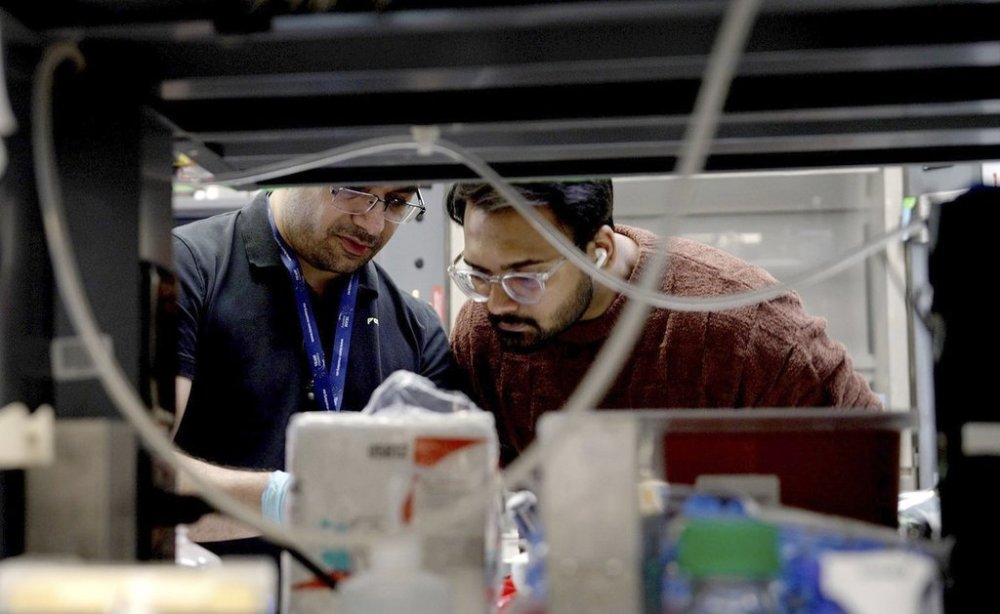
It’s hard for patients to comprehend how they could lose an undiscovered cure.
Yet “all the people out there who have, you know, sick parents, sick children, this is going to impact,” said neuroscientist Richard Huganir of Johns Hopkins University.
The administration’s unprecedented moves are upending the research engine that has made the U.S. “the envy of the world in terms of scientific innovation,” said Georgetown University health policy expert Lawrence Gostin.
Among the biggest blows, if it survives a court challenge: Massive cuts in funding from the National Institutes of Health that would cost jobs in every state, according to an analysis by The Associated Press with assistance from the nonprofit United for Medical Research.
That’s on top of mass firings of government workers, NIH delays in issuing grants and uncertainty about how many already funded studies are being canceled under the president’s anti-diversity executive orders.
Earlier this week, lawmakers pressured Dr. Jay Bhattacharya, the nominee to become NIH director, about the turmoil. Bhattacharya said if confirmed, he’d look into it to ensure scientists employed by and funded by the agency “have resources to do the lifesaving work they do.”
Funding cuts may leave rural patients more vulnerable
Patients who live in rural counties are 10% more likely to die of their cancer than those living in metropolitan areas, said Neli Ulrich of the University of Utah’s Huntsman Cancer Institute.
A third of patients travel more than 150 miles for care at the Salt Lake City cancer center. But for patients even further away — in Idaho, Montana, Nevada and Wyoming — it’s also the regional hub for NIH-funded studies of new treatments.
So Ulrich’s center helps train local doctors to do at least some of the blood tests and other steps of clinical trials that let patients from far away participate without traveling — a program threatened if her university loses tens of millions in NIH cuts.
The issue: Most of the NIH’s budget — more than $35 billion a year — goes to universities, hospitals and other research groups. The grants are divided into “direct costs” — covering researchers’ salaries and a project’s supplies — and “indirect costs,” to reimburse other expenses supporting the work such as electricity, maintenance and janitorial staff, and safety and ethics oversight.
NIH directly negotiates with research groups, a process that grants managers say requires receipts and audits, to set rates for those indirect expenses that can reach 50% or more. But the Trump administration now plans to cap those rates at 15%. The administration estimates it would save the government $4 billion a year but scientists say it really means they’ll have to stop some lifesaving work.
They are “real expenses, that’s the critical point – they are not fluff,” said Ulrich. Using separate cancer center funds to cover those costs would threaten other “activities that are really important to us in serving our communities across the mountain West.”
A federal judge has blocked the move for now but until the court fight is done researchers aren’t sure what they can continue to afford.
‘Indirect’ costs directly support local jobs
NIH grants divided between researchers in every state in 2023 supported more than 412,000 jobs and $92 billion in new economic activity, according to a yearly report from United for Medical Research that often is cited as Congress sets the agency’s budget.
The AP tallied how much money would have been lost in each state under a 15% cap on those grants’ indirect costs. Those lost dollars alone would have cost at least 58,000 jobs, concluded an analysis assisted by Inforum, a nonpartisan economic consulting firm that conducts UMR’s economic impact reports.
Consider Hopkins, which runs about 600 NIH-funded clinical trials plus other laboratory research and is Baltimore’s largest private employer. “If we can’t do science and we can’t support the science, we can’t support the surrounding community either,” Huganir said.
Research cuts could leave new treatments on the brink
Huganir studies how the brain stores memory as people learn when he discovered a gene that, when mutated, causes certain intellectual disabilities.
After years studying the SynGap1 gene, “we have what we think is a really great therapeutic” almost ready to be tested in severely affected children. Huganir has applied for two new NIH grants key for moving toward those trials.
“The problem is for the kids, there’s a window of time to treat them,” he said. “We’re running out of time.”
NIH reviews of new grant applications have been delayed despite court rulings to end a government spending freeze, and it’s unclear how quickly they can get back on track.
“Everyone I know is basically freaking out because we suddenly don’t know how much longer we’ll be able to keep our labs open,” said neuroscientist Rebecca Shansky at Boston’s Northeastern University, who’s awaiting word on grants for her study of how the brain processes pain and trauma.
Even scientists with existing funding are left wondering if their projects — from transgender health to learning why white breast cancer patients in Oklahoma fare worse than Black patients in Massachusetts — will be caught in Trump’s anti-diversity crackdown. Some already have, even though studying different populations is fundamental to medicine.

“Those studies are very much threatened right now. People don’t know what the rules are,” said well-known Hopkins specialist Dr. Otis Brawley. “We’re actually going to kill people is what it amounts to, because we’re not studying how to get appropriate care to all people.”
___
AP journalists Shelby Lum and Adithi Ramakrishnan contributed to this report.
___
The Associated Press Health and Science Department receives support from the Howard Hughes Medical Institute’s Science and Educational Media Group and the Robert Wood Johnson Foundation. The AP is solely responsible for all content.