Grocers doubled down on online grocery shopping when COVID hit. Is it here to stay?
Advertisement
Read this article for free:
or
Already have an account? Log in here »
To continue reading, please subscribe:

Digital Subscription
One year of digital access for only $205*
- Enjoy unlimited reading on winnipegfreepress.com
- Read the E-Edition, our digital replica newspaper
- Access News Break, our award-winning app
- Play interactive puzzles
*First annual payment billed as $205.00 + GST for one year. This annual subscription will automatically renew at $233.00 + GST every 52 weeks (10% off the regular annual price of $259.35). Offer available to new and qualified returning subscribers only. Cancel any time.
To continue reading, please subscribe:
Add Free Press access to your Brandon Sun subscription for only an additional
$1 for the first 4 weeks*
- Enjoy unlimited reading on winnipegfreepress.com
- Read the E-Edition, our digital replica newspaper
- Access News Break, our award-winning app
- Play interactive puzzles
*Your next Brandon Sun subscription payment will increase by $1.00 and you will be charged $17.95 plus GST for four weeks. After four weeks, your payment will increase to $24.95 plus GST every four weeks.
Read unlimited articles for free today:
or
Already have an account? Log in here »
Hey there, time traveller!
This article was published 14/03/2025 (553 days ago), so information in it may no longer be current.
Before COVID-19, it might have been unthinkable to have a stranger picking out bananas or selecting the perfect pork roast for your Sunday dinner.
But the pandemic prompted many Canadians to turn to grocery e-commerce for the first time, as the weekly grocery shop became a source of fear and stress amid society’s widespread shutdown.
“If you asked Canadian consumers before the pandemic how often they shopped online, whether or not you said groceries, it would be a much smaller portion of the general population. And certainly when you talk about grocery, that would be even smaller,” said Lauren Steinberg, executive vice-president and chief digital officer at Loblaw.
“Obviously that changed quite quickly.”
When the pandemic hit, Canada’s biggest grocers accelerated investments in e-commerce as more customers looked to avoid stores, said Lisa Hutcheson, a retail strategist with J.C. Williams Group.
The grocers were already starting to adopt the “click-and-collect” model that had caught on in Europe, Hutcheson said, “and they sort of put their foot on the gas.”
A Statistics Canada report shows e-commerce was a small but steadily growing part of sales at food and beverage stores before the pandemic, going from 0.5 per cent of total sales in 2017 to 0.7 per cent in 2019.
In 2020, the share of e-commerce sales at food and beverage stores jumped to 1.7 per cent of total sales, and in 2021, it was 2.1 per cent.
While comparable data isn’t available for the years that followed, other data from Statistics Canada show online grocery sales continued to grow.
Before COVID, e-commerce brought in less than a billion dollars a year for Loblaw, said Steinberg, compared with $3.9 billion in 2024.
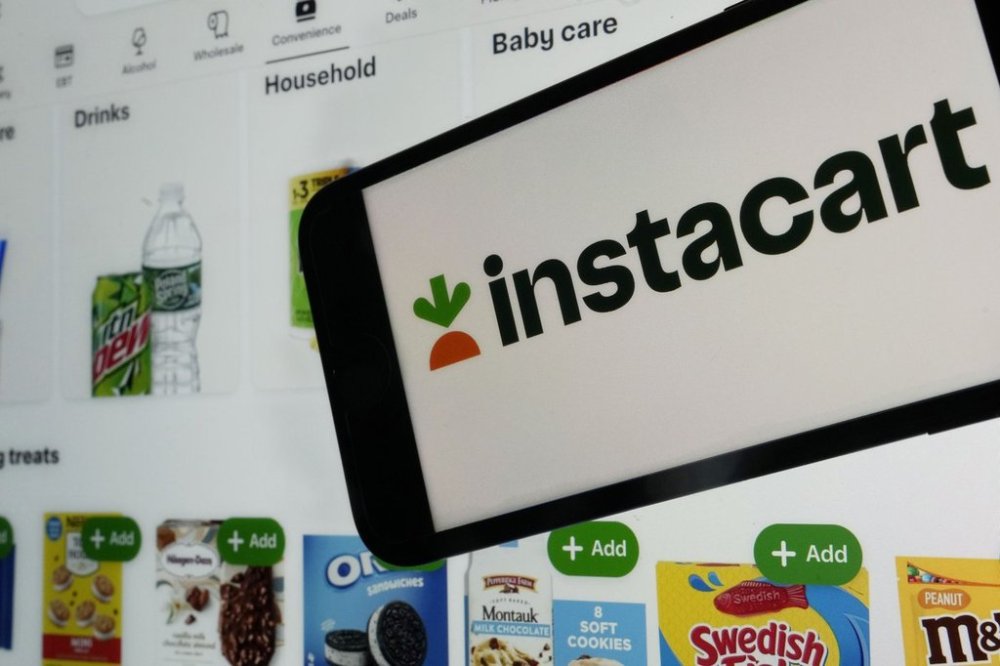
About 80 per cent of that was click-and-collect, with the rest delivery — and of that, mainly through third-party service Instacart, she said.
There are three main kinds of grocery e-commerce, explained Alain Tadros, Metro’s chief marketing officer and head of digital strategy. There’s click-and-collect, where customers order online and pick up at the store; in-house delivery, where the grocer fulfils the order and delivers it; and third-party delivery, where a service like UberEats sends someone to do the shopping and deliver it.
The pandemic significantly increased the desire for all these options, Tadros said.
Digital infrastructure was a key part of grocers’ early-pandemic investments in e-commerce as they ramped up their websites and apps to handle the influx of demand. They also re-tooled parts of their stores to pack up orders.
They also doubled down on delivery.
“We actually put in significant investment behind the delivery model, and then as we got ramped up on the delivery model, (we) started to expand on other types of services,” said Tadros.
Delivery has grown significantly, now making up about half of Loblaw’s e-commerce sales, Steinberg said. Another shift: the vast majority of those are through PC Express — the company’s in-house service (though it uses a third party for the delivery portion).
In a February 2023 analysis from Statistics Canada, authors Salim Zanzana and Jessica Martin said despite the reopening of the Canadian economy after pandemic shutdowns, e-commerce remained important for businesses. Between February 2020 and July 2022, retail e-commerce sales rose by almost 68 per cent, they said.
“The persistence of retail e-commerce sales above pre-pandemic levels suggests that the switch to e-commerce during COVID-19 lockdown periods may have prompted a long-term change in consumer spending habits and retailer operating models,” the authors wrote.
But since the pandemic-fuelled surge in grocery e-commerce, Hutcheson said she thinks it has “definitely pulled back.”
“There are still people that are using it and it certainly hasn’t gone away, but it’s not being used like it was,” she said.
Shoppers may have discovered they prefer picking certain things themselves in-store, said Hutcheson, in particular perishable items like meat and produce.
Inflation may have also taken a bite as shoppers cut back on discretionary spending.
In June 2024, Empire announced it was pausing the opening of a customer fulfilment centre in Vancouver, citing a smaller e-commerce market for groceries than it anticipated when it launched Voilà.
“While the Canadian market has not expanded as rapidly as initially predicted compared to other global markets, we remain optimistic that it will reach that level over time as more customers recognize the convenience and value of online grocery shopping,” said Mohit Grover, senior vice-president of e-commerce for Sobeys owner Empire, in a statement on March 10.
In 2022, grocers saw online sales either decline or slow down as they lapped strong growth in 2020 and 2021, though they maintained sunny outlooks.
Tadros says the peaks of the pandemic were followed by a “normalization” in grocery e-commerce. More recently, in the past year or so, he said he has noticed a resurgence in demand for e-commerce grocery.
On Empire’s third-quarter earnings call Thursday, CEO Michael Medline sounded optimistic about the trajectory for e-commerce, saying sales growth for the category was 72 per cent.
And at Loblaw, “our sales now are higher than they were in the highest of highs during COVID,” said Steinberg.
The company is still looking for ways to branch out. For example, as more shoppers are looking for deals and gravitating toward discount stores, the company has been expanding its delivery capacity for No Frills.

Hutcheson said the grocers have learned a lot from the past five years and she anticipates growth in grocery e-commerce still, particularly as younger generations become a bigger piece of the consumer pie.
This could include digital platforms that help shoppers navigate the aisles, or QR codes to scan for product information, or more local curation in stores based on information from loyalty programs, she said.
“I just think that it won’t necessarily be in e-commerce. It will be in integration, it will be sort of that blend of … online and in store,” she said.
This report by The Canadian Press was first published March 14, 2025.
Companies in this story: (TSX:L, TSX:MRU, TSX:EMP.A)
Related Articles
Lasting and lagging legacies of lockdown
Advertisement Advertise With Us
Advertisement Advertise With Us