Fly by night
Documentary follows 300-million-year story of moths

Advertisement
Read this article for free:
or
Already have an account? Log in here »
To continue reading, please subscribe:
Digital Subscription
One year of digital access for only $1.44 a week*
- Enjoy unlimited reading on winnipegfreepress.com
- Read the E-Edition, our digital replica newspaper
- Access News Break, our award-winning app
- Play interactive puzzles
*Billed as $5.77 plus GST every four weeks. After 52 weeks, price increases to the regular rate of $19.95 plus GST every four weeks. Offer available to new and qualified returning subscribers only. Cancel any time.
To continue reading, please subscribe:
Add Free Press access to your Brandon Sun subscription for only an additional
$1 for the first 4 weeks*
- Enjoy unlimited reading on winnipegfreepress.com
- Read the E-Edition, our digital replica newspaper
- Access News Break, our award-winning app
- Play interactive puzzles
*Your next Brandon Sun subscription payment will increase by $1.00 and you will be charged $17.95 plus GST for four weeks. After four weeks, your payment will increase to $24.95 plus GST every four weeks.
Read unlimited articles for free today:
or
Already have an account? Log in here »
Hey there, time traveller!
This article was published 21/03/2025 (577 days ago), so information in it may no longer be current.
‘Our time is mostly spent waiting,” explains quantitative ecologist Mansi Mungee, who is studying the distribution of hawk moths in the eastern Himalayas.
“We wait for nightfall, and then for the arrival of the moths.”
Her patience sets the tone for this slow, measured, quietly remarkable documentary. Indian filmmakers Anirban Dutta and Anupama Srinivasan follow Mungee from a careful distance, never imposing their own narrative, content to let the beauty and meaning of her work gradually unfold.
From stunning visuals of mist moving across mountaintops to the subtle soundscape of whispering, whirring insect susurration, this is a poetic exploration of an intricately interrelated natural world. If you give yourself over to this cinematic process, it’s an entrancing and meditative experience.
At the same time, Nocturnes (in Hindi, Bugun and English, with English subtitles) is also, in its own hushed and undramatic way, an urgent warning about climate change.
Mungee is working in the Himalayan mountains on the border of India and Bhutan, along with a local assistant, Bicki Marphew, a member of the Indigenous Bugun community.
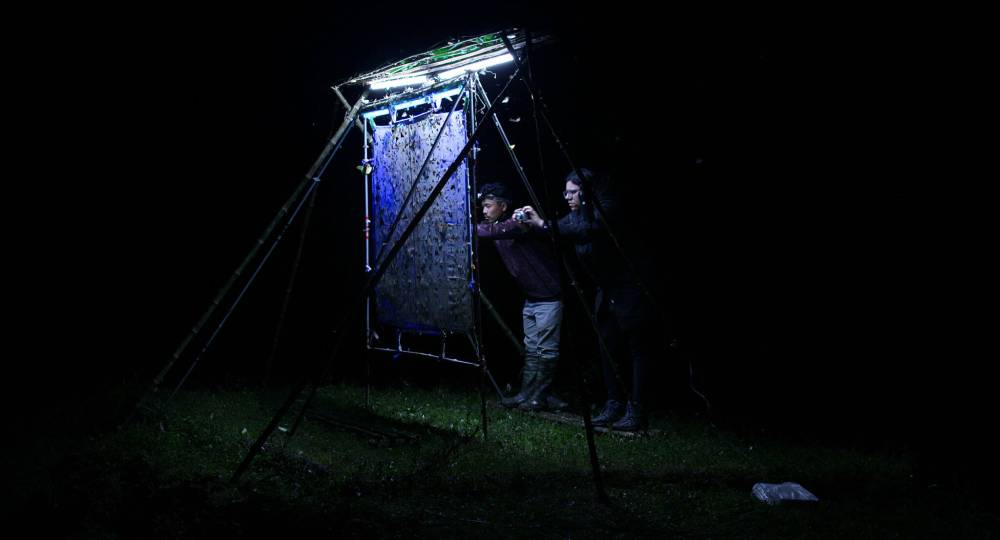
Through rain, cold and fog, the pair spends each night setting up an illuminated white screen in the hillside forests. Mimicking moonlight, this curtain of cloth attracts hundreds, even thousands, of moths.
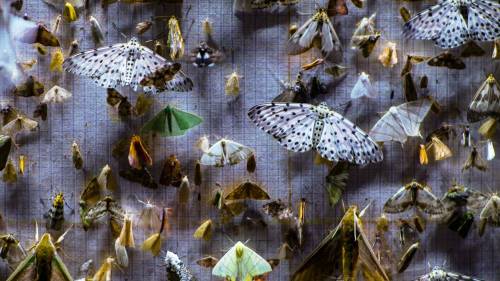
Some are bigger than an outstretched hand, others the size of a fingernail. Some display striking graphic markings, others are the colour of faded silk.
There’s an astonishing range of shape, scale and hue with these creatures, and Dutta and Srinivasan spend much of the film’s compact runtime just watching them.
GRASSHOPPER FILM
Follow the light: mimicking moonlight, this lit curtain attracts thousands of moths.
(And because this footage, which involves staring at a flickering square of light in the black night, is so clearly analogous to sitting in a darkened room looking at a movie screen, it really makes sense to see this film in a theatre where its incredible photography literally shines.)
Dutta and Srinivasan’s observant camera functions at both the micro and macro levels. Their ultra-close-up shots of moths convey exquisitely sharp details, from the delicacy of translucent wings to the texture of furred thoraxes. Their panoramic views follow the sweep of distant hills and vast changing skies.
The film’s timeline also zooms in and out. Mungee points out that the smallest moths might live a brief two or three days, but moths have been on Earth for 300 million years.
They have survived five mass extinction events, and she suspects they can survive things humanity might not.

At one point, Mungee’s strategic placement of the screen hits a snag. One of her colleagues suggests it’s because they are looking at the environment through human eyes and they need to look at it through a moth’s eyes, “which might take a few decades,” he says.
The film also takes a long view. Nocturnes keeps a deliberate distance from Mungee and her team. Conversations between co-workers are often recorded from many metres away, and nobody talks directly to the camera. Human beings, the film suggests, are just one part of this larger landscape, this larger chronology.

Supplied
There are about 160,000 species of moths in the world.
Still, taken all together, the film does celebrate human ingenuity and knowledge and passion. Mungee is scrupulously dedicated to tracking seemingly small differences that will yield big insights into where our world is probably headed.
Unfortunately, as the final minutes of the film suggest, it doesn’t look good — not for moths and not for us.
alison.gillmor@freepress.mb.ca
Studying at the University of Winnipeg and later Toronto’s York University, Alison Gillmor planned to become an art historian. She ended up catching the journalism bug when she started as visual arts reviewer at the Winnipeg Free Press in 1992.
Our newsroom depends on a growing audience of readers to power our journalism. If you are not a paid reader, please consider becoming a subscriber.
Our newsroom depends on its audience of readers to power our journalism. Thank you for your support.
Movie review
Nocturnes
Directed by Anirban Dutta and Anupama Srinivasan
• Dave Barber Cinematheque
• Not rated,
• 82 minutes
★★★★ out of five
Studying at the University of Winnipeg and later Toronto’s York University, Alison Gillmor planned to become an art historian. She ended up catching the journalism bug when she started as visual arts reviewer at the Winnipeg Free Press in 1992.
Our newsroom depends on a growing audience of readers to power our journalism. If you are not a paid reader, please consider becoming a subscriber.
Our newsroom depends on its audience of readers to power our journalism. Thank you for your support.
Advertisement Advertise With Us
Advertisement Advertise With Us