A Venus flytrap wasp? Scientists uncover an ancient insect preserved in amber that snatched its prey

Advertisement

Advertise with us

NEW YORK (AP) — An ancient wasp may have zipped among the dinosaurs, with a body like a Venus flytrap to seize and snatch its prey, scientists reported Wednesday.

Read this article for free:


or

Already have an account? Log in here »

To continue reading, please subscribe:

Subscribe and receive a limited-edition Free Press branded hat or tote.

Digital Subscription

One year of digital access for only $205*

  • Enjoy unlimited reading on winnipegfreepress.com
  • Read the E-Edition, our digital replica newspaper
  • Access News Break, our award-winning app
  • Play interactive puzzles

*First annual payment billed as $205.00 + GST for one year. This annual subscription will automatically renew at $233.00 + GST every 52 weeks (10% off the regular annual price of $259.35). Offer available to new and qualified returning subscribers only. Cancel any time.

To continue reading, please subscribe:

Add Free Press access to your Brandon Sun subscription for only an additional

$1 for the first 4 weeks*

  • Enjoy unlimited reading on winnipegfreepress.com
  • Read the E-Edition, our digital replica newspaper
  • Access News Break, our award-winning app
  • Play interactive puzzles
Start now

*Your next Brandon Sun subscription payment will increase by $1.00 and you will be charged $17.95 plus GST for four weeks. After four weeks, your payment will increase to $24.95 plus GST every four weeks.

Hey there, time traveller!
This article was published 26/03/2025 (524 days ago), so information in it may no longer be current.

NEW YORK (AP) — An ancient wasp may have zipped among the dinosaurs, with a body like a Venus flytrap to seize and snatch its prey, scientists reported Wednesday.

The parasitic wasp’s abdomen boasts a set of flappy paddles lined with thin bristles, resembling “a small bear trap attached to the end of it,” said study co-author Lars Vilhelmsen from the Natural History Museum of Denmark.

Scientists uncovered over a dozen female wasps preserved in 99-million-year-old amber from the Kachin region in northern Myanmar. The wasp’s flaps and teeth-like hairs resemble the structure of the carnivorous Venus flytrap plant, which snaps shut to digest unsuspecting insects. But the design of the wasp’s getup made scientists think its trap was designed to cushion, not crush.
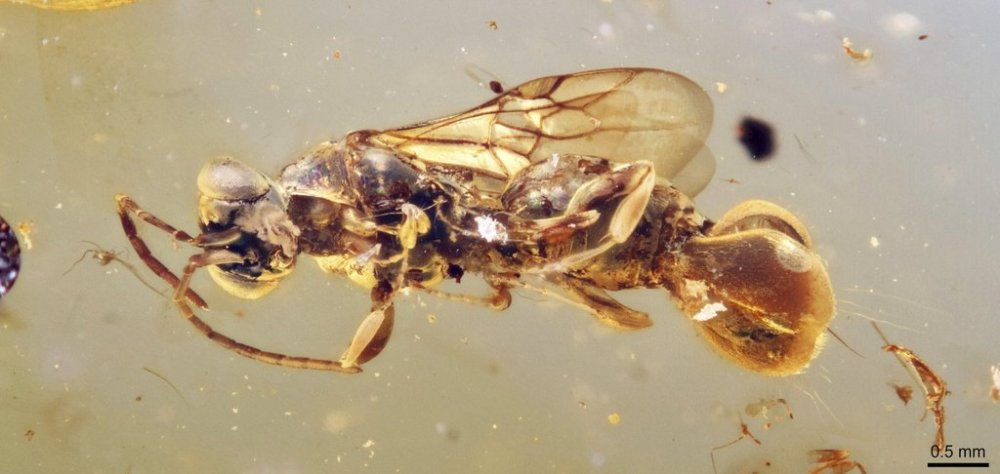
This photo provided by Qiong Wu in March 2025 shows an ancient wasp, preserved in amber from Myanmar, whose back end resembles a Venus flytrap plant. (Qiong Wu via AP)

Instead, researchers suggested the flytrap-like structure was used to hold a wriggly insect still while the wasp laid an egg, depositing a baby wasp to feed on and drain its new host.

It’s a playbook adapted by many parasitic wasps, including modern-day cuckoo and bethylid wasps, to exploit insects. But no known wasp or any other insect does so with bizarre flaps quite like this one.

“I’ve seen a lot of strange insects, but this has to be one of the most peculiar-looking ones I’ve seen in a while,” said entomologist Lynn Kimsey from the University of California, Davis, who was not involved with the research.

Scientists named the new wasp Sirenobethylus charybdis, partly for the sea monster from Greek mythology that stirred up wild whirlpools by swallowing and expelling water.

The new study was published in the journal BMC Biology and included researchers from Capital Normal University and the Beijing Xiachong Amber Museum in China.

It’s unclear when the wasp went extinct. Studying unusual insects like this one can help scientists understand what insects are capable of and how different they can be.

“We tend to think that the cool things are only found today,” said Gabriel Melo, a wasp expert at the Federal University of Paraná in Brazil, who had no role in the study. “But when we have this opportunity, we see that many really exceptional, odd things already happened.”

___

The Associated Press Health and Science Department receives support from the Howard Hughes Medical Institute’s Science and Educational Media Group and the Robert Wood Johnson Foundation. The AP is solely responsible for all content.

Report Error Submit a Tip

More Stories

TV to raise and lower your stress-hormone levels

Denise Duguay 4 minute read Preview

TV to raise and lower your stress-hormone levels

Denise Duguay 4 minute read 2:00 AM CDT

Is it just my Instagram feed that is flooded with prescriptions for how to stem the flood of stress hormones in these trying times? Consult a real professional and take care of yourselves out there. Like social media, TV is not letting up, however.

Read
2:00 AM CDT

Winnipeg police ID deceased man, notify family

Free Press staff 3 minute read Preview

Winnipeg police ID deceased man, notify family

Free Press staff 3 minute read Sunday, Aug. 30, 2026

Winnipeg police have been able to notify next-of-kin about the death of a man found unresponsive on a city street in July.

The man was identified after police asked for the public’s help and issued a composite sketch and description of the unknown man on Friday.

On Sunday, police said his family has been notified and thanked the public. Additional details about the man were not released in order to respect the family’s privacy, police said.

The man died in hospital after being found unresponsive July 28 at the corner of Main Street and James Avenue in Winnipeg, and investigators’ previous efforts to identify him were unsuccessful.

Read
Sunday, Aug. 30, 2026

Rare and tough to notice, sarcomas may lurk in the body

Jen Zoratti 12 minute read Preview

Rare and tough to notice, sarcomas may lurk in the body

Jen Zoratti 12 minute read Yesterday at 6:00 AM CDT

Last summer, Michelle Finley was going about a normal day.

She had just dropped her car off at a garage and was walking back to her office building downtown when, suddenly, she was stopped in her tracks by a searing cramp on the bottom of her right foot.

“It was so painful it took my breath away,” says Finley, now 52. “I stopped and held on to the side of a building for a second — like, it was bringing tears to my eyes.”

Finley thought she had a really bad case of plantar fasciitis. Nine months later she would lose her foot to sarcoma.

Read
Yesterday at 6:00 AM CDT

At last, some good news on homelessness

Editorial 4 minute read Preview

At last, some good news on homelessness

Editorial 4 minute read 2:00 AM CDT

There is no shortage of reasons to be frustrated about homelessness in Winnipeg. But the latest numbers provide something that has been increasingly difficult to find — evidence that at least some things are getting better.

Read
2:00 AM CDT

Port of Churchill celebrates first grain shipment in six years

Aaron Epp 5 minute read Preview

Port of Churchill celebrates first grain shipment in six years

Aaron Epp 5 minute read Yesterday at 6:02 PM CDT

Approximately 30,000 tonnes of Canadian durum wheat from Saskatchewan-based AGT Foods is being loaded at the northern Manitoba port and will be shipped to customers in Europe.

Read
Yesterday at 6:02 PM CDT

Letters, Aug. 31

7 minute read Preview

Letters, Aug. 31

7 minute read Updated: Yesterday at 7:48 AM CDT

Connor Hellebuyck, as we know, backstopped the U.S.A. to Olympic gold. Shortly after winning, he was invited to the Oval Office and accepted the Presidential Medal of Freedom from his country, a medal that has been awarded to numerous famous athletes — Babe Ruth, Billie Jean King, Jackie Robinson, Muhammad Ali, Michael Jordan, to name a few.

Read
Updated: Yesterday at 7:48 AM CDT